The results of a recent bone scan confirmed what was suspected–– that the septuagenarian skeleton is losing density. The rheumatologist who proscribed the scan advised me to be careful in strenuous activities. He informed that within seven years of diagnosis of osteopenia–– bone density loss–– 10% of the elderly suffer broken hips. Most of those breaks result in the patient’s rapid decline. Demise generally follows…
While sensitive to that warning, I resist regarding myself frail. So long as the knees hold out, I am determined to walk briskly and pedal hard. But admittedly, I am taunted by the image of a grimly grinning skeleton, straining its thinning bones…
Of course, thinning bones is nothing compared with the trauma of impending organ failure or metastatic cancer. But the apparent weakening of the densest cells of one’s body arouses a peculiar queasiness. Resilient bones were required for the evolution of the most primitive vertebrae. Without a sound skeleton, limb movement is restricted and even internal organs are vulnerable. That most fragile jelly which generates consciousness could even be in jeopardy should the skull itself thin.
Yet to the present day, these old bones have served wonderfully well. The timbers of few houses could hardly have withstood more than seven decades of such wear and tear. If they hold out for another decade or so, they will have exceeded any optimistic expiry date. Either before or soon after that–– the mortal coil will likely be scattered dust or decomposing organic matter. In the latter case, the bones could endure for a while–– barring their upheaval by real estate development or natural disaster.
Of course, it is both morbid and senseless to worry about what might happen to one’s remains. Still, imagining my bones objects of curiosity is exceedingly creepy. That thought was particularly unsettling several years ago, on a tour of the catacombs of the St. Francisco monastery in Lima, Peru:
Like many tropical cities with a long history, the gritty centro historico of Lima is permeated by odours of ancient decay. Founded in 1535, the former capital of the Viceroy of Peru is not nearly as old as Cairo or Varanasi. Yet like those much older cities––every pinch of dirt in Lima’s alleys probably holds a few molecules of once living human beings. Some of those molecules are further recycled though living bodies–– probably even in those of tourists passing through.
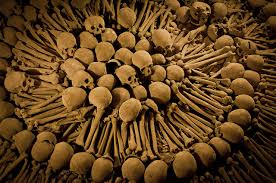
The catacombs under the St. Francisco monastery hold the remnants of only a minority of the city’s ghosts. Still, our guide in the monastery tour informed that the bones of nearly 70,000 limeños were interred in its dank chambers. In the largest of those chambers, skulls are elaborately arranged in concentric circles. In deeper alcoves, los huesos humanos are barely distinguishable from the greyish stone encrusting them. Many of those older bones in the catacombs are of victims of a major earthquake that struck the city in July 1586.
Among fellow sweating bodies, I shuffled along the dim lit passageway, deaf to the ghostly screams echoing amid the rumble of falling walls. Worse than the stifling heat was the dusty smell of ancient bones. Even though photography was (appropriately) not permitted, the ghoulish displays seemed an indignity to those nameless indigines the bones once animated… I shivered in the thought of my skull ogled by half-bored tourists.
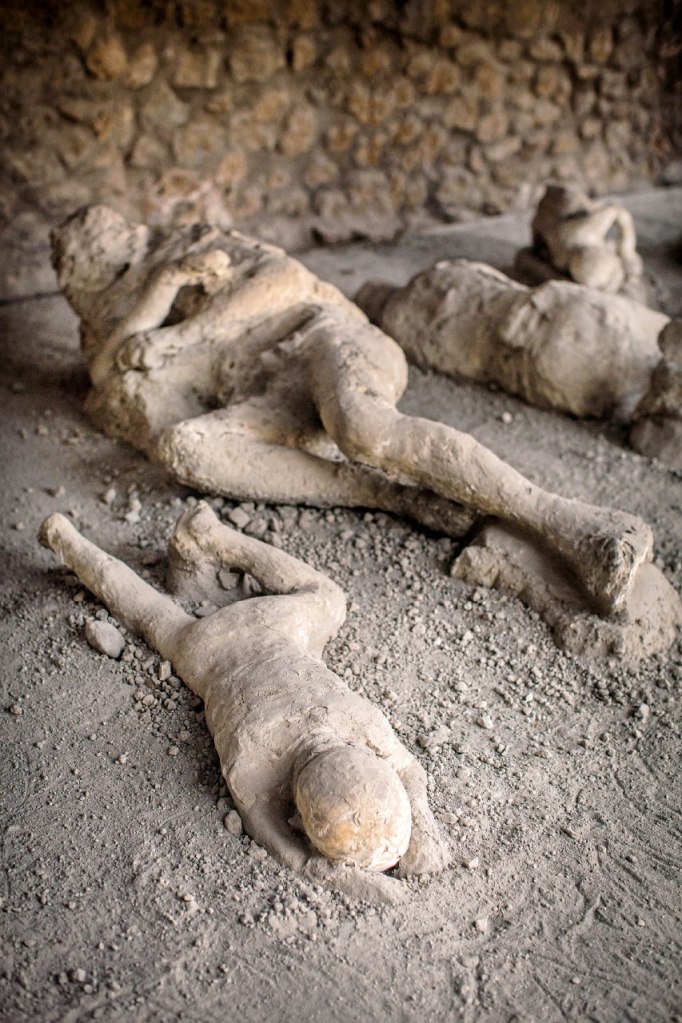
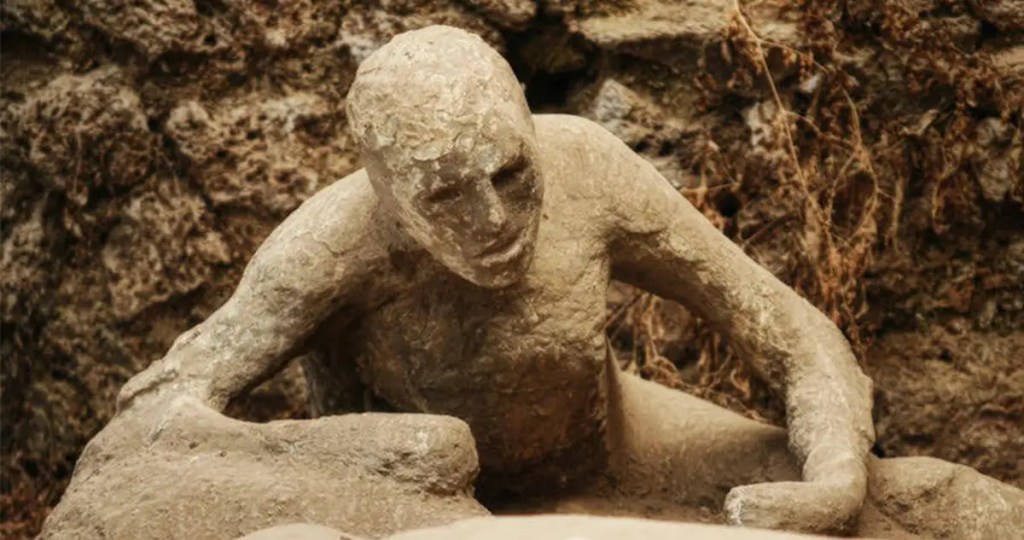
I have never visited Pompei or its famous museum, but the photos of what was excavated at the site of that ancient Roman city are almost as unsettling as the smell of those bones in the San Francisco monastery.
When Pompei was destroyed by the violent eruption of Mount Vesuvius in 79 CE, its trapped inhabitants were killed in the intense thermal surge. Archaeologists in the 1960s made plaster casts of the voids in the hardened ash around fossilized skeletons. The casts revealed the contortions of bodies in the throes of death. The imprints of faces even captured the rictus of their terror. One would guess that they would not have chosen for their remains to be displayed any more that would have the limeños in the San Francisco monastery…
It is exceedingly strange to imagine one’s remains providing a shock to the living–– nineteen centuries after one’s violent death. It is weirder still to think that one’s fossilized bones could be studied 45,000 years after one’s demise. That was the case of neanderthals unearthed in a cave in Kurdistan in the 1960s. Their story was featured in a recent Netflix documentary.
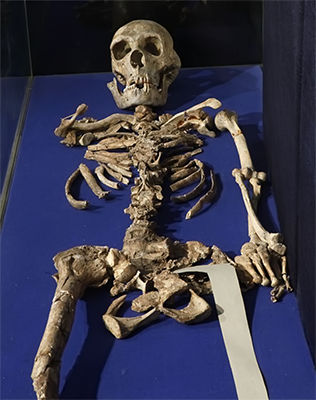
One fossilized skeleton, labelled as Shanidar #1, was speculated to have been a male of about forty. He had attained that prehistoric ripe old age despite having incurred serious injuries long before his death. His bones revealed that he probably walked with a limp and was half blind from a blow to his head. Most interesting to the archaeologists was the missing right forearm. The paleontologist examining his bones took his survival with such disabilities as evidence of social support by his clan. Perhaps overlooked was the possibility that with his one good arm–– Shanidar #1 was deadly accurate with a spear….
Watching the closeups of his skeleton, I thought of my DNA ancestry test result. Of course, DNA evidence has established that before their extinction about 40,000 years ago, neanderthals interbred with rival homo sapiens. According to 23andMe, my haplogroup analysis revealed more neanderthal genetic variants than in 66% of others in the database of more than fourteen million DNA test takers.
That information led me to wonder about the slight bump at the back of my head. Could it be a residual ‘occipital bun’–– the bony protrusion characteristic of the neanderthal skull? It occurred that I could even carry traces of the DNA of Shanidar #1, himself…
In a recent coffee shop chat, a friend spoke of his travails in acting as executor of the estate of another friend. Without a detailed will, he had to agonize over the sale and dispersal of property. Meanwhile, the children of the deceased were impatient for their inheritances. In concluding that woeful anecdote, my friend said the experience convinced him that not leaving a mess behind was a high moral duty. He then spoke of membership in a memorial society and recommended the same for my wife and I.
“It saves a lot of money and hassle,” he said. “And your children will be very grateful for it.”
As grim as it is to face up to it–– that friend’s advice was wise. The absence of an immortal soul does not lessen the obligation to loved ones. I still have much cleaning up to do.
Drearily enough, after the age of seventy, death does increasingly become a practical matter. When not merely neglected (the usual case), planning for permanent absence seems rather like preparing to take a new job in another city. The essential difference, of course, is that arrangements for the big move are needed only for the departure.
Not insignificant among the objects from one’s (however paltry) estate to be disposed of is the body. I have already made explicit my revulsion that the corpse be displayed or subjected to a mortician’s creepy ministrations. I also shudder in the memory of tombstones in the distant village of my origin, etched with birth dates followed by a dash. I have further made it explicit to my family that I would rather my corpse fed to salt-water crocodiles than be planted anywhere near that vicinity…
For many years, I took it rather for granted that cremation was the most practical option. One’s family scattering ashes in a place one loved is not an unpleasant imagining. But is it ethical to cap decades of stomping out an out-sized consumer footprint with a 2½ hour 980° centigrade blast of carbon emissions?
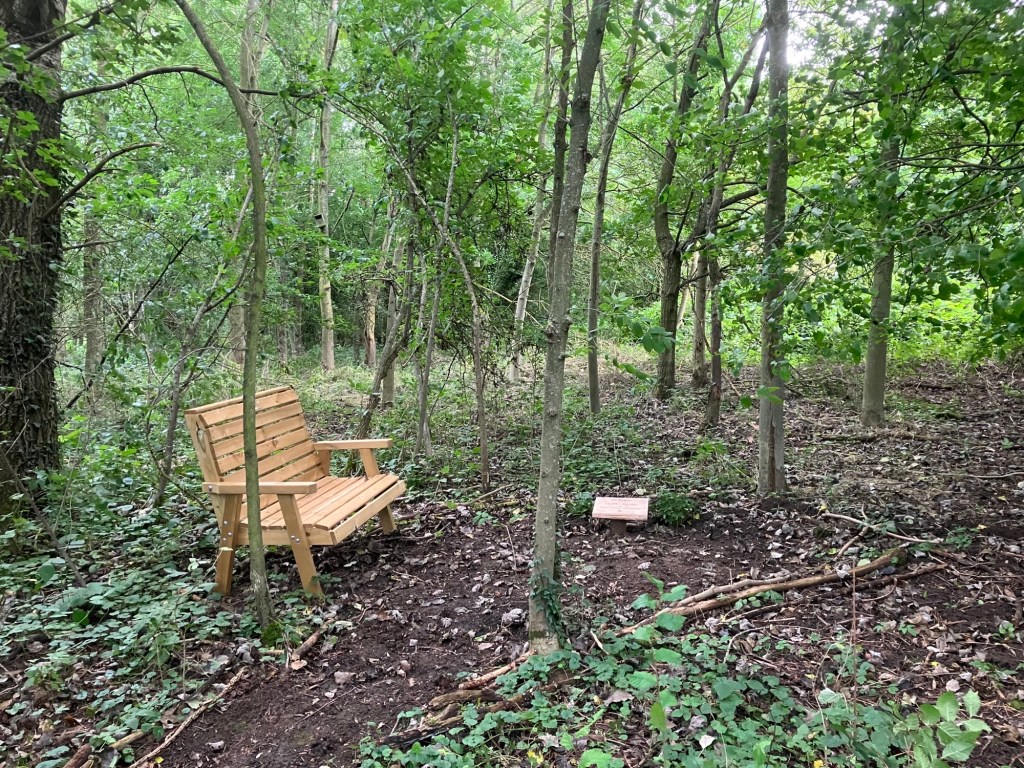
So it is, I have been increasingly drawn to the notion of a green burial. There is solace is the thought of nourishing soil and roots in some woody place. The plain body, without toxic preservatives, would be interred in a cotton shroud, wicker basket or cardboard box. Unfortunately, at present that option is more expensive than cremation and rather more difficult to arrange. But in anticipation of the big move–– that method of disposal is definitely under consideration…
There is one irrational worry yet to be overcome. That is the thought that bony bits which do not decompose could be unearthed. In some distant future, might such bones–– like those of Shanidar #1–– be studied chiefly for their abnormalities?
Yet the horrible truth is that there may well be no distant future––neither for the living nor for the remains of the dead. All present indications are that we homo sapiens are determined to cook our fragile ecosystem in our poisonous effluence. Barring some miraculous change of direction, within the millennium the surface of the planet could even be inhospitable for thermophile microbes.
Before a future as distant as Pompei is in the past––bones, thick and thin–– human, neanderthal, dinosaur–– could return to cosmic dust. That rather puts the angst of personal mortality in some perspective…
–2024, May
 Coprolites in Amber (etc.)
Leave a comment