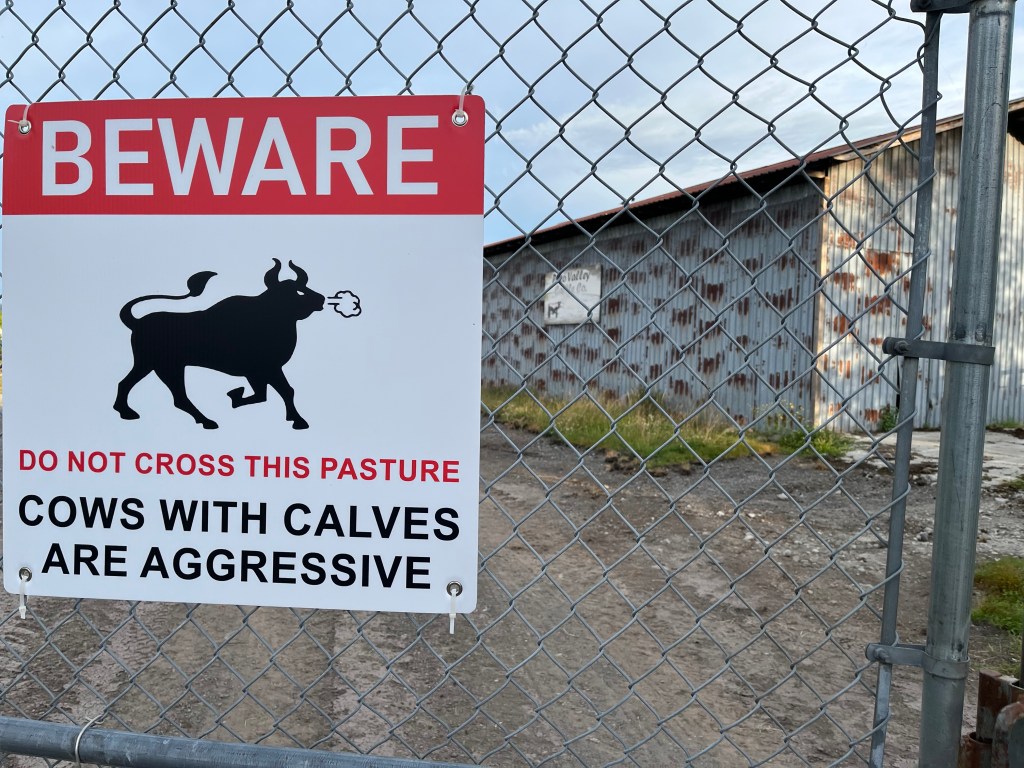
Since moving to our Port Coquitlam neighbourhood a decade ago, the most common route of my morning dog walks has been through “the farm”. That seemingly mundane reference is to a two-block expanse of incongruously agricultural-zoned land fenced off from surrounding townhouses, a Home Depot and a golf course. The only resemblance to a real farm is the presence of a few cows and their calves brought to graze there in summer. They shelter in a rusty aluminum-sided barn with a faded sign that reads: ‘Poco Valley Cattle Co.’ That is the only building on the unoccupied site.
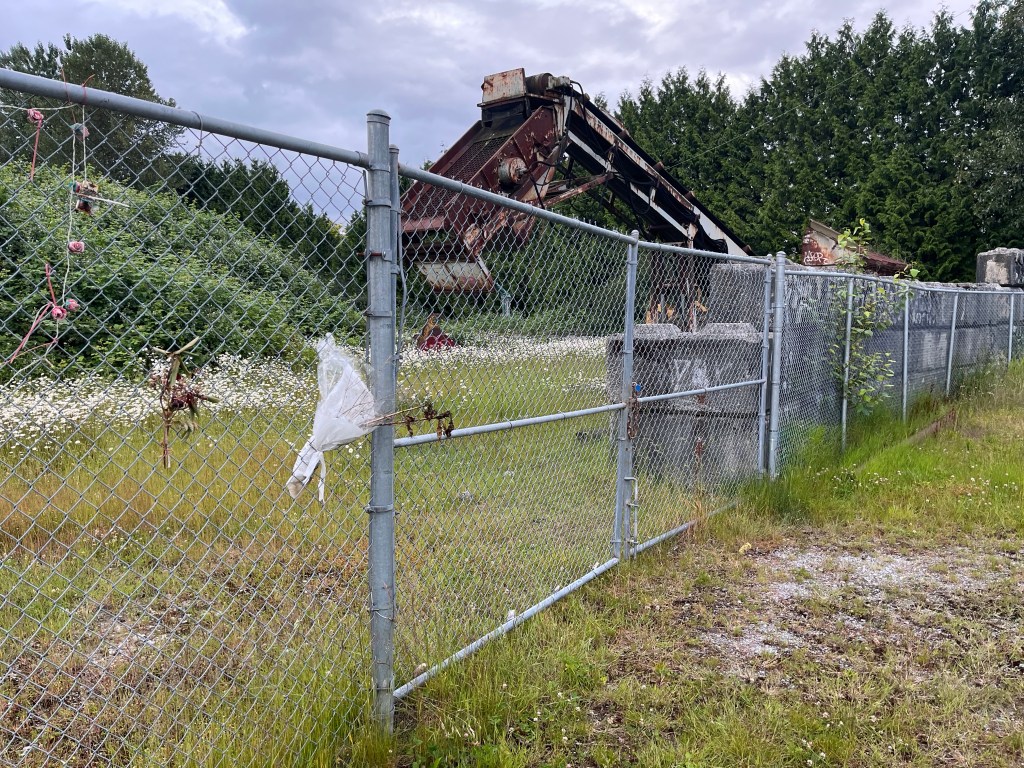
A fenced-off public walkway runs through the middle of the farm, cutting the north side from the south pasture. The north side has been left to grow wilder. Just over the walkway fence are junked car chassis and derelict machinery. A rusted conveyor, long-necked as a sauropod, hangs over a bramble-covered hillock. A stranger might guess the mound is the overgrown slag heap of an abandoned mine. Yet adult passersby who know nothing of the farm’s real history are rare.
Creatures of the wild take refuge on the site. Several times, I have seen coyotes exiting their den on that brushy hillock. More than once, they have hungrily eyed my chihuahua as we passed below. Black bears sometimes amble along the walkway drawn by the blackberry bushes clinging to the eastern fence. In winter, flocks of Canada geese often nest amid the deep puddles and dead grass. In late fall, murders of crows are often seen flying across the fields to nearby roosts.
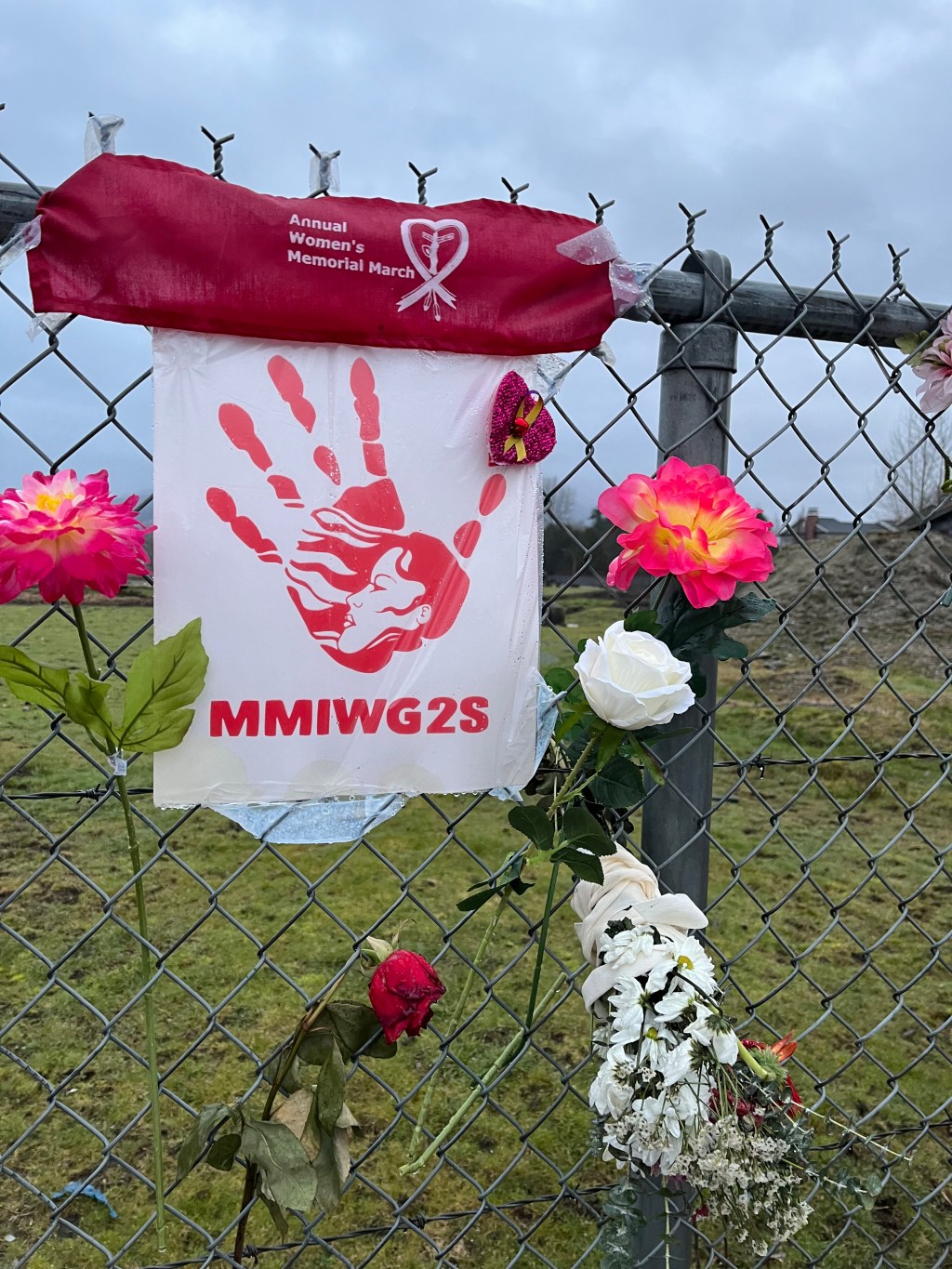
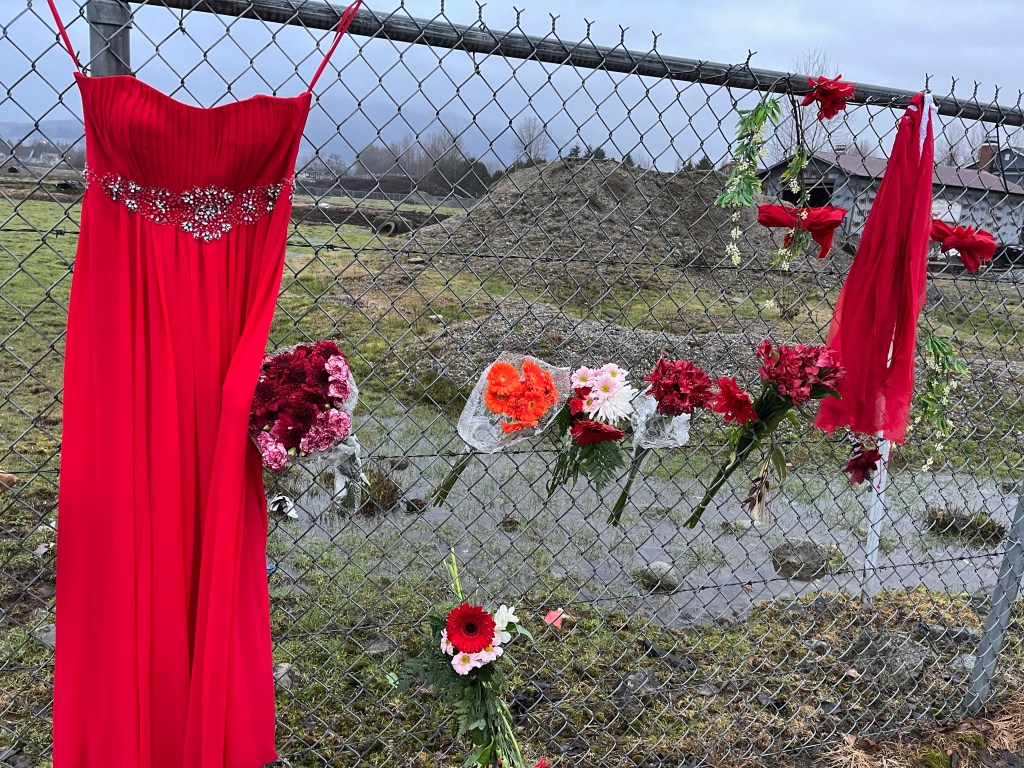
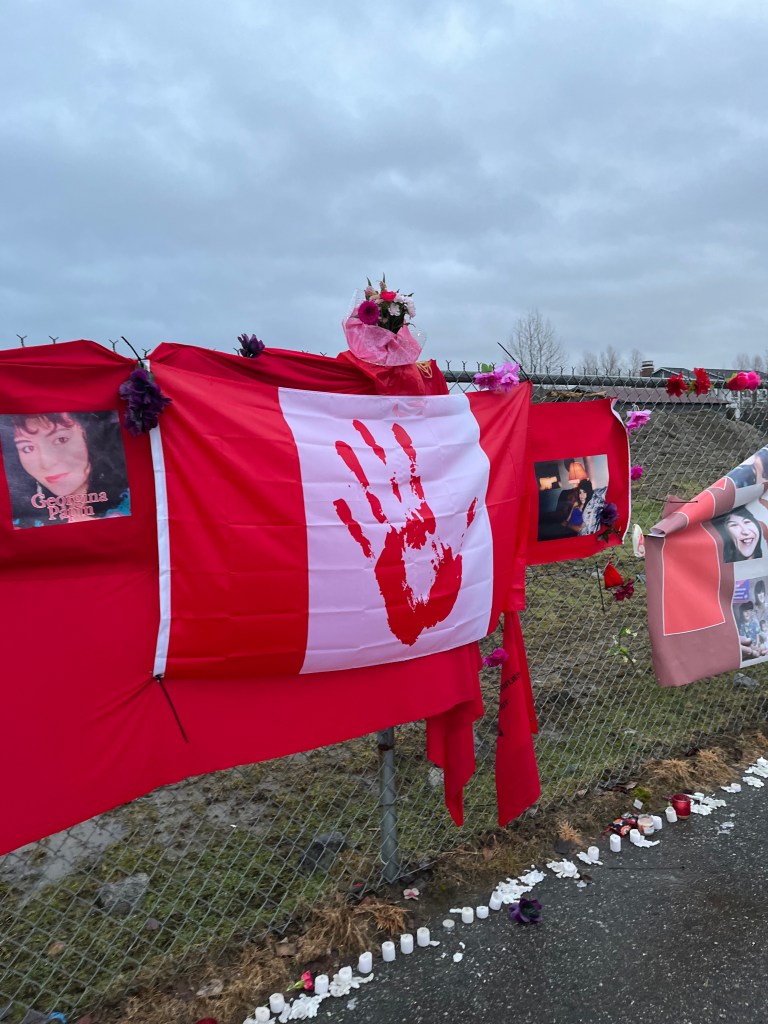
Without knowledge of its history, the farm might appear little different than any tract of suburban land, passed over for reasons unknown. Yet no-one could get through the walkway without noticing the mementos pinned to the fences. Among those that regularly appear and disappear are cards, bits of clothing and flowers. Some plastic flowers, faded by rain, have endured for years. More personal objects––such as photos, sachets and wreathes of sweet grass–– tend to be taken down within a few days. The south fence, extending an entire block along Dominion Ave., was once hung with red dresses. They had been placed there after one of the evening vigils periodically held there.
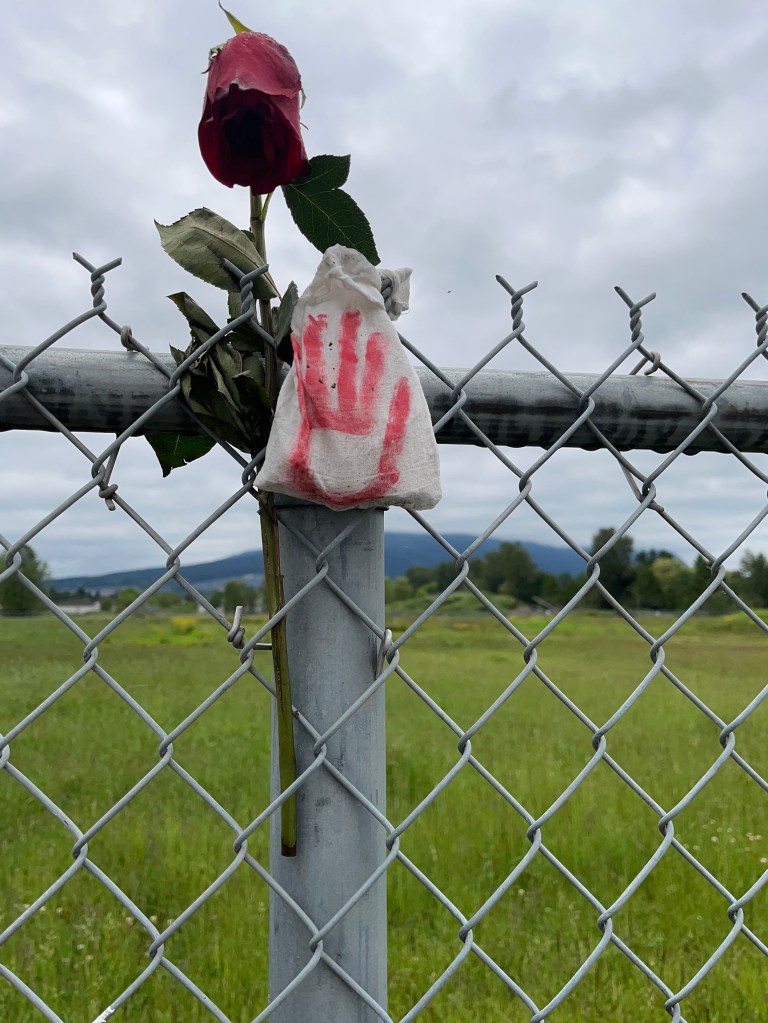
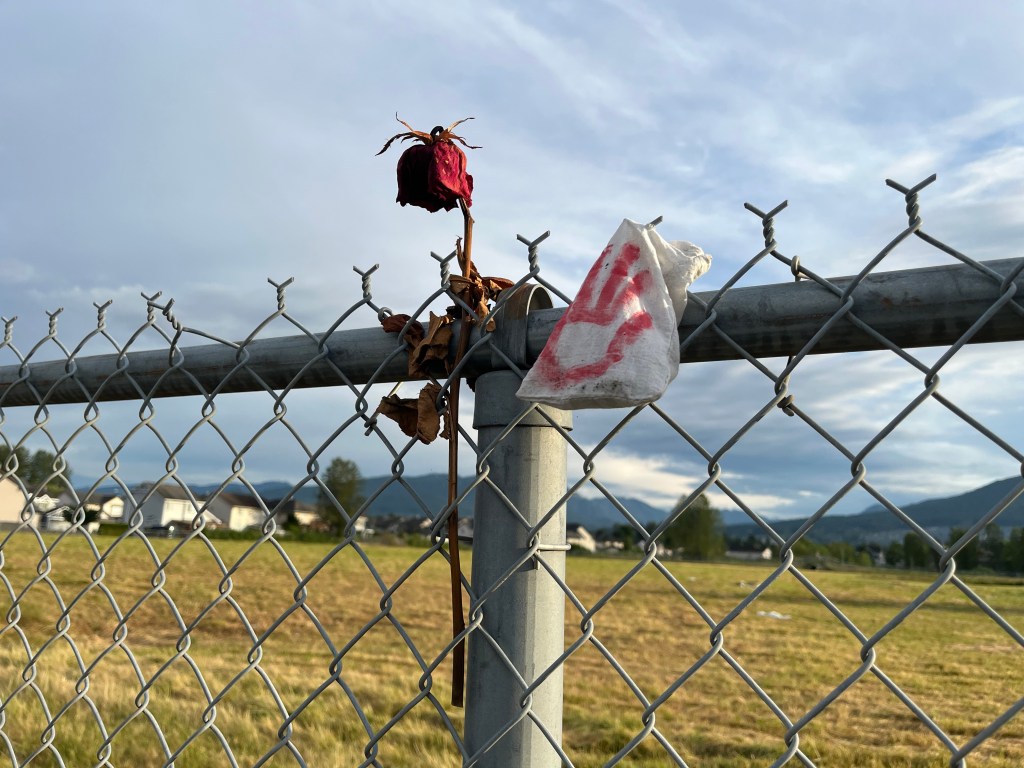
On the drizzly morning of June 1st, I was not surprised to see several long-stemmed red roses strung along the south fence. There had been a vigil the evening before. That was just hours after the news broke that Robert “Willy” Pickton was dead. He was reported to have succumbed to earlier injuries sustained at his maximum-security prison after another inmate speared him in the face with a broken broomstick.
The families of his victims could well have imagined a more fitting death for Canada’s most notorious serial killer. Still, for those who attended the May 31st vigil and pinned up the roses–– at least there was relief that the mass-murderer would never be paroled. The possibility of his parole hearing had been raised a few months earlier. However heinous the crimes of the former pig farmer, after twenty-two years in prison, he was eligible for consideration.
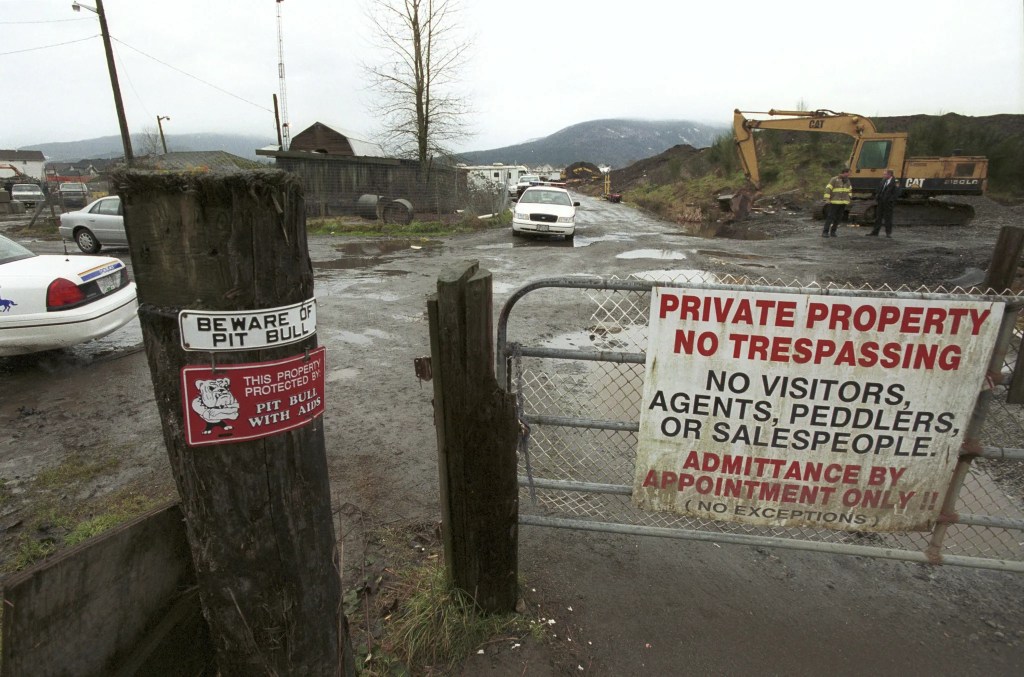
The horrors of the farm first sprang to public attention in February, 2002. That was when the RCMP raided the slovenly property that Willy Pickton then shared with his younger brother. In Willy’s trailer on the north side of their thirteen acres, personal items were discovered of women missing from Vancouver’s seedy downtown east side. A further search of his nearby barn found human body parts.
There followed the most extensive forensic investigation of a crime scene in Canadian history. Thousands of tons of soil and manure around Willy Pickton’s property were methodically sifted and analyzed for DNA.
In talking to an undercover cop planted in his jail cell, Willy had boasted of forty-nine murders. Bone fragments and DNA recovered in the painstaking search, clearly identified twenty-six missing women. As for the additional twenty-three possible victims: it was quite probable that all traces of them had disappeared. They could have been disposed of in an east Vancouver rendering plant along with animal remains. Even more shocking was the possibility that Pickton had also fed human body parts to his pigs…
The prosecution decided to pursue two trials. The first trial of six counts of murder was believed to be more clear-cut. It was for Pickton’s most recent victims for whom grisly physical evidence was found. The trial for the murder of those women for whom recovered DNA was the primary evidence, was to be stayed. It was thought that a clear conviction for the first six murders would make convictions in a second trial easier.
The first trial did not begin until 2007. The crown prosecution came disturbingly close to losing it. The defence argued that Willy was too dumb to have planned and committed the murders alone. They emphasized the murky comings and goings at the farm. Scores of other DNA profiles, male and female, was found at the farm along with those of the disappeared women. Those included some of the crowd who attended the wild parties the Pickton brothers sometimes held at the nearby hall they called ‘Piggy’s Palace.’
Particular suspicion fell upon an old Filipino hog butcherer who’d had sex with at least one of the murder victims. One of his meat-saws had traces of human DNA. Another possible accessory was a street-tough Cree woman who may have assisted Pickton in luring prostitutes from the downtown east side. Personal items of some victims were found in her possession. Then there was the younger brother, Dave Pickton. He had faced rape changes long before the gruesome discoveries on Willy’s side of their joint property. Before Willy was arraigned, Dave and the other two suspects were briefly held––but no changes were laid.
Despite all that ambiguity, the prosecution cleaved to the contention that Willy Pickton was solely responsible. In the end, he was convicted only of second-degree murder. In the prospect of even more reasonable doubt in another jury, the second trial was stayed indefinitely…
So it was, a half-witted Canadian pig farmer was vaunted to the gallery of the world’s most notorious serial killers.
It is well established that from Jack the Ripper onward, serial killers have preyed on the socially vulnerable. Pickton’s victims were particularly so. Many were indigenous women who paid for their drug habits by hustling their bodies in the roughest neighbourhood in Canada. Some were missing for at least seven years before their DNA turned up on the farm.
Of course, not all missing women in Vancouver were the victims of Willy Pickton. A list compiled by a missing women’s task force set up in the late 1970s included many names added years before Pickton probably began his killing spree. Still, police failed to detect a pattern from the mid-1990s that could have led them earlier to the Port Coquitlam farm. The grieving families of victims were left to bitterly wonder whether the disappearances would have more closely investigated had the missing women been middle-class and white…
In the aftermath of the trial, there at least emerged an official inquiry. A 2012 report acknowledged “systematic bias” of police against marginalized women, especially those of indigenous background. There was an official apology. Yet only a handful of the families of Pickton’s victims received a $50,000 ‘compensation’ payment. The mementos that continue to be pinned up on the fences attest that after twenty-two years––the grieving and the anger has not lessened…
Yet as time passes, it grows harder to connect the shocking newspaper reports and photos of 2002 with the appearance of the farm today. In a place one might expect to feel shivers of Dachau, one sees neighbours brushing their dogs or picking wildflowers. Sometimes parents take their kids to the fence to feed treats to the cows. School kids who walk and cycle daily through the walkway, were born almost a decade after the Pickton trial. Few, probably, have a clue about the dark history. For those with longer memory who regularly traverse the walkway–– the farm grows ever more insidiously familiar. Despite the mementos, the farm seems to become ever more disconnected from the evil that transpired there.
One afternoon in exiting the walkway, I encountered a three-person film crew wrapping up a shoot. Upon casual enquiry, the camera operator informed they were preparing a documentary on serial killers for German television. He said they were shooting in “several locations around North America”.
Morbidly curious about those other locations, I later did a Google search. Among the macabre tidbits dug up were ’then and now’ photos of an apartment building in Detroit. The recent photo looked eerily similar to the one taken in 1966 soon after its infamy. It was once a nurses’ residence where Richard Speck murdered eight student nurses. In contrast, the house in Chicago where John Wayne Gacy tortured teenage boys in the 1970s was torn down soon after bodies were dug from its basement. That lot stood vacant for many years before a new house was built on the property (One wonders about the real estate listing). As for the apartment building in Milwaukee where Jeffrey Dahmer cannibalized his male victims in the 1980s–– it stood empty for several years before being torn down…
It seemed that places where such horrific murders were committed remained desecrated. However razed and rebuilt upon–– the dark history was never completely erased…
Another disturbing aspect reinforced in that Google search was the titillation of serial killings in popular culture. Monsters from Speck to Bundy continue to provide lurid entertainment long after their deaths…
The attempts to capitalize on the Pickton ‘story’ were thus, predictable. A low-budget horror film entitled ‘Pig Killer’ has already been released. Even in the sub-genre of ‘splatter’ flicks–– it was panned. There will probably be other movies–– even more tasteless. Sick comedy about Pickton is neither surprising. A troupe from Alberta recently provoked outrage for ‘jokes’ and merchandise that were cruelly indifferent to Pickton’s victims… Perhaps it is naive to think that Canadian consumers of such fare would have any more respect for the grieving families than American audiences.
Still, one may wonder whether the farm itself would attract more perverse attention if it were south of the border. Guided tours to the sites of the most infamous serial killings in America are popular–– especially at Hallowe’en. Roadside ‘museums’ of the heartland often feature exhibits of blood and gore. Some enterprising collector of horror memorabilia would probably love to display Pickton’s meat hooks alongside the taxidermy tools of Wisconsin farmer, Ed Gein, who inspired ‘The Texas Chainsaw Massacre’…
I have yet to see them–– but maybe a few horror groupies do turn up at the ‘Poco Valley Cattle Co.’ farm. If looking for creepy mementos, those freaks are bound to be disappointed. The fence is high and both gates are chain locked. Meanwhile, all the potential ‘souvenirs’ have either been destroyed or remain locked away in police vaults.
I recently had an interesting exchange with a neighbourly dog-walker while we waited in the walkway for our sniffing mutts to perform. The cordial talk unexpectedly turned from coyote sightings to the farm itself.
We touched upon what we both knew: that Dave Pickton, who lives on a smaller property on nearby Burns Rd., was still in charge of the farm. He is trying to keep it in the Agricultural Land Reserve as long as possible to avoid payment of its heavy liens. After a forced sale, the crown will claim much of the proceeds to recover a portion of $100 million spent on Willy’s prosecution. The families of the victims will also claim damages. Nothing from the sale of the Pickton farm will be left for Dave and his sister…
The neighbour (who looks a little like Waldo in the ‘Where’s Waldo?’ puzzles) expressed his hope that the sale would remain tied up in the courts for another decade or so.
“That’s about as long as I’ll be around,” he joked. “In the meantime, I’d rather be looking out my window at cows than at more condos!”
I’d known his house was on the west side of the fence. What I hadn’t known until then was that he’d moved there in 2001–– the year before the shocking revelations.
“A few months before the raid, the RCMP knocked on our door,” he said. “They asked whether we’d ever seen or heard any funny business.”
“And had you?” I asked.
“Nope,” he rubbed his moustache. “It was pretty quiet here!”
On another morning in the walkway a few years ago, I saw the north gate swung open and an escaped cow grazing on the fringe of the path. There was clearly a danger of it taking fright and bolting.
I called the ‘in case of emergency’ number that was in a plastic envelope pinned to the walkway entrance. The fellow who answered was initially suspicious but listened to my explanation for the call.
“I’ll be right there,” he said in a slightly high-pitched voice.
Within five minutes, a dirty white pickup truck pulled up to the gate with two men in the front. Out from the driver’s side climbed a small man with a bushy red beard. He was wearing blue overalls and yellow rubber boots.
“Thanks for calling,” said Dave Pickton. Behind us, his assistant was shooing the cow back into the gate.
“No problem,” I nodded towards Dominion Ave. “Wouldn’t want to see her getting into traffic.”
He smiled and ambled back towards his assistant who was about to lock the gate.
Strange–– that the younger Pickton brother who was expected to look like a homicidal Hell’s Angel–– resembled Gimli, the dwarf, in ‘Lord of the Rings’. Even stranger was our neighbourly exchange…
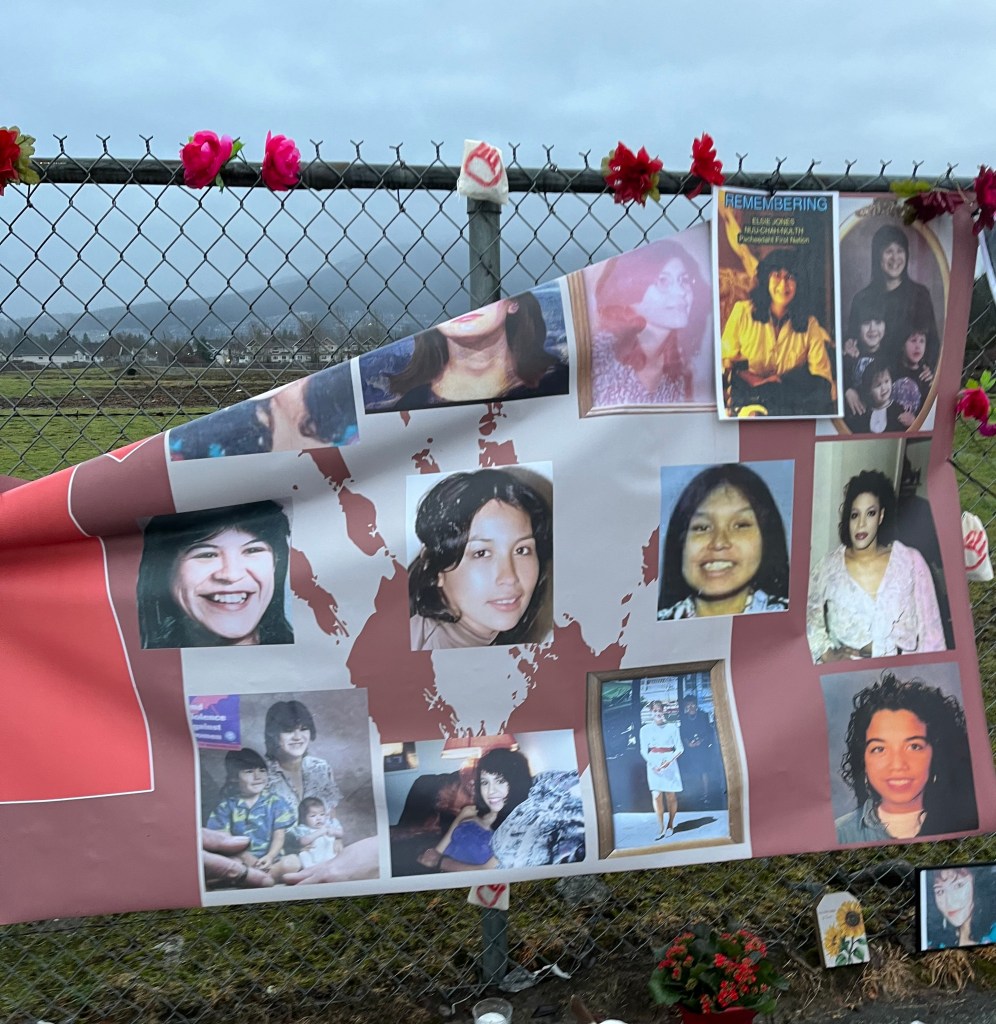
On May 31st, after hearing about Willy Pickton’s death, the question that has so often disturbed passings along the fence came to mind: Why can’t his name be forgotten–– erased from memory–– while those of his victims be remembered?
It is a near certainty the property will eventually be developed. The hillock will be flattened and the rusted machinery hauled away. Whatever replaces that–– townhouses, parking lot–– even flower gardens–– will still be built on ground where serial murders were committed. Whatever is constructed there will be upon soil once sifted for traces of the murdered women. How might the connection with that soil be somehow preserved in a respectful way?
Perhaps an answer partly lies in the recent development of a swampy parcel of land just two blocks east of the farm. The land abuts the golf course built on property once owned by the Pickton family. The Poco City Council decided to keep the public-owned property for public use rather than selling it to real estate developers.
The creation of a park on what was once a ranch and tannery was a costly three-year project. Toxic waste ponds had to be drained and tons of contaminated soil trucked away. At the beginning of its transformation, the site was a pit of mud surrounded by gravel banks, swirling in dust. It took three years of rain to refill the ponds. In late 2019, the landscaping was completed and Blackburn Lagoons Park finally opened.
One proposal had been to dedicate the park to the missing and murdered women. Families of Pickton’s victims were apparently consulted. Many of them expressed a wish that the farm itself will eventually become a memorial to all disappeared women.
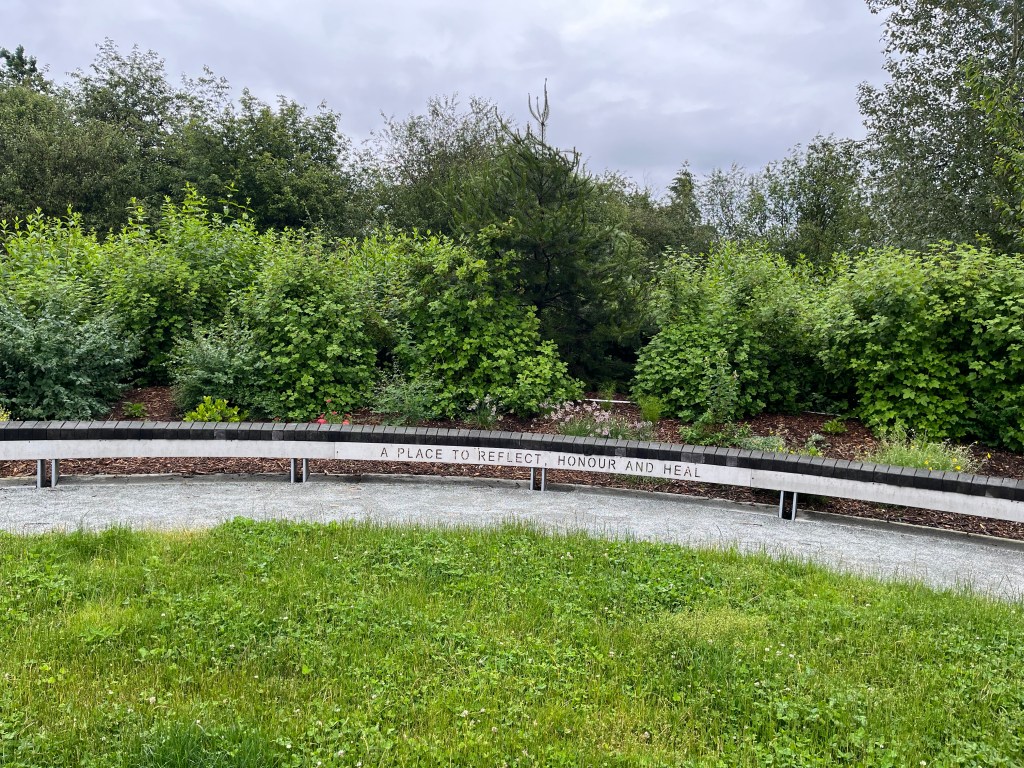
Still, a special space was created in the far corner of Blackburn lagoons, set off from the perimeter trail. In the middle, facing a pond, is a long stone bench. Etched on its underside are the words: ‘A place to reflect, honour and heal.’
Whether or not a more elaborate memorial is ever created at the farm, there are few public places more suitable for reflection than that little corner of Blackburn lagoons. Just five years after transplantation, shrubs and trees already form a lush green shelter around that bench. The combination of cultivated and natural regeneration is inspiring, indeed…
––2024, June
 Coprolites in Amber (etc.)
Leave a comment