Notes on an old traveler’s first ever guided tour (April-May 2022)
1
In the approach of my wife’s seventieth birthday in 2020, I proposed a trip of her choice. In her footloose mid-sixties, she’d joined me in a couple of ‘Rough Guide’ style trips to South America. But at three score and ten, she was no longer up to the spontaneity of unscripted adventures in the global south. For that next trip, she had in mind a guided tour.
In earlier years, I tended to eschew guided tours as excursions for the timid and/or moribund. Yet I had to acknowledge that in the approach of the latter–– even an old Lonely Planeteer begins to put safety and comfort before independence…
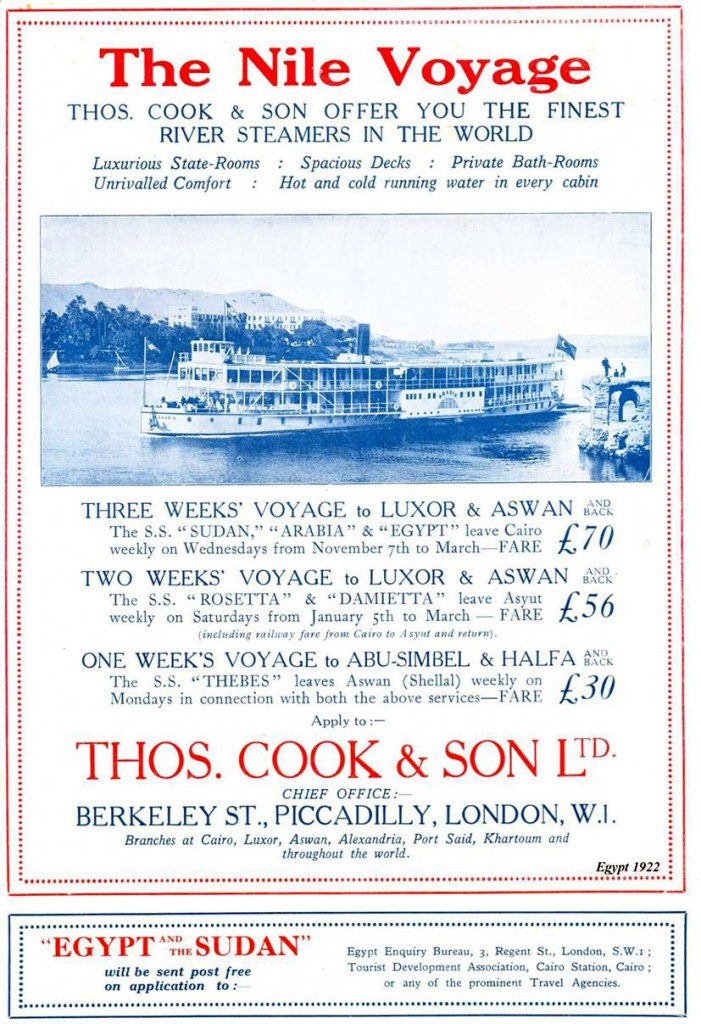
A guided tour to Egypt seemed a fair enough compromise with my wife. After all, the trip was intended as her gift. Egypt had always been on our common bucket list. If it had to be a guided tour–– why not follow the Nile Valley route by which Thomas Cook & Sons Ltd., in the Victorian era, launched modern tourism? I was at least relieved that my wife hadn’t proposed a Disney Caribbean cruise…
As expected, there were a broad range of Egyptian tour packages. Had there been more arterial blood to siphon, I’d have considered a boutique option such as those tours advertised in ‘National Geographic’ or ‘The New Yorker’. One with a pre-departure reading list, an accompanying archaeologist and a tightly focused itinerary would have been the preference. However, such a four-star Michelin tour was astronomically out of reach. My search was thereby confined to the McDonald’s menu of tour packages.
From the travel section of the Vancouver Sun, I found an ad for a fifteen-day tour to Egypt and Jordan with a company called Nexus Travel. ‘All-inclusive deal’, it proclaimed; ‘Unbelievable! 40% OFF’…
On offer was a slimmed-down version of that standard Cook’s tour. Included was Giza and Memphis (without the exterior pyramid climbing) and a Nile cruise with stops to view antiquities between Luxor and Aswan. Not included were gratuities, museum fees, or a Cairo dinner cruise with belly-dancers. Adding more steeply to the cost was the optional excursion to Abu Simbel and the balloon ride over the Valley or the Kings––both of which I could do without. What really sold me on the package were the additional four days in Jordan which included a visit to the fabled Petra. So, nearly eight months in advance of departure, I sent off the non-refundable deposit.

A few days before we set forth on our McTour–– a thunderbolt struck. An outbreak of the insidious new ‘coronavirus’ (clearly not named after the Mexican beer) had occurred on a Nile cruise ship. Still, the Nexus Travel rep in Toronto assured that the tour would go ahead. She said there would be a major upgrade in luxury hotels in lieu of the cruise. Thinking that the virus scare would thin out the crowds, we took the offer.
On March 11th 2020, we started off in some trepidation. Just before leaving Vancouver, we heard reports of corona virus outbreaks in Italy. Then during our layover in Toronto came news of cascading border closures. In the final minutes before check-in at the EgyptAir counter at Pearson airport, we bailed. On our own dime, we flew home–– arriving within forty-eight hours of the pandemic lockdown… Because we’d aborted the trip before the company was forced to cancel–– and we’d had no travel insurance––it seemed we were clobbered by bad timing combined our own caveat emptor failure.
After weeks of emailed pleading, we were offered a pro-rated refund from EgyptAir and a travel voucher from the tour company. Instead of fighting for a total cash refund–– we jumped on it. The refund was more than we’d expected in our initial despair. There was still anxiety that the tour company would go bankrupt and the voucher rendered worthless. Fortunately, the company survived the lockdown–– probably with a lift from Covid-19 government subsidy. Our voucher honoured––we rebooked their first Egypt-Jordan tour offered after the lockdown.
We set out again in April 2022– cautiously hopeful. In entering the line-up before the same EgyptAir check-in counter at Pearson airport where we had cancelled two years before–– the relief was enormous. Then came the reminder that we were not traveling alone:
The old man in suspenders shuffling along the cordon in front of us would be one of our tour companions. With a grin and hand squeeze, the retired truck driver introduced himself and his wife. From old Bill, I would hear more than I’d ever cared to about driving a big rig in Alberta…
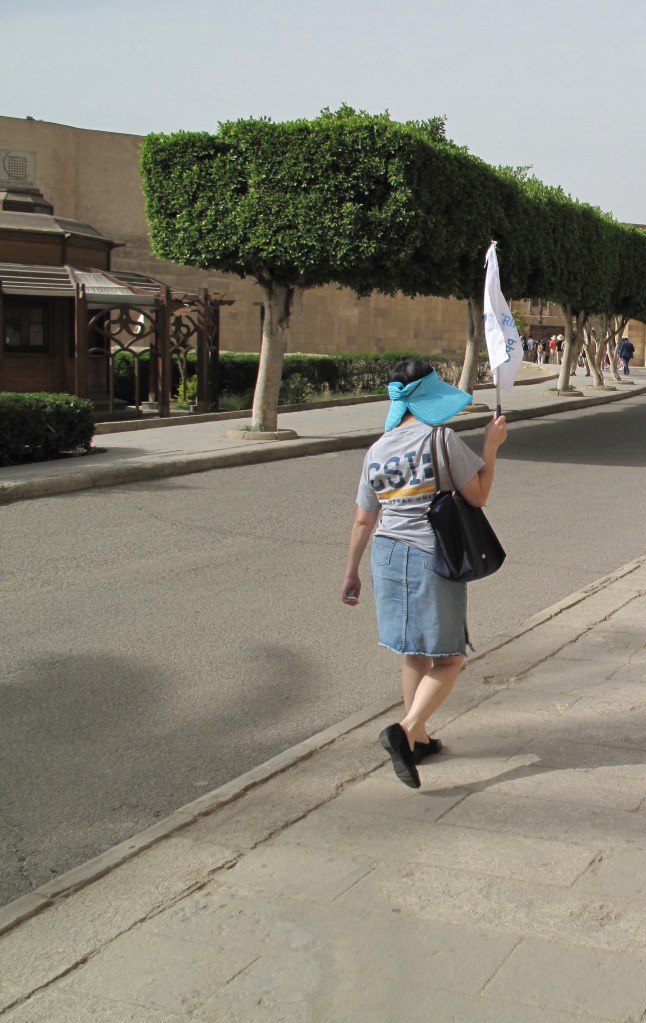
A half hour later in the departure gate, we met our tour guide, Popsy. She was a Chinese Canadian woman of about forty, soft-spoken and serious: not the type one might expect for an Egyptian tour escort. She was holding a flag with the tour company’s new name. That white flag with blue insignia was aimed to guide us over fourteen days through airports, hotel lobbies and the field trips between them.
Popsy said she was escorting her fourth such tour. It was something of a relief that she was not the happy-face blonde pictured in reading her introductory email, a week before. Yet when she handed out name tags, I pocketed mine instead of putting it round my neck as did my wife. That did not generate the most favourable first impression…
Before boarding we got a first look at other members of our group clustered around Popsy’s flag. To our pleasant surprise, my wife and I were not the most senior. The oldest appeared to be the chatty truck driver. As luck would have it, he would sit directly across the aisle on the cramped ten-hour flight to Cairo.
2
In the daze of waiting for our bus near the international arrivals’ door at Cairo airport, we got clearer impressions of our small group:
The most simpatico was Ken, a retired tour bus driver about my age, from Nova Scotia. We would chat a few times in walking to and from the buses. He said he was an eleven-year survivor of prostate cancer. When first diagnosed, he said he expected no more than six months. He was also proud of the gold Rolex bought for $1900 in Malaga and assessed in Canada to be worth $18000. It seemed that his wealth was from an inheritance, likely on his wife’s side. Janet was a well-preserved redhead whose pink suitcase was the most massive in the group’s luggage.
John was a wiry senior, best remembered for kindly emailing the photo he’d take of me in the inner chamber of the Great Pyramid, when I’d forgotten my iPhone in the tour bus. John and his diminutive wife were always chipper–– even in the sweltering heat. I heard from my wife––who chatted freely with everyone–– that he was a retired judge who was a surprising eighty years old.
The couple’s friend, Howard, had a Groucho moustache and wore a Tilly hat. I never spoke directly with him but assumed that he had booked the trip along with the judge and his spouse. Throughout the tour, they were usually a threesome.
Norm, from Ottawa, was a retired sales rep of General Motors. Although not quite as gabby as old Bill, he spoke at length about his son. He was especially proud that his 53-year-old boy was: “a city recreation manager in charge of every Zamboni in Ottawa!” From Norm I learned a critical point of tour group conversational etiquette: unless prepared to joust for one-upmanship––never talk about one’s adult children…
Harold, from Calgary, introduced himself as a survivor of a recent stroke which affected his short-term memory. Throughout the tour, his expressions shifted between lucidity and semi-confusion. A few times, he wandered along with my wife and I to the buffets but seemed to mostly stick with Norm. They were the two solo travelers on the tour. Unlike Norm, Harold took turns in conversation…
The “youngins” of the group were a mid-fortyish couple whose names I fail to remember. The husband and I often vied for the spot furthest at the back of the group during the tour guide’s longer spiels…
Then there was old Bill and his wife, Beatrice. She apparently did Alberta landscape scenes in watercolour which supplemented her retirement income. My wife grew friendly with her. That led to the oddly matched couple often sitting across from us in the tour buses or buffet tables…
Bill’s slight limp and bib overalls brought to my mind Walter Brennan–– who played grand-pappy Amos in ‘The Real McCoys’. When sitting across from him during a meal, a forkful on the way to my mouth was apt to be frozen in one of his boomed-out conversational gambits such as: “Does that taste anything like the macaroni back home?”
Of course, Bill had good reason to regard me a standoffish twit. Although justly scolded by my wife for unsociability ––l couldn’t help wonder: what might the inter-group chatter have been like on a higher quality tour? Expectations for the McTour were modest–– but hauling freight up to Fort MacMurray at forty below zero was not what I expected to hear about enroute to the Valley of the Kings…
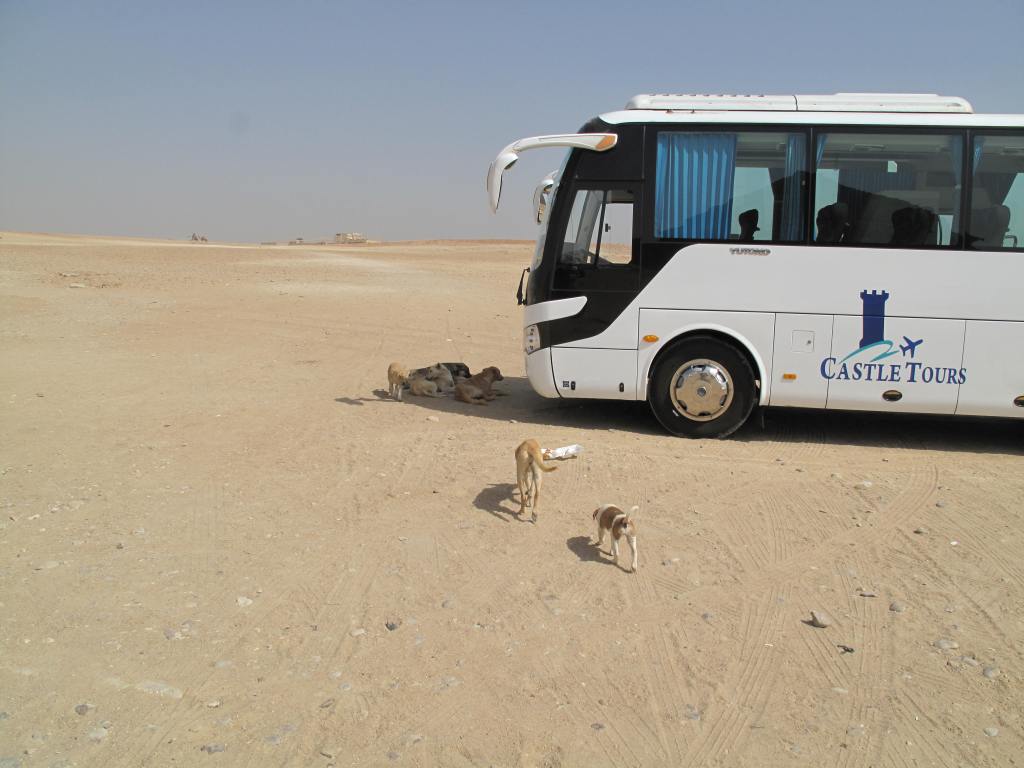
On the morning after arrival in Cairo, we first met Emad, our Egyptian guide. We were waiting in the tour bus outside our first hotel (Movenpick Media City) when he stepped aboard, Wearing the dark sunglasses we rarely saw him without over the following nine days, he was smiling broadly. He began by saying that his English was rusty from disuse over the pandemic shutdown. He then proceeded to show it off–– speaking of his official qualifications and long history as a tour guide, along with his personal interest in Egyptology.
After his introduction, he handed out audio pick-up devices that looked like low-tech transistor radios. “Guard these with your life while you are in Egypt!” he urged.
The devices were intended for focusing on a single voice amid a multilingual cacophony of other guides talking in a crowded place. Emad insisted we always wear them–– another cord to tangle with the name tag. There were quizzical expressions all round upon insertion of the earpieces. Even in barely hearing Emad’s voice through crackles of distortion, the group obediently hung them round necks for the first few days. Fortunately, the batteries in mine were the first to die.
“Guys, guys–– don’t forget to drink water,” Emad shook his half-empty bottle. “I drink six of these a day. In the desert–– water is life.” He then patted his side. “Always––always–– remember where is your passport! You got all that, guys?”
After that introduction, the bus shuddered off in the assurance that the mittens of its elderly passengers were safely pinned to sleeves…
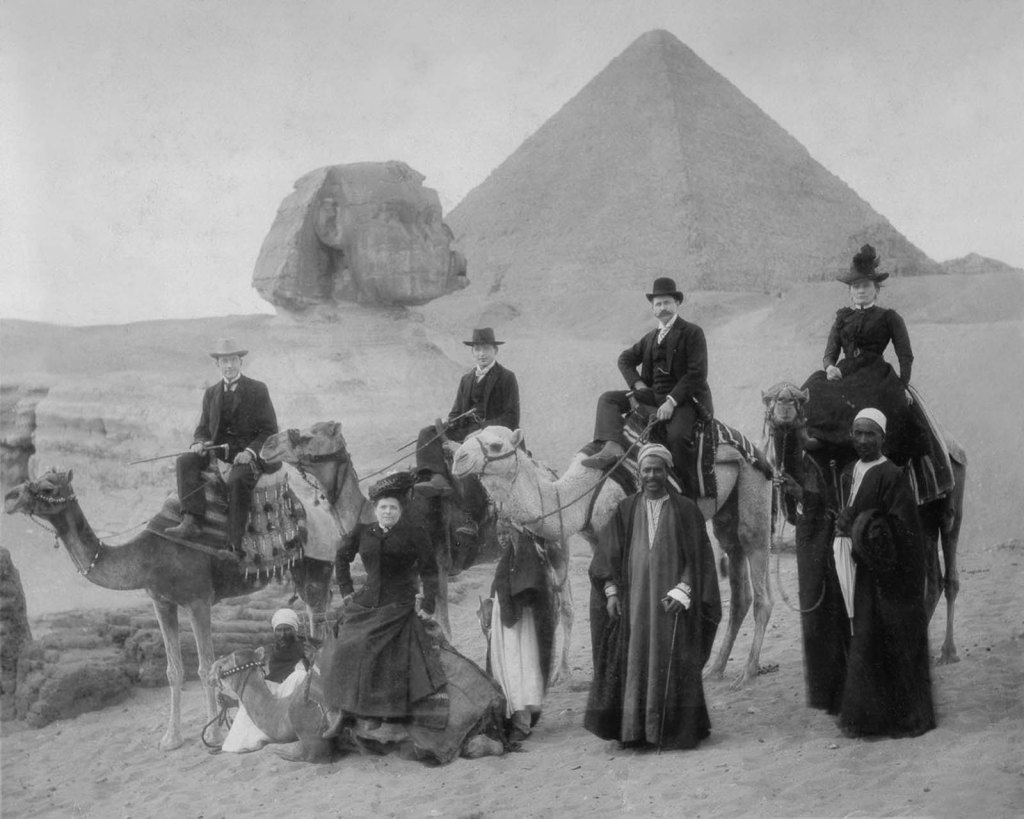
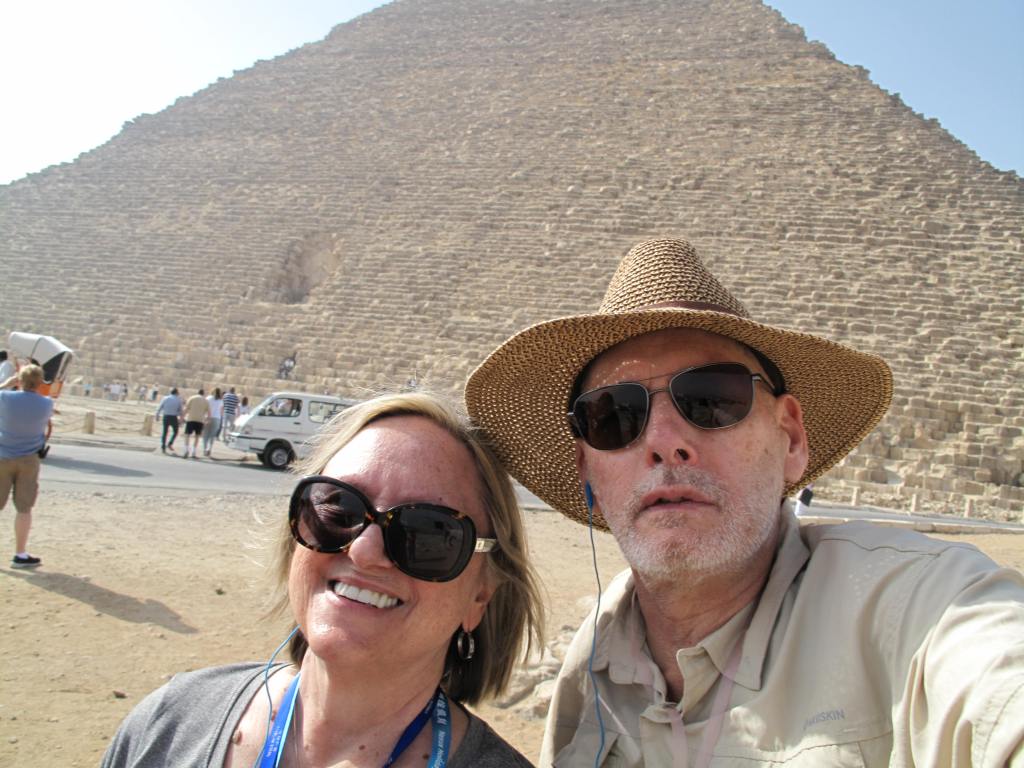
As with the millions of others guided along the same narrow path for at least a century and a half–– our first visit was to the 4,500-year-old Great Pyramid of Giza. There followed the routine we would come to expect in every stop in the Nile Valley:
…Arrive at the site bumper to bumper with a line of other tour buses… Follow Popsy and Emad through the gantlet of touts… Gather in a semi-circle around Emad near the site entrance… Listen to Emad’s lengthy presentation … Follow Popsy’s flag (amid several other flag-bearing tour groups) through the ticket gate… Circle through the site while stopping several times as bidden by Emad’s raised hand… After Emad’s talk, take a little time to wander–– but not too far from Popsy’s flag…
After the first few site visits, I no longer bothered to strain to hear Emad’s mini-lectures. By the end of the tour, I often drifted a few metres away with back turned to view some detail of a frieze or mural. Admittedly, a McTour trooper I was not!
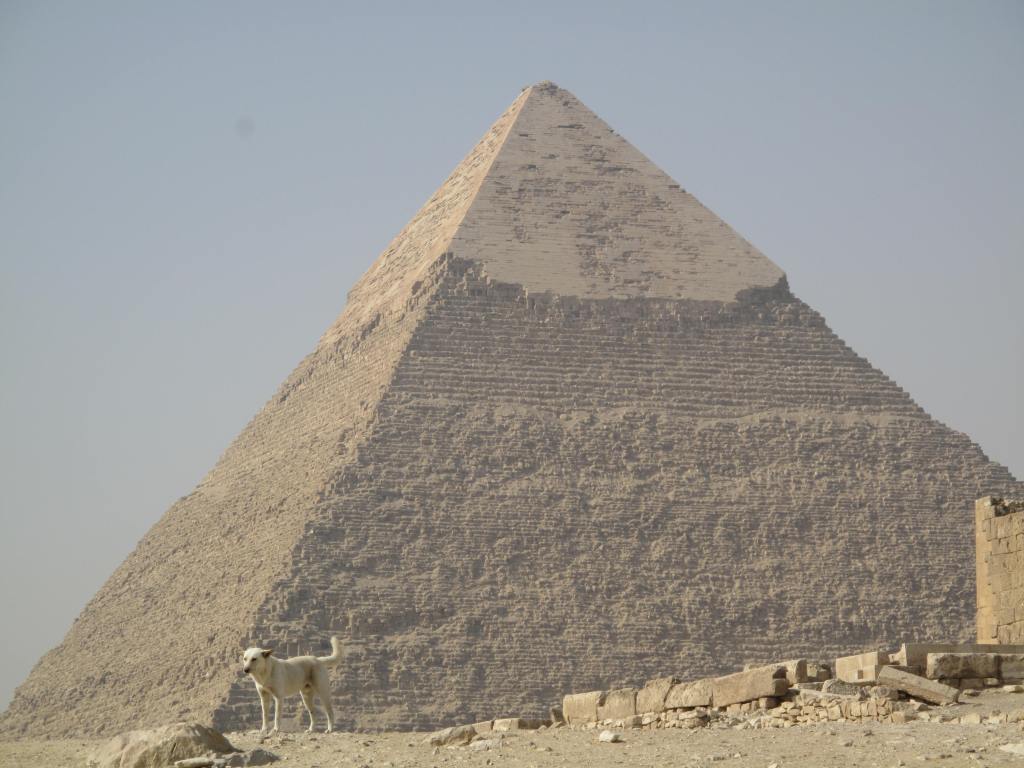
On that first stop at the Great Pyramid, against Emad’s recommendation I opted for the entry into the inner chamber ($20 US). With the mummy of the pharaoh, Khufu, long removed, only the stone dais that once held his sarcophagus remains. My wife wisely declined that claustrophobic squeeze through a narrow passage in baking-hot darkness.
My wife also passed up on the camel ride around the pyramid. That standard feature of Egyptian tours (masochistic as it is photogenic) was included in the package.
Last of our group to mount a camel, I drew a beast as geriatric as myself. With every lurch, I clung to the saddle for dear life. When the fellah pulling the tether paused halfway round the pyramid for photo taking, I was startled to find my camera missing from around my neck. Presuming it had dislodged and fallen–– I pleaded with the leader to circle back to look for it in the sand. Rather than completing the circuit, the whole group was obliged to follow. Having forgotten that the camera had been left in my wife’s lap did not further endear me to fellow McTourists…
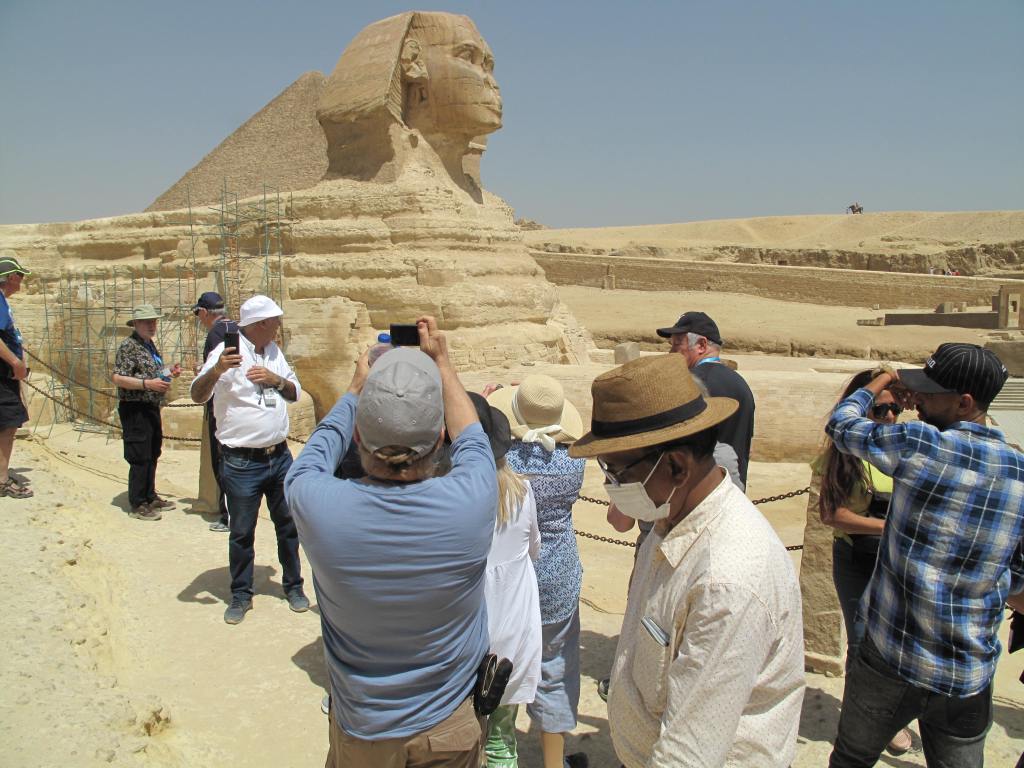
Of course, we could not leave Giza without viewing the Great Sphinx. As with the Mona Lisa in the Louvre, it was impossible to get the obligatory photo without including some of the horde lunging for the same pic. My wife and I skipped the return visit after dark to see the noseless Sphinx lit up in a laser light show… Tour fellow, Norm, reported the next morning that the optional spectacle was “not nearly as cool as the Northern Lights show in Ottawa!”
Our second day in Cairo featured a visit to the Egyptian Museum (EMC) in Tahrir Square. Built by the French in 1902, from its inception the Beaux Arts building had housed ancient Egypt’s most fascinating artifacts. Yet in April 2022 the old museum was half-empty. Many of the exhibits were crated up in the hallways awaiting transport to the new Grand Egyptian Museum (GEM) in Giza, yet unopened.
Most plainly in absence at the EMC were the pharaonic mummies. Some galleries of the old museum still displayed mummified animals and others had the sarcophagi of nobles. The royalty, however, had already been vacated from the premises. In fact, our visit was a year after the spectacular Pharaohs’ Golden Parade. That was the ceremonious procession in April 2021 of twenty-two royal mummies through Cairo’s streets. At the portals of their new home, the new National Museum of Egyptian Civilization (NMEC), they were welcomed by would-be fellow-Pharaoh, President El-Sisi.
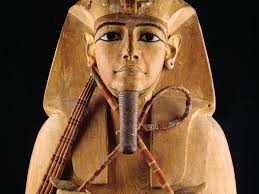
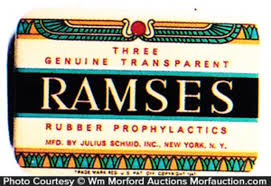
Among those who took that journey by vehicles decked out like ancient Egyptian funerary boats, was Ramesses II (1303-1213 BCE). Christians and Jews have often identified him as the Pharaoh of the mythical Hebrew ‘exodus’ from Egypt. Also known as Ozymandias by the ancient Greeks, he is the potentate who inspired the classic poem by P. B. Shelley: ‘Look on my Works, ye Mighty, and despair!’
“More than any other ancient ruler of Egypt–– I love this guy!” grinned Emad, at the end of his mini-lecture before Ramesses’s statue in the entrance of the museum. It was not a surprise to learn that the reputed conqueror of lands from Nubia to Syria––and namesake of a pioneering brand of condoms–– was also a favourite of President El-Sisi…
The absence of Ramesses and his fellow royals in the half-empty Egyptian museum was a memorable disappointment…
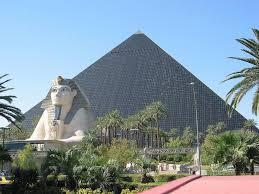
Before directing us to the gift shop, Emad spoke of the new Grand Egyptian Museum in Giza. The ultra-modern museum will apparently be integrated with the Great Pyramid and Sphinx. High-tech wizardry will supposedly showcase these wonders of the ancient world in a spectacle more jaw-dropping than the flashiest production of cirque du soleil…
All of that hype brought to mind the Luxor Hotel and Casino in Las Vegas, U.S.A. There, the full-size Sphinx replica has painted eyebrows and a perfect nose. In future visits to the Giza Sphinx, one might well wonder: where is the imitation–– and where is the ‘real thing’?
Unsurprisingly, Emad failed to mention that the GEM is primarily a billion-dollar vanity project of President El Sisi. The latter-day Ramesses will no doubt ensure that visitors to the new complex and its surrounding luxury hotels avoid exposure to the nearby Giza slums…
3
Had I been travelling solo, I’d have taken the train to Luxor. In the Cook’s tour tradition: a boat directly from Cairo up the Nile would have also appealed. Yet on the telescoped McTour itinerary, day #5 began with a 6:00 AM flight to Luxor. There we embarked on our mini cruise.
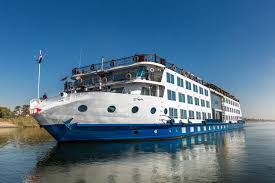
The MS Tuya was a triple decker with a hundred and fifty passenger capacity: one of nearly three hundred tourist boats that ply the Egyptian Nile in high season––mostly internationally owned and operated. In our four days between Luxor and Aswan, our ship was more often docked than in motion. We not only stopped at designated tourist sites enroute, but sometimes docked in the middle of the night. When disembarking for the site visits, we usually had to cross the decks of no fewer than three other cruise ships. According to Popsy, a McCruise in the high season might require crossing the decks of as many as five ships before reaching the gangway. Unsurprisingly, the higher-class cruise boats were docked on the inside…
In our little cabin, the double bed took up most of the space. Still, we had our own (closet-sized) bathroom and a TV–– albeit receiving only one fuzzy Egyptian channel. Of course, no reminder was needed that we were not on the Nile to watch TV. The buffet-style meal-service on the lower deck was a reminder that we were neither on the Nile in pursuit of gourmet dining.
Still, the boat’s common areas had little nooks of privacy with comfortable chairs. Most pleasant was the open upper deck. In watching the passing shore, there were sometimes glimpses of village life. There were hot drafts from the desert and wet whiffs of Nile mud. No where else on earth, it occurred, was mud and water recycled though so many human bodies over so many years…
Particularly memorable was the early morning on the upper deck when the boat was docked at the quayside of Edfu. Being early risers, my wife and I had skipped the party the night before. That had been another ‘tradition’ from the Victorian era cruises in which tourists dress up for photos in Egyptian garb.
With the ship quiet from that late night disco, at 4:30 AM I stole up to the top deck to bathe in the starlight. That morning of May 2nd also happened be ‘Eid al-Fitr’–– theend of Ramadan. Just before the break of dawn, the muezzin began droning from minarets on both the near and far banks. From the villages on the far shore, there echoed whoops of celebration and pop-poppings of fireworks. Instead of snatching up my iPhone to record, I just savoured the moment…
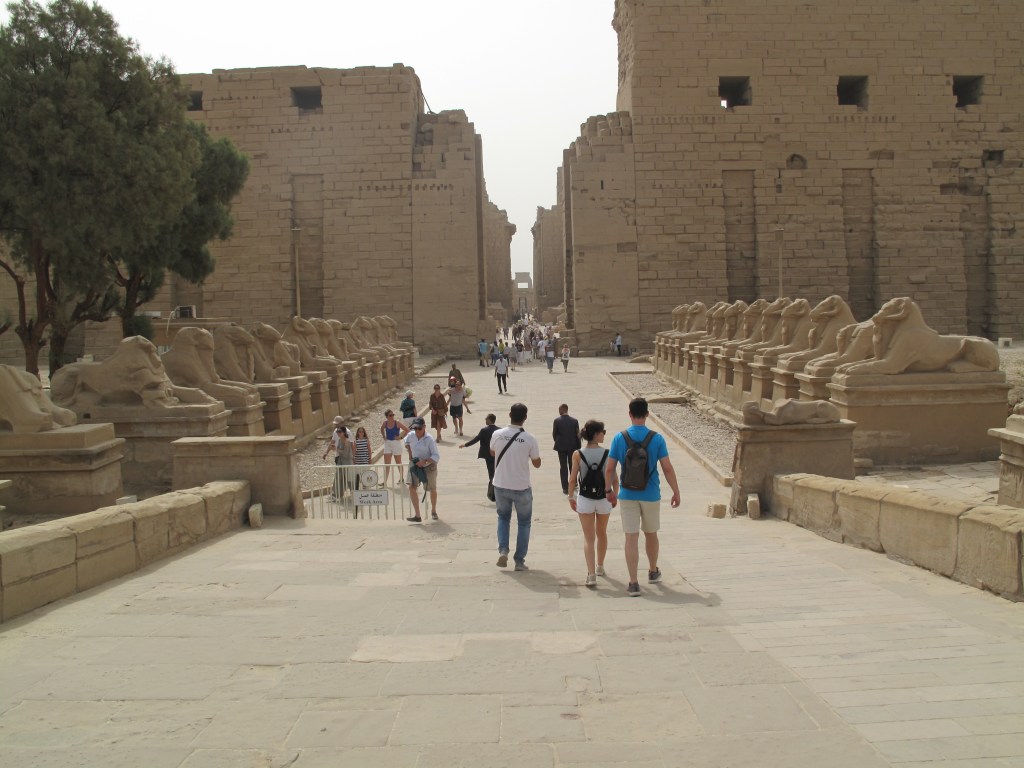
Before leaving Luxor on the first day of the cruise, we visited the temple of Karnak on the East Bank. There we beheld imposing statues of the same Ramesses encountered back in the Cairo museum. Back on the boat by mid-afternoon, we crossed the river to the West Bank and docked for the evening.
When the sun rose the following morning, I was on the upper deck at the same time as a dozen hot air balloons rose above the desert hills behind the West Bank. My wife and I had declined that opportunity to float over Luxor in a basket. Even if it had been the thrill of a lifetime–– $180 US was just too steep for it. When the others in our group returned from their thrills-of-a-lifetime, we set off for the Valley of the Kings.
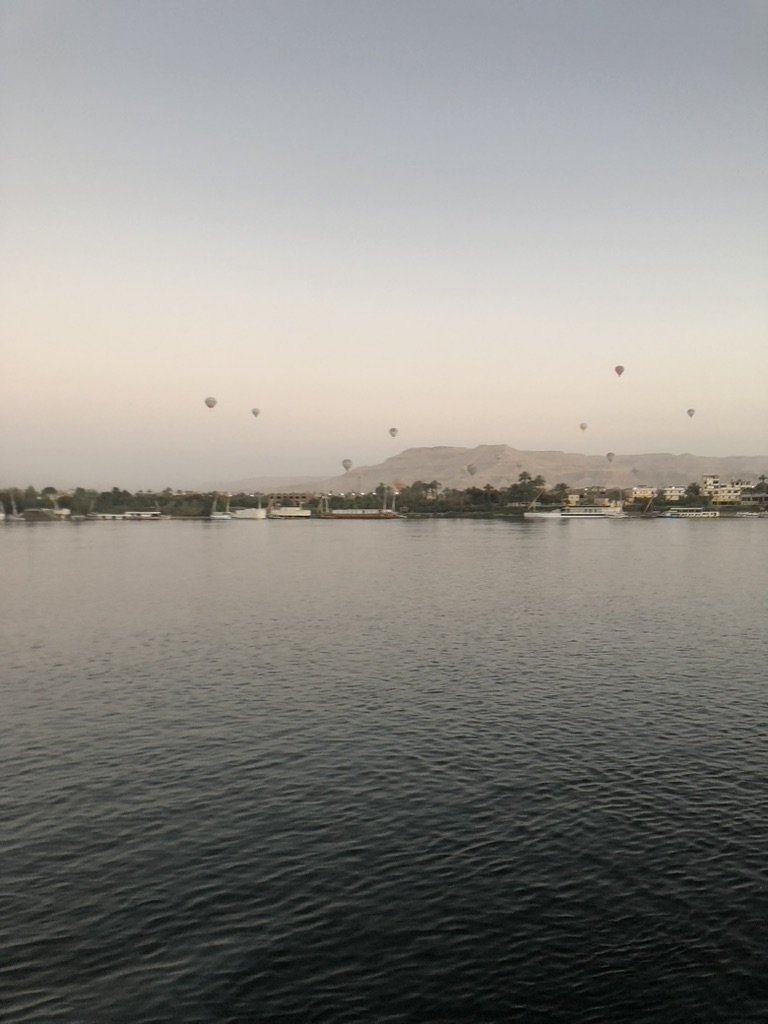
Even one who has never flipped through a National Geographic or lingered on a Discovery Channel documentary can hardly have failed to have been exposed to some information about the Valley of the Kings. Only the most grossly incurious can resist being drawn to elaborate royal burials, thousands of years preserved. Little wonder that the Luxor area draws close to two million visitors a year…
In the modern era, Egyptologists have excavated and catalogued more than sixty-five tombs in the Valley of the Kings alone. The greater area––known as the Necropolis of Thebes–– also contains the tombs of ancient Queens. Identified as well are the graves of the labourers who served the royal burials though the eighteenth to the twentieth dynasties of ancient Egypt (circa 1650-1550 BCE).
As well known, the tombs of the nobility were designed to provide the spirits of their occupants a five-star luxury passage to the hereafter. From the beginning, the royal tombs were unsurprising targets of curse-defying grave robbers. Falling scree and shifting sands allowed a few royal mummies to rest in peace–– for a blink of eternity, that is.
For the last two millennia, visitors have been drawn to what has been uncovered in the tombs as well as to the attractions on both banks around Luxor. Apparently, there is ancient Roman graffiti in the temple of Luxor. Much more recently, an inscription in Chinese characters appeared in the same temple declaring: ‘Ding Jinhao was here’. The Government of China was obliged to apologize on behalf of that jokester–– a 15-year-old student. Perhaps the boy was defensibly partaking of an old tourist tradition.
At the ticket gate of the Valley of Kings, Emad chirped out some of the foregoing facts and figures. He did not mention the 2013 Ding Jinhao scandal but reminded that it was forbidden to touch any surfaces. He neither mentioned the November 1997 al-Jama’a al-Islamiyya terrorist attack in which sixty-two international tourists were murdered near the place we were standing. Understandably, there was a sharp downswing in visitors in the months thereafter. There would be another sharp drop in the wake of the 2011 Arab Spring. Then came the 2020 global pandemic…
Our mid-morning visit in early May 2022 coincided with visits of no less than twenty other tour groups. German, French and Spanish were heard in the clusters around their leaders’ flags. Still, Popsy said the crowd was half the size as she had seen on earlier tours. Tourism from Japan, Korea and China was apparently still limited by pandemic restrictions. Double the numbers swarming the narrow valley in uniform caps and tee-shirts was not a pleasant imagining. It also occurred that the Pharaohs themselves would not have been amused by such a volume of traffic around their tombs…
About a dozen tombs were open for viewing during our two-hour visit. Most of the tourists were lined up at the tombs at the lower end of the narrow valley. Few seemed inclined to stray too far from the tour buses, let alone walk uphill in a desert furnace.
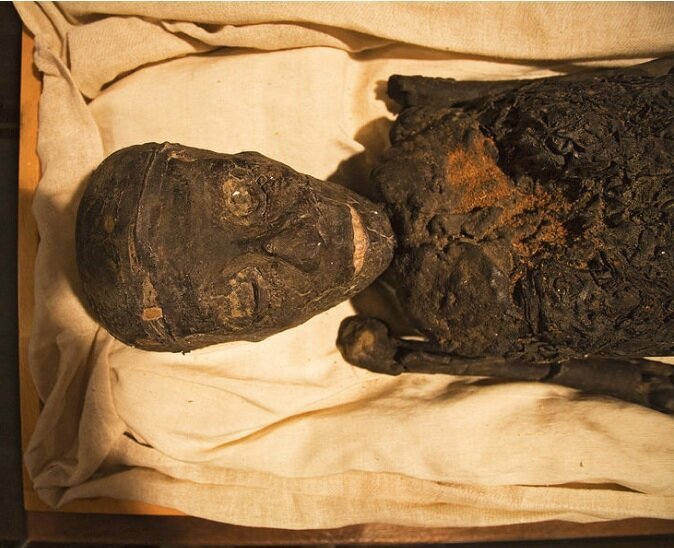
The longest line-up, unsurprisingly, was for the tomb of Tutankhamun. When rediscovered in 1922, the tomb was largely intact. Since then, much of its treasure has been on display in Cairo or circulating to museums around the world.
For a $15 US extra fee and an hour wait, we had the chance to see King Tut’s funerary mask and sarcophagus. My wife and I skipped it. Afterwards, I was disappointed to hear that the Pharaoh’s actual mummy was on display. Still, with only the blackened head and feet visible inside the hermetically-sealed glass–– the veracity of the most curious detail about the mummy could not have been confirmed. Had the penis of the young King Tut really been mummified erect? Without seeing the bulge on the linen wrappings, one could never know…
After a mere forty-minute line up, we did see the tomb of Amenhotep II (1427–1397 BCE). Some biblical scholars have identified him as having been a more likely candidate than Ramesses as the Pharaoh played by Yul Brynner in ‘The Ten Commandments’. His mummy was long absent from the tomb–– separated from 3400-year-old renderings of such funerary attendants as Horus and Anubis, intended to protect his ‘ka’ [soul]… Apparently, until the recent introduction of humidity controls, tomb paintings hieroglyphics were deteriorating from mass exposure to breath and sweat.
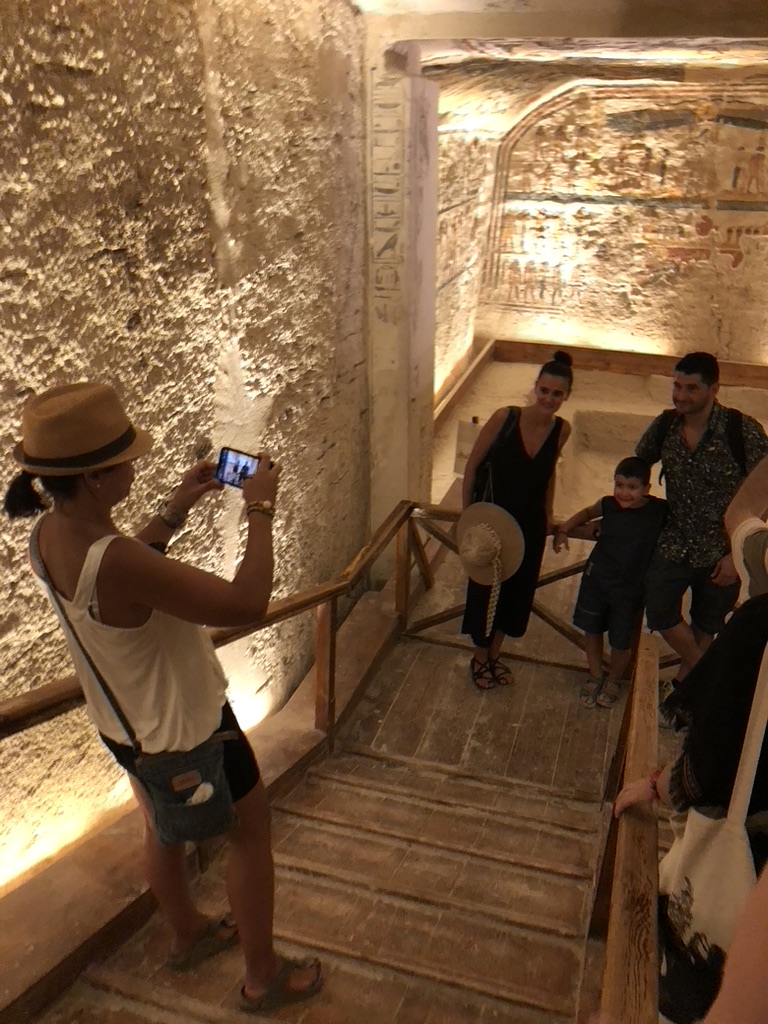
Shuffling past the sarcophagus of Amenhotep brought to mind the line-up for Lenin’s mausoleum in the Kremlin. Apparently, that is an equally tedious wait for a two-second glimpse. My cell phone photo from the railing was appropriately blurred…
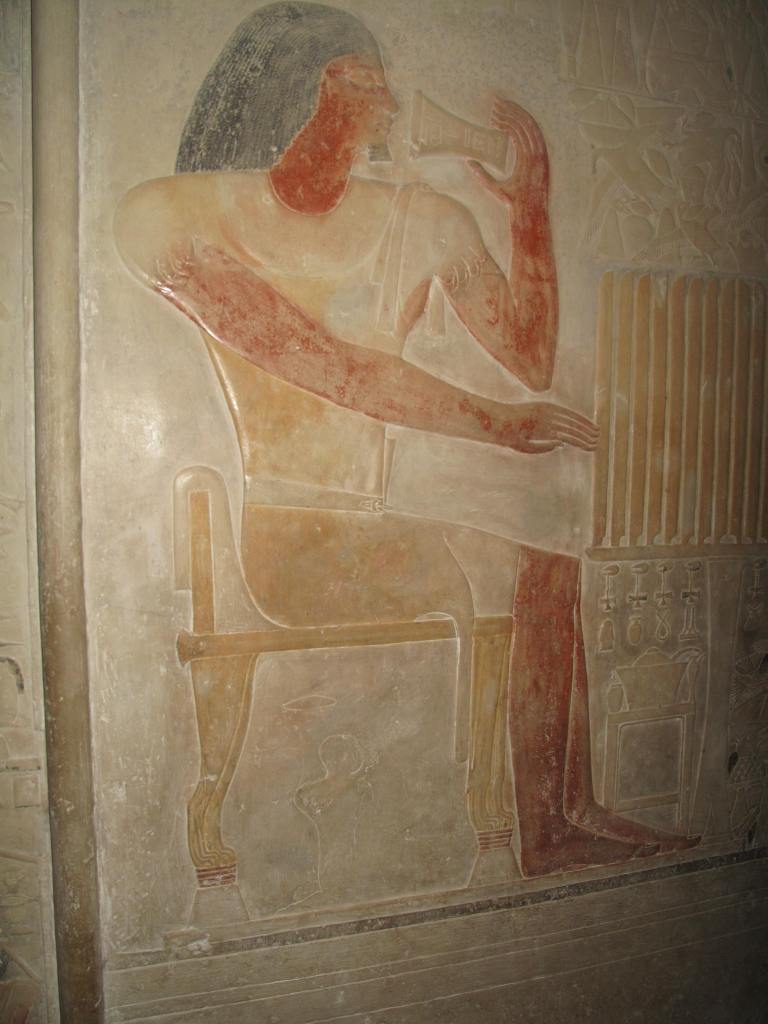
Our basic ticket to the Valley of the Kings allowed entry to three tombs. Each additional visit cost extra. For the punching of the remaining visits on our tickets, my wife and I walked further up the valley to the tombs of lesser lights. Even in the fierce sun, it was a welcome respite from the swarm. In the two less prestigious tombs we visited, the mural paintings and hieroglyphics looked remarkably unfaded. There was a tiny suspicion that they had been touched up for tourist benefit.
Had I any more an ‘authentic’ experience of the Valley of the Kings than might have been had from a 3D Imax documentary? In getting back on the bus, it seemed the fulfillment of expectations therein was about equivalent to a meal of a big Mac and fries…
4
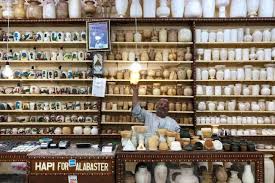
Having started the morning a little behind schedule, before departing the Valley of the Kings, Emad suggested we skip the Temple of Hatshepsut and Colossi of Memnon which were also on the West Bank. But there was time before lunch, he said, to visit the nearby showroom of an alabaster factory. It was a familiar routine:
Before leaving the bus at every site, he warns of the hawkers clamouring outside the doors… He says the trinkets thrust into our faces are worthless imitations… He then shepherds us both ways through the fray… Back on the bus, he promises to take us to a “safe” shop where the quality of handicrafts is superb and the prices are fair (“You won’t have to bargain,” he assures)…
We are driven to a workshop with an attached showroom… We are usually offered a tea or a sweet, while watching a demonstration… Afterwards, we are invited to browse the air-conditioned shop where credit cards and American cash are the preferred payment…
These shopping stops usually took as long as the scheduled site visits. At the alabaster factory, I waited for a half hour on a bench outside the showroom. Then in a surfeit of second-hand smoke from grandpappy Amos (who also skipped the presentation), I went inside. My wife was in front of a table of alabaster scarabs. When I asked if she knew their price, old Bill’s wife overheard.
“Well, these just cost $60,” she smiled, showing a few alabaster eggs she had purchased.
From what I’d seen from souvenir displays around the Giza pyramids entrance–– she could have got the same pieces for no more than $2 US each––before bargaining.
“How dare they charge so fucking much!” I muttered as the startled old woman turned away.
“You are embarrassing me!” my wife seethed.
I managed to talk my wife out of the scarabs. Yet in view of further harm to marital harmony, I made no such effort in her later purchases of gifts. At the perfume shop, she spent $100 on four tiny vials of essential oils. At a textile shop she paid $80 for a few pillowcases. Then there was the carpet shop where she swiped her Mastercard for $110 US for a tiny wall hanging. Still, I cannot claim to have avoided wielding my plastic in similarly profligate manner:
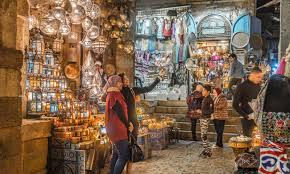
At a papyrus workshop, the manager assured that real papyrus paintings never crack or fade like their banana leaf imitations. Hook in mouth, I paid $60 US for a tiny scroll depicting Ma’at, god of justice. I imagined it hanging under glass in my lawyer son’s office. Yet it looked remarkably like the banana leaf ‘imitations’ hawked for $1 US. Could the ‘real’ papyrus one really be expected to last sixty times longer than the imitation? Yet more embarrassing was the Cleopatra doll purchased in the Cairo museum gift shop for my granddaughter. Too late, I discovered that the ‘Egyptian handicraft’ for which my VISA was dinged $40 was made in China…
The annoyance thereafter was not so much in being a typical tourist–– but in spreading dollars among the Egyptians who need it least. While the shopkeepers must have had drastically reduced profits through the pandemic drought–– the lowlier dependents on the tourist trade would barely have eaten.
“One dollar! One dollar!”
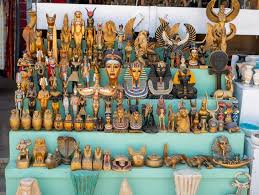
In almost every site visited, we heard that cry upon our approach or at our backs.
Even in those moments of feeling like a walking ATM, I tried to remind myself why hawkers were so eager to make a quick withdrawal. Even in those few days on the Nile Valley beltway, I came to appreciate just how dependent the Egyptians are on the tourist trade… Tourism’s reported 12% of the total economy would no doubt be ever higher if all petty hawking is included. Considering that the median Egyptian income is less than $4000 US a year––most hawkers probably get less than half that. Given the two-year absence of walking cash machines, it was little wonder that there was frenzy in their sudden reappearance.
Although I have enough clutter in my life without the addition of Egyptian baubles, I often regretted not taking along a wad of greenback singles. Even if I couldn’t give away a bag of cheap souvenirs (eg. pyramid keychains) there would be some satisfaction in having helped feed a few Egyptian kids…
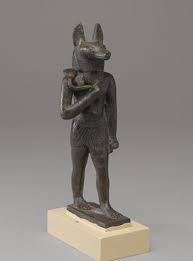
Only once did I defy Emad’s warning about hawkers:
Two black soapstone statuettes caught my eye outside the temple of Karnak. The one of Bastet, the feline goddess, looked like a suitable gift for my cat-fancying elder daughter. Another was a likeness of Anubis, the jackal-headed tomb attendant. It looked right for my younger daughter’s bookshelf. The hawker’s first price was 1000 Egyptian pounds ($21 US) for the cat alone. When I turned towards the bus, the hawker held up both trinkets–– his price dropping with every stride between us. When I got into the bus, he came to the doorway waving the statuettes. The final price was 500 Egyptian pounds for both pieces.
Maybe it was mean-spirited to have so squeezed a poor hawker, but he nonetheless seemed pleased by the sale. While I handed over the Egyptian pounds and took the statuettes, Emad stood in the aisle behind, fuming…
A few days later outside the temple of Philae, he reacted similarly when McTour fellow, John, bought a Nubian wood carving. Whatever Emad barked in Arabic at the hawker needed no translation. His tone said it all: “Hands off–– these are my sheep for fleecing!”
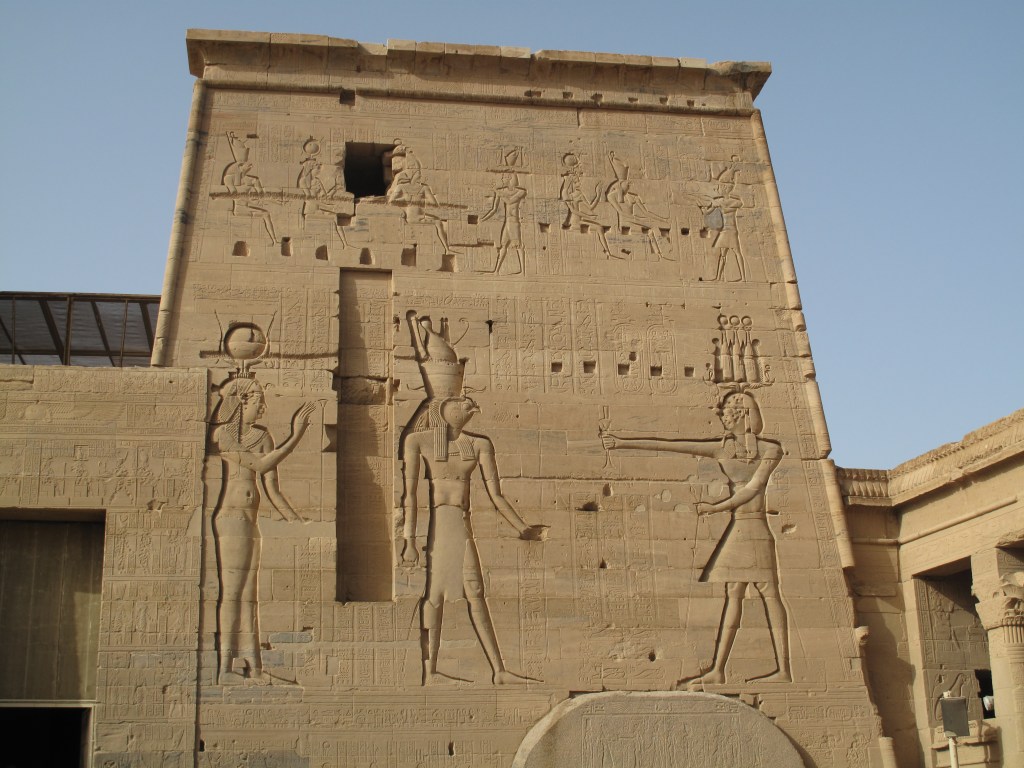
To be fair, Emad probably felt he was protecting his vulnerable charges. His tone and behaviour often suggested he was providing both protection and amusement–– rather like an activity coordinator in seniors’ day care…
In such regard, Emad’s introduction to the Temple of Horus in Kom-Ombo comes to mind. On that afternoon of day #7, he may have detected a little tedium in his group. Indeed, we were as eager to get out of the merciless sun as to appreciate the magnificence of 180 BCE Ptolemaic dynasty architecture.
Lining up the four who stood at the front of the group, he tried to spice up his mini lecture on the Egyptian creation myth with a little role play:
So you are Isis and Osiris,” he said, nudging Judge John and his wife closer together, “king and queen. “And you––” with hands on both shoulders, he drew Norm beside them. “You are Set–– the jealous brother who wants to be king.”
Emad then held up Norm’s hand. “Set kills Osiris.” He made stabbing motions. “But Isis–– she breathes life back into him.” He nodded to John’s wife. “Com’on, Isis!” She dutifully blew on her husband’s cheek. “And then they make love,” continued Emad, encouraged by the titters, “and they have a son. That son is Horus… Who wants to be Horus?”
A little dazed, Harold stepped forward. Emad mimicked slashing motions. “Horus fights Set,” instructed Emad. “Horus wins–– becomes king!”
Emad beamed as his charges clapped–– all but one of them. Admittedly, I suffer from chronic impatience–– as my wife will attest.
As for Emad’s job performance–– others on the tour would give him high marks. He delivered standard information in relatively comprehensible English and spent long days with the group. When Bill’s wife broke her ankle in Cairo on the steps outside the Muhammad Ali mosque, Emad got her to a private doctor. He translated and helped the couple secure documents for a health insurance claim. For that, old Bill and his wife were alone in tipping him…
Popsy told us that Egyptian guides did not expect tips. She assured that Emad would be paid from the gratuities charged within our economy tour package. Plainly, he depended much less on that gratuity than on his cut from the pricey shops to which we were steered…
So, encouraging our shopping was the most lucrative opportunity in Emad’s job. He cannot be faulted for that. Guiding in Egypt has probably always worked that way. One might well imagine Roman legionnaires steered to the shops of ‘friends’ of enterprising Egyptian guides of old…
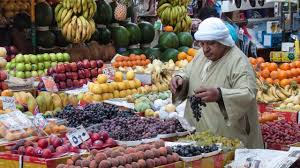
Over the fourteen-day tour, only once was I able to break away for a few hours on my own. That was in Aswan on the morning when fellow McTourists went on the excursion to the Abu Simbel temple. Even my wife was not deterred by the $180 US fee for the seven-hour bus ride.
In my private ‘walking tour’ of Aswan, I set off in the wrong direction and almost got lost. After an hour of circling back in the 40° swelter, I finally reached the town center. Happening upon a ‘tourist information’ office, I obtained brochures and a map from the old man behind the counter who introduced himself as Hussein. In halting English, he asked if I wanted to change money. I declined but gave him a little baksheesh for the help.
I then wandered through a market, attracting a few stares at the old ‘ghareeb’ [foreigner] who strayed a few blocks off the tourist path. Yet I was just as surprised when a vender squatting behind heaps of assorted nuts spoke a few words of English. When he insisted he was a widower with three kids, I relented in my attempt at haggling. For just 100 grams of raw peanuts, I paid him the equivalent of $5 (US) in Egyptian pounds.
Afterwards, in a small grocery I was surprised to pay only ten pounds for a bottle of water which cost forty pounds on the boat. In scanning it at the till, the clerk had to charge me the regular Egyptian price… It was another sweaty hour’s walk back along the corniche to the quay where the Tuya was docked. However mundane, the brief glimpse of a few backstreets of the ‘real’ Egypt was refreshing…
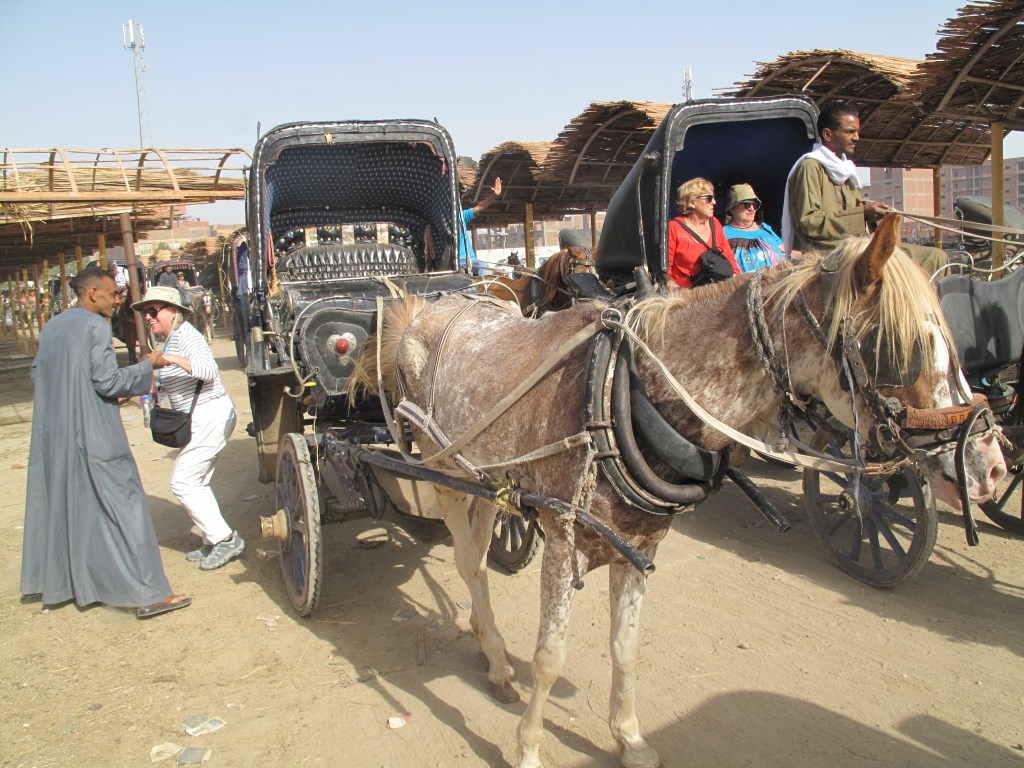
The day before that in Aswan, my wife and I took the horse carriage ride that was included in the tour package. All the passengers from our boat were led to one of the dozens of Egyptian Hantours lined up on the corniche above the quayside. As soon as our turn came to climb into a carriage seat, the attendant whistled like a traffic cop. Thereupon we clip-clopped away at a brisk pace. With the Eid festival still underway, there was excitement in the crowded streets. A few kids waved and called out––some cupping hands as if to receive tossed alms…
Within a half hour, we circled back to the spot where the carriage driver waited to receive the next pair of tourists. As we stepped down, a street photographer surprised us with a photo he’d taken of us unbidden, just as we’d set out. The photo was printed on a mid-sized poster with a hieroglyphics chart in the background. His first price for the unsolicited photo was one hundred pounds. As we walked away, the price came down–– fifty, forty–– finally, twenty-five pounds. We kept walking.
Just as we’d missed the couples’ photo of ourselves astride camels at the Great Pyramid, neither of us felt any need for a ‘romantic’ Hantour memento… Still, I felt guilty for the poor photographer’s wasted effort…
In terms of spending–– my wife and I were certainly the church mice of the group. Our fellow Canucks signed up for all the tour options–– from the belly dancer dinner in Cairo to the Nubian village visit in Aswan. They didn’t blink at the jacked-up liquor prices on the cruise. Moreover, they flashed their plastic freely in every shop visit.
Had there been a biggest spender award for the group–– that would have gone to the Nova Scotia couple. By the end of the tour, the wife may well have doubled the weight of her enormous suitcase… In the lobby of Dead Sea hotel in Jordan on the day before flying back to Toronto–– the middle-aged red head showed my wife her gleaming gold bracelet and earrings.
“We like to buy some gold jewelry in every tour,” said the husband proudly.
It was a relief that my church mouse partner showed no envy.
In fact, my wife had managed to get a souvenir that pleased her. She got it in the market in Cairo where we were taken to kill a couple of hours before heading to the airport for the onward flight to Jordan…
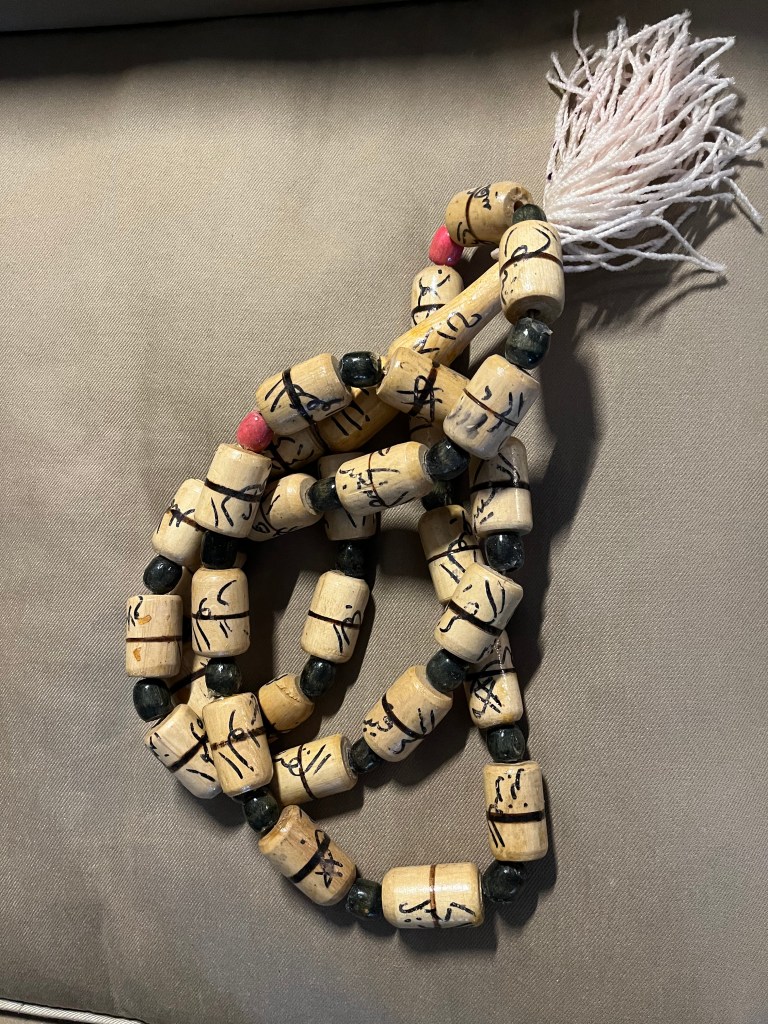
We momentarily veered away from the tourist section and embedded into a crowd of Egyptians, moving down a lane of houseware products. Among the stalls was one selling Islamic prayer beads… My wife was taken with a large wooden ‘misbaḥah’, designed for hanging in a home. Each bead was scribed in Arabic with one of the hundred names of Allah. With some miming and the help of a passerby who knew a few words of English, we persuaded the woman in the stall to sell the beads to a non-Muslim. That artifact–– my wife’s only treasured keepsake from Egypt––now resides in a corner of our living room…
5
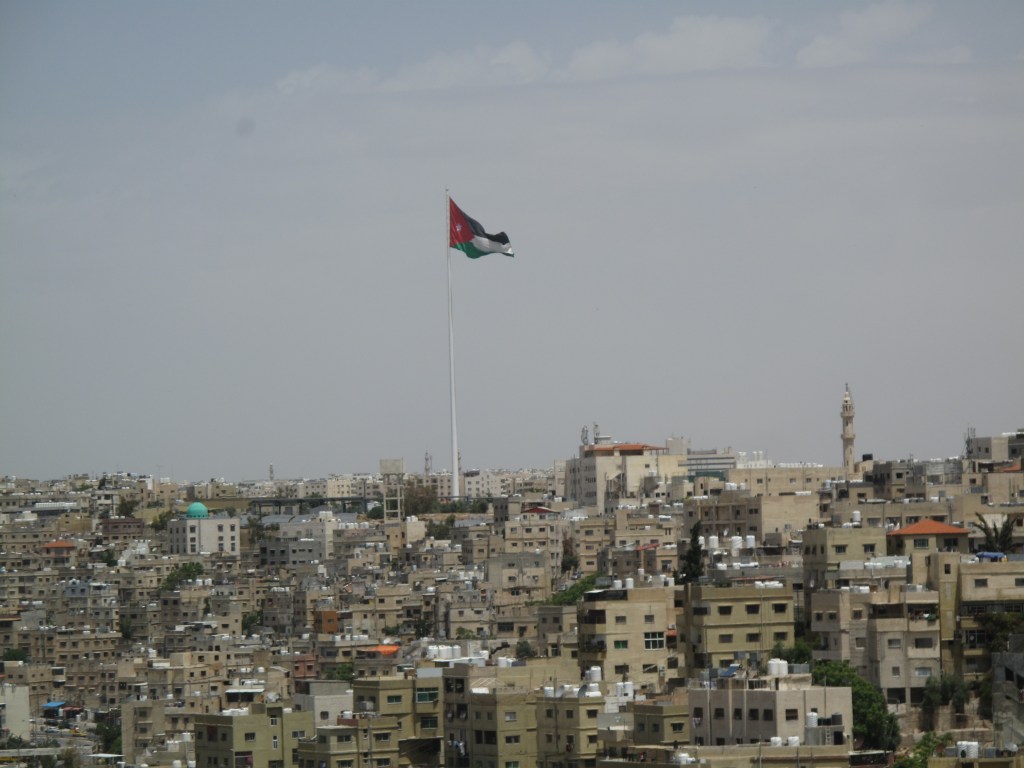
The whirlwind pace of the McTour continued through the final four and a half days in Jordan. Still, the transition from the Nile Valley felt rather like exiting a busy freeway for a drive along a secondary road. That drive was pleasant–– until the final thirty-six hours…
Despite our short stay, the bus journeys were long: nearly four hours from Amman south to Wadi Rum and nearly the same driving distance from Petra back north to the Dead Sea.
During those drives, our guide, Bashar, often stood in the aisle, delivering his talks on Jordanian history, ancient and modern. He was a mid-thirtyish Christian-Jordanian with shaved head. His calm demeanor contrasted well with Emad’s nervous jokiness. An engaging speaker–– Bashar’s English was markedly more fluent than that of our Egyptian guide.
He did make a few eyebrow-raising claims. Eg. Were the ancient Nabataeans who built Petra–– really direct descendants of the biblical Ismael? Was ‘Hellenistic’–– the term by which the ancient Greeks referred to themselves––really derived from the Nabataean word for “strange’? Was the Prophet Mohammed really born in Petra rather than in Mecca?
Bashar was also notably more pro-Israeli than most Jordanians. He said that he had attended a Christian seminary in Jerusalem but hadn’t been ordained. After describing the Black September conflict in 1970 between the Jordanian army and the PLO, he tsked:
“Everywhere they’ve gone–– the Palestinians have made trouble!”
Perhaps the elderly white North Americans Bashar had previously guided were Israelophiles. Maybe he was reassuring a few old Canucks that not all Arabs supported ‘the Indians’ against ‘the cowboys.’ It hardly mattered. While he opined, nary a batted eyelash was noted among fellow McTourists.
As for the whirlwind stops: both my wife and I agreed that Wadi Rum and Petra were the standout visits of the tour.
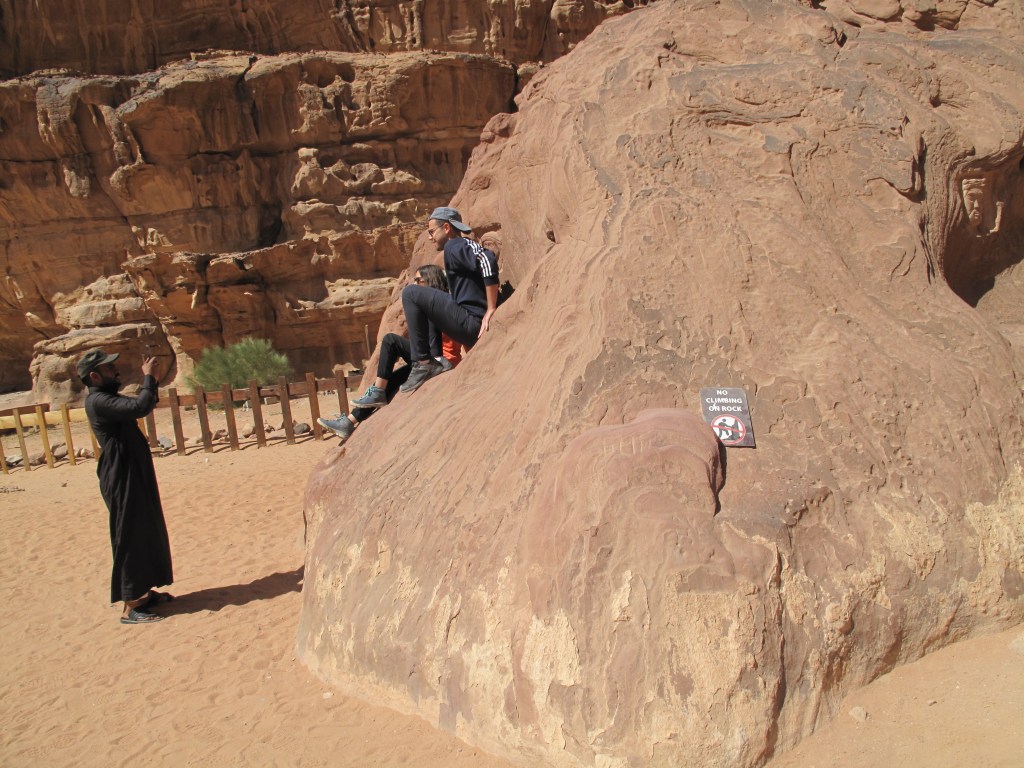
At Wadi Rum, AKA, ‘the Valley of the Moon’, we bounced along a desert trail in the back of a pickup trunk. Above us loomed the crags which inspired T.E. Lawrence’s: ‘Seven Pillars of Wisdom’. (“Was Lawrence of Arabia a real person is just a legend?” asked McTour fellow, Howard, on the bench across).
Unfortunately, I missed the spectacular views as we circled ride back to the bus. A gusty wind came up against which I had to keep head ducked so my new hearing aids wouldn’t blow out. Losing them forever in the red sand of Wadi Rum would have been a juicy story–– but not worth $1700––no matter how many times retold…
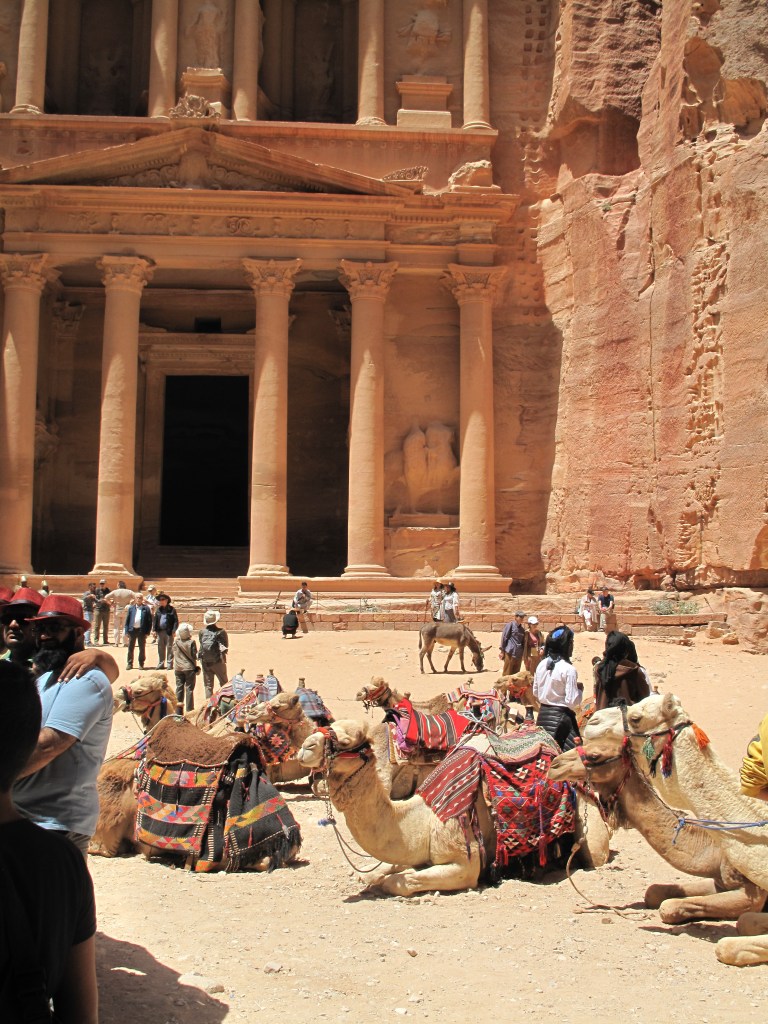
While Wadi Rum narrowly exceeded expectations–– Petra blew them away. The ancient city of the Nabataeans hewn from red sandstone cliffs is truly among the wonders of the world…
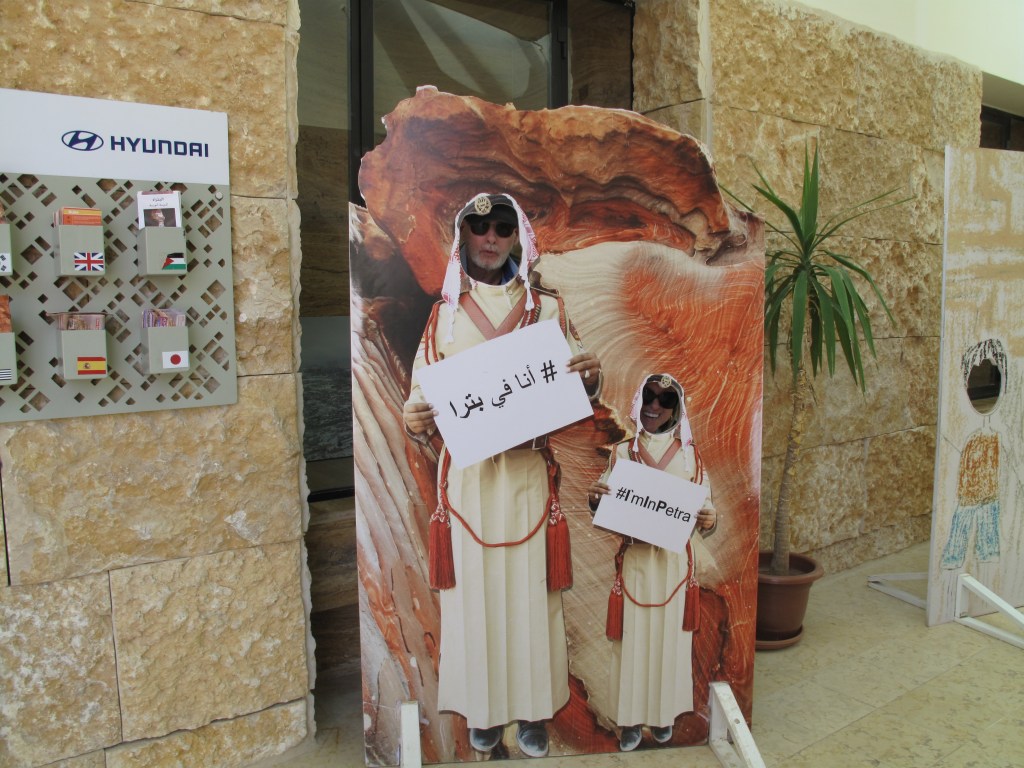
As in Machu Picchu, the ancient architecture in Petra is rendered otherworldly by a spectacular setting. In entering the site, one walks (or rides on horseback, if so hired) through a narrow kilometre-long siq [gorge] that opens to a natural plaza. Therein, one faces the Treasury–– a Grecian-style edifice cut into the cliff-face nearly 2000 years ago… Amid the cacophony of hawkers, tourists and bleating camels amplified by the canyon walls–– the spectacle is jaw-dropping…
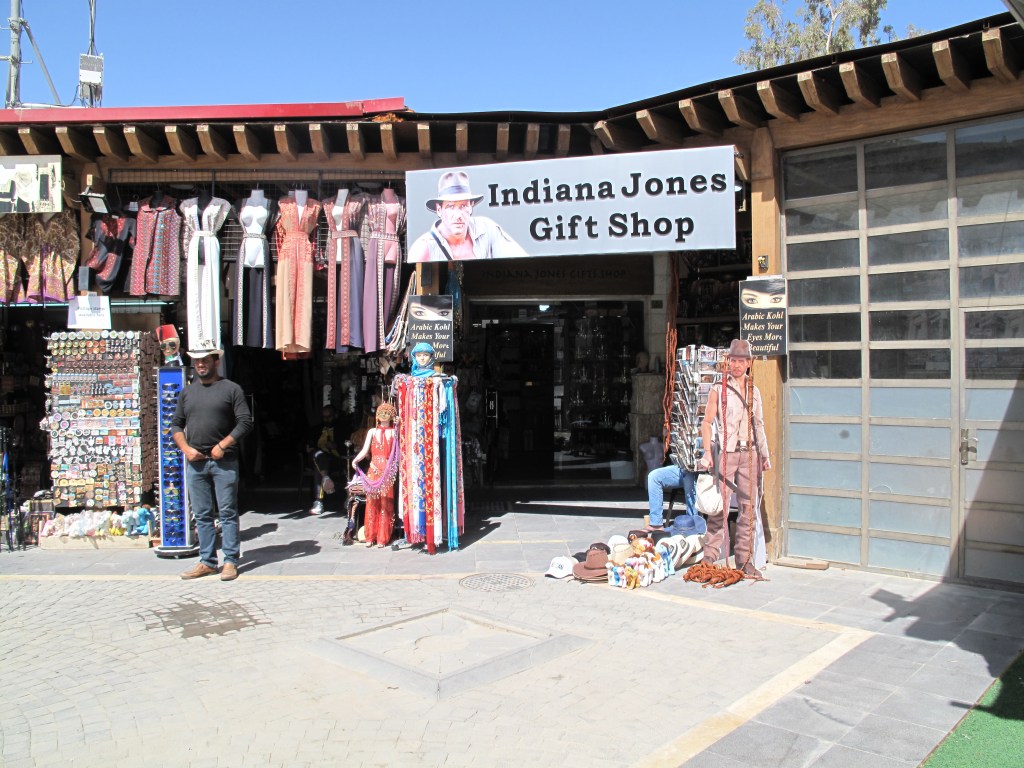
After exiting, my wife and I got some fast food near the entrance from a kiosk beside the Indiana Jones gift shop. I took note of that only because the falafel shawarmas were so delicious. They were a tease of the Middle Eastern comestibles missed in our McTour confinement to ‘safe’ buffet fare. For supposed sensitive stomachs, I suspect it was all irradiated.
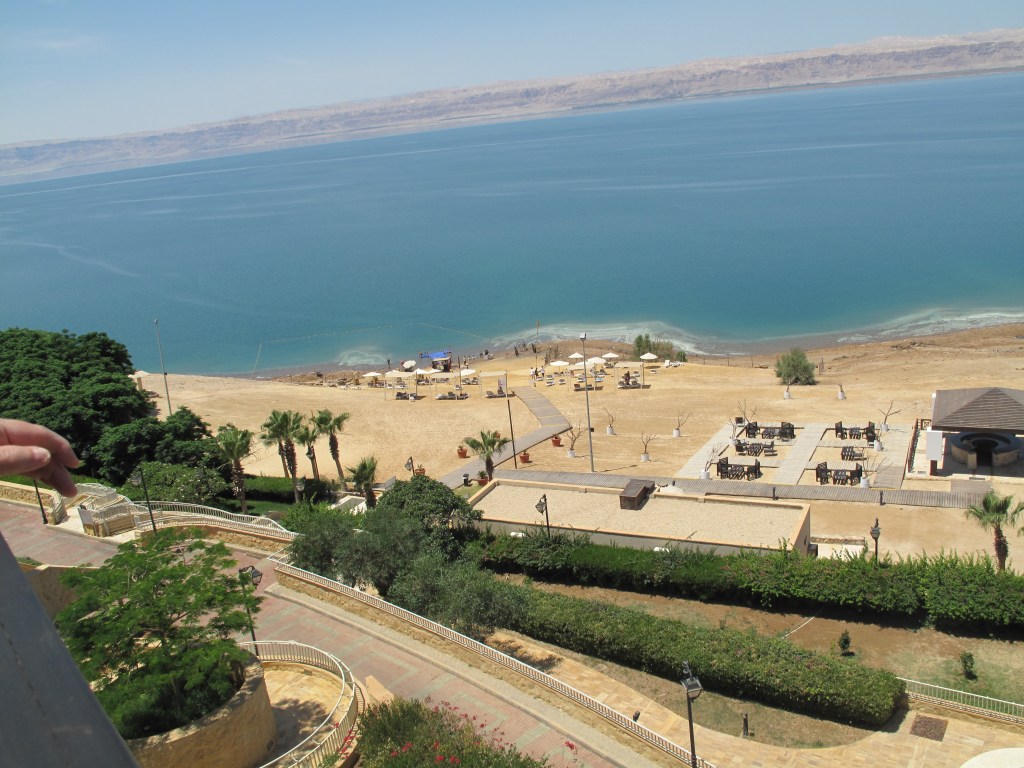
There followed a long rattling bus trip from Petra to the Dead Sea. Our final two nights were booked at a resort hotel in that place of mythic renown. However little stock I have in Abrahamic lore, I was certainly curious about setting foot near the supposed site of Sodom and Gomorrah, destroyed by Yahweh for their wickedness. Perhaps the Abrahamic deity would be tempted to rain a little brimstone on an old blasphemer, briefly in the same vicinity…
I was much more interested in experiencing the lowest land elevation on the planet (minus 427 metres) and its soupy saline sea. Yet bone tired, I looked most forward to a day of rest without scheduled touring. Even more exciting was the prospect, a day thereafter, of flying home.

The following morning at the Crowne Plaza Dead Sea resort–– those expectations were upended. I woke with a sore throat and stuffy sinuses. I had no such symptoms the night before when my wife and I submitted the online ArriveCAN declarations intended to screen for Covid-19.
Like many travelers in those months, we’d brought along a Covid rapid test kit. I did the nostril swab. A few tense minutes later, a pale pink line below the red bar confirmed the worst. In the surge of panic, I flashed on the sneezing Spaniard ahead of me in the buffet line in the last day of the cruise–– a careless bastard…
My wife then took the test. Her result was negative. Still, we realized that within a couple of days she would probably also test positive. With luck, that would be in Canada.
We also knew that we could get screened for a random Covid test upon arrival in Toronto. That would mean quarantine at a government designated hotel. The bill for several days of isolation could be as much as the cost of the whole McTour…
Yet even that dark scenario depended upon even getting back to Canada on our scheduled flights. For all I knew at the time–– I could have been a Typhoid Mary super-spreader of a new viral strain. I was sweating––not from fever but from synaptic wildfire…
I knew we ought to have told Popsy about our predicament–– but she would probably have insisted I not fly. She would have just been following regulations. Still, a missed flight, a forced quarantine in Jordan or Egypt of indeterminable length–– and a one-way ticket home––would surely break the bank.
In the meantime, my symptoms seemed no worse than those of a cold. Normally, a cold did not result in missing work–– or cancelling a flight. It seemed especially cruel that we had voluntarily tested ourselves–– which few others with mild symptoms would probably have done. It occurred that the result might even be a false positive…
So long as I wore a mask, I reasoned–– how could I be putting others at risk? Of course, I knew that rationalization did not pass an ethical smell test. But my wife agreed with it–– she did not want to fly home alone… We decided to keep silent.
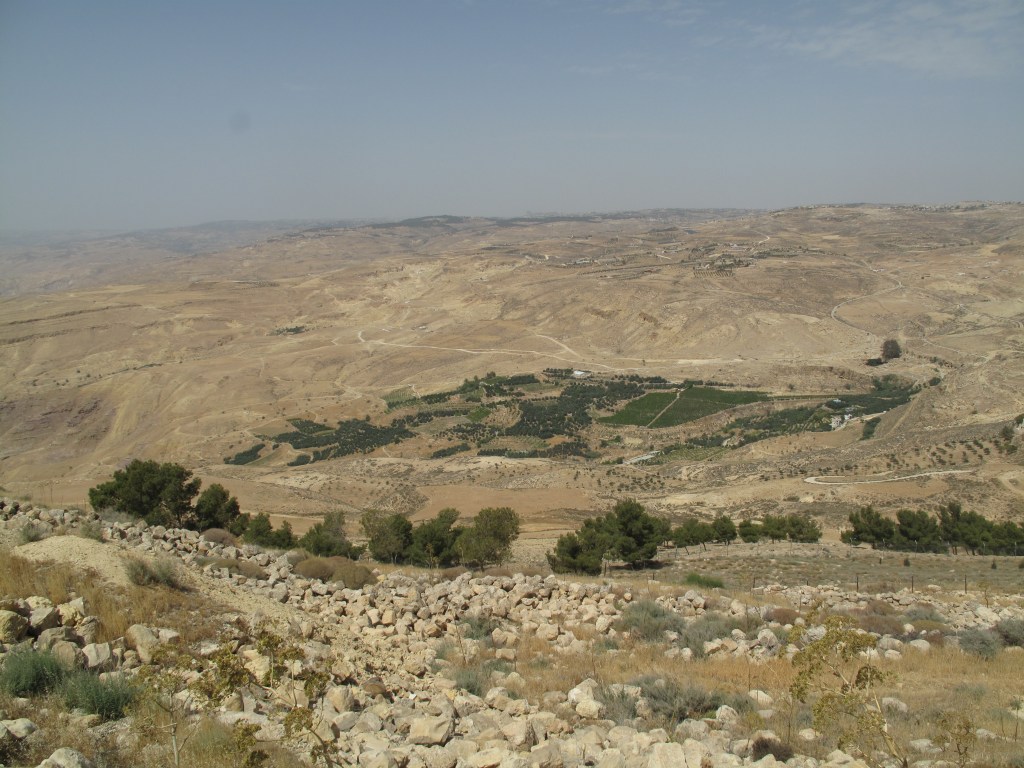
An exceptionally grueling twenty-four hours followed. On the tour of Amman and Mount Nebo before heading to the airport, I walked behind the group. Every cough and swipe of my dripping nose, I tried to conceal. Although dosed with Tylenol, upon arrival at the airport in late afternoon, I was half-dead on my feet. There followed torturous waits and multiple security checks both at Amman and later in Cairo airport. Like a notorious fugitive in flimsy disguise, I avoided eye contact and kept head down… By Allah’s mercy, in the middle of the night we boarded the EgyptAir flight back to Toronto.
Most challenging over the ten and a half hours sardined on that plane, was breathing through my mask with nostrils plugged. Even with burning bronchi, I tried not to cough. Meanwhile, throughout the flight. coughs and sneezes erupted from elsewhere in the cabin. The conscience was slightly eased by the likelihood that I had not been alone in carrying a viral hitchhiker into Canada…
I took an extra Tylenol before passing though Immigration Canada. Perhaps looking no more haggard than most oldsters disgorged from international flights, we were mercifully spared the random Covid testing…
We passed through customs about the same time as did Popsy. Even without her flag, she appeared to be still on duty. She politely smiled when we shook her hand. In the last glimpse of her, she was directing poor Harold towards the gate of his connecting flight. She had the worried expression of a peasant woman guarding the last of a brood of ducklings…
6
Back home in British Columbia the following morning, my wife tested positive. Like me, she only had mild symptoms––very likely of the then widely-circulating Omicron bug rather than of some new variant. It was a little ironic that so soon after the resumption of global tourism we should be infected by the virus which for two years, had shut it down…
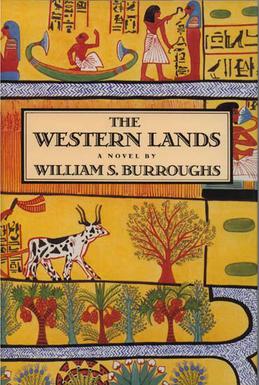
Sometime during the week of self-isolation, from the bottom of my bookshelf I pulled out the ‘Larousse Encyclopedia of Mythology.’ It was the same text I’d pored through in my early twenties. I turned to the chapter on Egyptian mythology. No other chapter had more underlining in various inks… In my early thirties, the fascination with ancient Egypt was deepened by novels like Mailer’s ‘Ancient Evenings’ and W.S. Burroughs ‘The Western Lands’. The pharaohs’ quest for immortality though the preservation of their bodies had always been as fascinating as it was creepy…
That’s largely why two destinations were placed on my tentative retirement travel list. South Sulawesi, where the Torajans make their mummified relatives guests of honour at celebrations, seemed evermore inaccessible. Yet even geriatrics on a budget could get to see the mummies and tombs of ancient Egypt.
Despite the reservations about a guided tour––in April-May 2022, I still expected to bring back more than ‘been-to’ photos and tacky souvenirs… There was even hope of gaining some insight into that state of non-being too soon to be shared with those ancient Egyptians who had gone to such extraordinary length trying to avoid it… But amid banter of long-haul trucking, Zambonis and Rolex watches––there was little space for meditation on mortality…
So apart from a blur of superficial impressions, I wondered–– what was the takeaway of that whirlwind tour?
If anything, it was the tease of what was missed. The self-guided tour I’d have planned for Egypt-Jordan would have lasted no less than six weeks. It would have included climbing Mount Sinai, snorkeling in Sharm El Sheikh or visiting an oasis in the Egyptian western desert. In Jordan, I would have spent a whole week hiking around Petra. In a visit to the Nile Valley on my own itinerary, I’d have avoided the tour bus traffic jams like the plague of Moses…
Still, given the obvious limitations of the guided tour–– I cannot deny failing to make the best of it. Yet from the first sight of Popsy’s flag, I was determined to be a stubborn old geezer. That’s how my wife would have most charitably described my prevailing attitude…
Guilty? Probably so. That stubbornness is especially indefensible given the few––if any–– travelling opportunities remain. Working legs, lungs and relative lucidly–– are certainly not to be taken for granted in the eighth decade. Still, I am not greedy. I’ve already had far more than my share of travel. I also acknowledge, sadly, that travel-weariness deepens on the cusp of decrepitude…
Would I do another McTour? That will probably be up to my wife. Anything but a cruise–– I would plead… Among my visions of hell is suffering some incapacity, after which I am booked (by well-meaning children?) on an Alaskan cruise. I see myself wheeled across the gangway of a twelve-decker wearing a Tilly hat, tied under my chin…
-2022, 2024
*Photos are mostly (however ineptly) my own–– supplemented with a few open-source photos. Supplemental images are used without any intention of violating copyright.
************************************************************************
 Coprolites in Amber (etc.)
Leave a comment