
A recent CNN interview did not pry any answers from the architect of Trump’s draconian deportation plan–– but it did reveal his character. Throughout the interview, Stephen Miller dodged questions, talked over the host and smirked. In response to Jake Tapper’s repeated queries about the impact of mass deportation on US agriculture––Miller claimed that the majority of illegals were not farm workers but welfare recipients or criminals.
Plainly, Miller’s performance was primarily for his boss––who expects nothing less than fanatical loyalty from his first-order bobbleheads. Yet the prime impression was that Trump’s Deputy Chief of Staff is an arrogant 39-year-old teenager…
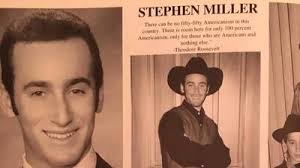
As a student at Santa Monica High in the late 1990s, Miller once spoke publicly against a school directive requesting students not to leave messes at the cafeteria tables. That speech is captured on video. A smirking Miller insists that students have every right to refuse doing ‘work’ which immigrant cleaners were paid to do… The teenage Miller was also known to pester students conversing in Spanish while demanding they switch to English.
Growing up in a conservative family in SoCal suburbia, perhaps his earliest contact with Latinos was through the services of maids, gardeners or cleaners. Seeing Latinos in subservient roles in early childhood may have fixed in him an impression of their social inferiority. He may even have been nurtured to regard privilege as his birthright. That could account for a predisposition that hardened in reaction to a laid-back high school environment in ‘liberal’ California.
Miller himself claims his passion for conservative causes was ignited by the NRA gospel he absorbed in his early teens from reading ‘Guns Crime and Freedom’ (1994). Yet it was animus for the migration of ‘undesirables’ across the southern border that would become his obsession…
About two decades later, whether by luck––or by uncanny political intuition––Miller hitched his destiny to Trump. As Oval Office advisor in the first Trump administration, the odour of Miller’s influence was unmistakable in one of his boss’s earliest executive orders: the Muslim travel ban. (Exceptions were made, of course, for the states with Trump family business ties).
Miller has also served his master as a speechwriter. He is the phrasemaker of some of the most toxic rhetoric Trump has used since descending the golden escalator in 2015. “Vermin… poisoning the blood of our country,” a description of undocumented immigrants made by Trump during his 2024 re-election campaign, bears the Miller imprimatur. Whether intentionally or otherwise, those vile words could have been directly lifted from a speech by Adolph Hitler.
Many commentators have pointed out the irony that among Miller’s forebears are Jewish immigrants who escaped the pogroms of eastern Europe. One would think anyone who has such family history (and a beating heart) would show a little empathy for the modern-day “huddled masses yearning to break free…” Not Stephen Miller. For someone with his attitude, any comparison of Ashkenazi Jews with refugees crossing the Rio Grande would be preposterous. One can imagine his smirking rhetorical response: ‘Did the dregs of the third world or European go-getters help make America the greatest nation in the history of the world?’

Miller may feel that ridding America of illegal aliens is his righteous duty. He may even sincerely believe he was divinely chosen for that mission at a critical moment of his nation’s history. On the other hand, he may be exactly what he appears to be: a cynical xenophobe and racist. If the latter–– I still wonder about the prima causa.
It would be revealing to know whether little Stephen first heard negative comments about non-white immigrants from either of his conservative parents. Even if he hadn’t––a child who grew into such a racist teenager, could not have fond memories of first whiffs of Mexican food, or the first incomprehensible sound of Spanish. Perhaps at the poolside or outside his garden utility shed he was repelled by the sweaty odour of migrant labourers.
One need not review Sociology #101 to recognize how bigotry emerges from ignorance and fear of a tribe/race perceived to threaten one’s own. A child does not naturally feel fear in first encountering those who look or act differently from its kind. Yet a negative reaction is far more likely when notions of danger have already been embedded. Added to that might be some incidental impression of coarseness or dirtiness.
Like the roots and branches of William Blake’s “poison tree”, the revulsion unchecked–– grows deeper and spreads wider. Racism can be embedded in the very roots of a culture. A people can even regard their supposed superiority as a divine dispensation. That toxic belief can lead to the wreaking of revenge in exponential orders of magnitude. That has been horrifically evidenced in the recent war in Gaza…
I have long taken the view that ‘race’ is not a biological feature–– but is a social construct. At the same time, I like to believe that I was never infected by the virus of racism. I have never assumed that due to some higher moral endowment. Had I grown up in Israel or in white Rhodesia–– I probably would not have resisted the endemic racism of my tribe––which only a few heroic individuals are able to do. Had I been a student of Santa Monica High at the time of Stephen Miller, I cannot even be sure that I would have been bold enough to boo his speech…
Yet I do feel lucky to have come of age at a time and place in which immigration or race were not even issues:
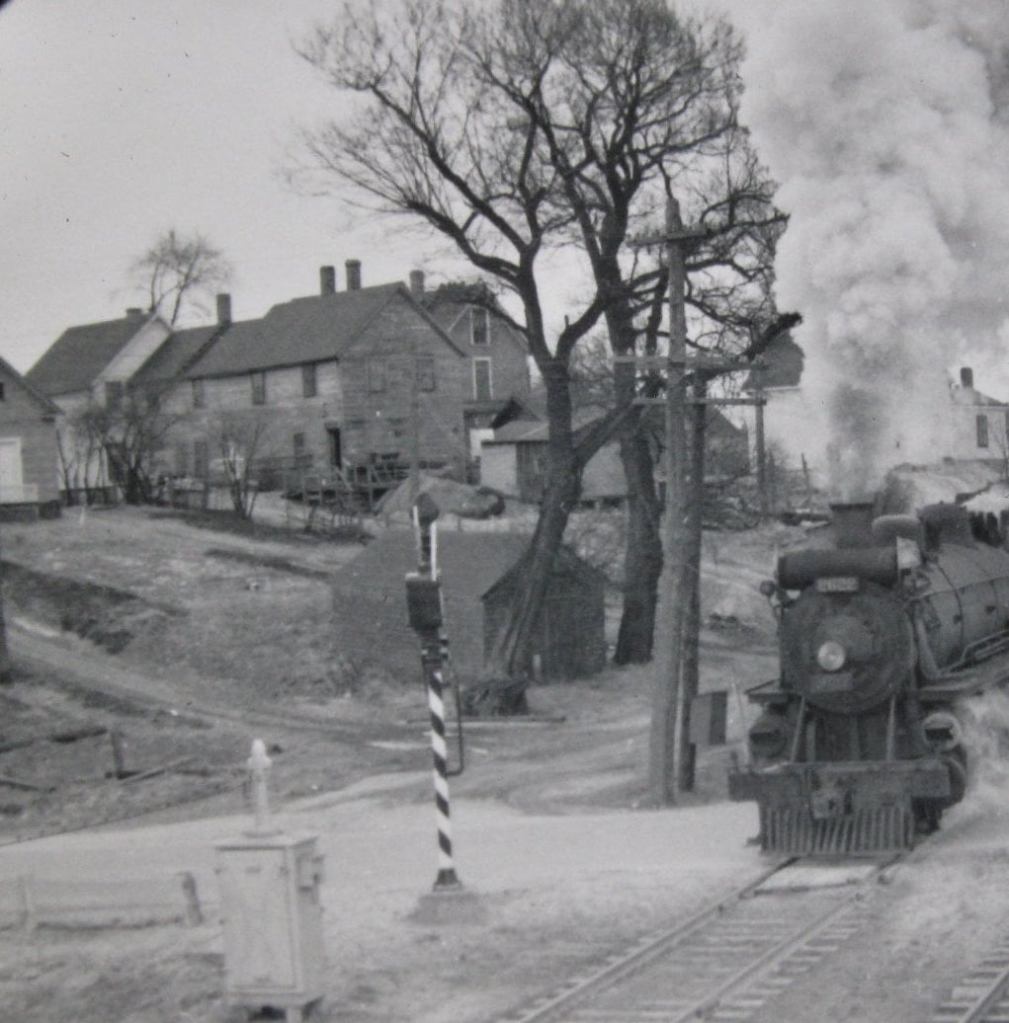
In the declining village in southwestern New Brunswick where I grew up, ‘race’ primarily referred to running fast. Since everyone was white, skin-tone had nothing to do with identity–– let alone an identity supposed under threat from hostile invaders. In the same era (1950s-1960s) immigrants would have been welcomed–– had there been any work to be had.
Despite the ongoing economic decline, six decades ago there was a rough social equality in that village. Some Protestants felt superior to Catholics, and the Anglo majority felt superior to the French–– but there were no Brahmins or overlords. Most families with a steady income had a modestly comfortable standard of living.
That was largely due to the union jobs in the railroad shops. While the railroad operation (by which the village had come into being) gradually closed down, the village still remained on life support. That was through government subsidy and a scattering of other jobs such as those on the nearby Canada border post where my father worked. In a relatively low-cost area–– along with the providence of gardens, fishing rods and rifles–– almost any regular income supported a decent living.
Of course, the chronically unemployed (and unemployable) did not all share in that decent living. Moreover, unlike in most dying towns–– the jobless were not all given to moving on.
The most rooted among the village’s poor were marked by ills similar to those of their hillbilly cousins in rural Appalachia. Large broods headed by a shiftless father or an obese single mother lived in ramshackle houses in the village’s “tough end.” The ragamuffin kids who attended school were often two grades behind. When their knees grew too big for the desks, the boys disappeared and the girls got knocked up, maintaining the inter-generational cycle…
So, the village did have an underclass––one which unconventionally shared a common ancestry with those who looked down on them. Indeed, the more fortunate village majority tended to regard the unlucky minority with self-righteous pity and scorn. That was not racism–– but it certainly was bigotry.
For a few years, I was undeniably infected with it.
Up until about the age of eleven, I had the notion that there were two species of poor people–– the virtuous and the slovenly. The former used their few resources wisely and raised themselves up. The latter preferred to live on handouts. I believed the gossip about certain slovenly women spending their welfare cheques (whatever that was) on booze rather than on food and soap. I even perversely supposed that certain families enjoyed wallowing in dirt…
Their very surnames seemed to have a foul odour. One of my elementary school teachers, wrinkled her nose when calling out the same names of the waifs who were often absent. In my own home, I had heard the names of certain families spoken with a shiver of disgust. Meanwhile, I had no doubt that my surname had a clean smell…
With absolutely nothing to be snobbish about–– I was an odious little snob. Yet between the age of ten and eleven, two events rattled my little brain and led to the dislodging of the virus:

During a bitter-cold snap in January of 1961, the sewer pipes under my family’s house froze. The taps and the toilet were unusable, and the stink of sewage permeated every room. The smell even got into the blankets.
Not alone is that predicament, we had to to wait for a few days before the village sewer crew backed an iron boiler on wheels into our driveway. When they fired up the black boiler, the smoke of burning coal mingled with the stench in the icy air.
Soon thereafter, the crew of three dragged a hose right into the open front door. In dirty boots they tracked across the kitchen linoleum and pushed the hose down the trapdoor of the root cellar. From the top of the cellar steps, I watched as they hosed steaming water over the drainpipe connected to the upstairs toilet.
From the top step, Herman M. (a pseudonym), the head village sewer man, surveyed the two younger men directing the snaking hose. At that time, Herman was about sixty–– rotund with piggish eyes. He was dressed in blue overalls and a greasy duffle coat. Motioning with the stem of his pipe, he gave his underlings gruff orders. I shuddered in being so close to the fellow with the dirtiest job in town. Standing beside a caveman would have been less unsettling.
Suddenly, the thawing drainpipe burst open. In a wallop of stench, a yellow brown slurry belched onto the bare ground. Herman looked over at me with a chuckle. He seemed amused that I was cowering…
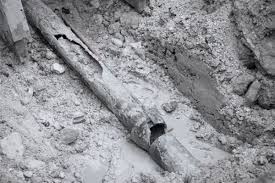
Afterwards, the crew had to dig a trench outside in the frozen ground to replace a burst pipe attached to the septic tank. I can’t remember how long it took for the stink to disappear. But after the sewer-men had departed, I recall my father complaining:
“Old Herman expected me to drop a five-dollar bill right there in the trench,” he said. “And him gettin’ paid by the town. Who ta Christ does he think he is?”
I assumed that my father was offended that someone in such filthy clothes should expect to be tipped. But the plumbing was working again––so gratitude seemed due. More disturbing than my father’s stinginess was feeling indebted to someone like old Herman. Especially unsettling was having needed his help for something so embarrassing…
Most unforgettable was Herman’s little wink when the sewage was gushing from the drainpipe: ‘You see, Master T.,’ his piggy eyes seemed to tease, ‘your shit stinks, too!’
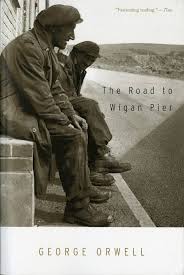
That stark memory reminds me of a reflection of George Orwell in ‘Road to Wigan Pier’ (1937). He writes of a boyhood experience of travelling in a railway carriage, squeezed among “navvies and pigmen.” When they pass around a bottle of beer, he dreads it coming to him: ‘If I drank after all those lower-class male mouths, I felt certain I should vomit. I cannot describe the horror I felt as that bottle worked his way toward me…’
Orwell reflects that his revulsion to “lower-class dirt” rubbing off on him revealed a deeper anxiety. He believed that in his childhood, he was infected with an unnamed fear: that of slipping down from the lower-middle class into the next lower rung. That lower rung was the working class …
During the early 1930s, he sought redemption from that inbred fear by “going native” in his own country. He lived in frowzy boarding houses and even among tramps. In having to adjust to the lack of indoor heating and plumbing––he no longer associated the sweat and grime of the poor with carelessness about hygiene. Most importantly, he discovered the essential decency of fellow Brits of the working-class.
I would like to believe that I too, experienced a kind of redemption from a childhood prejudice against a ‘class’ of fellow natives. Rather than through deliberate immersion, mine seemed to come accidentally. The shock that uprooted my childhood bigotry came just over a year after the first one. The actual date was determined in a recent check of listings in a New Brunswick cemetery:
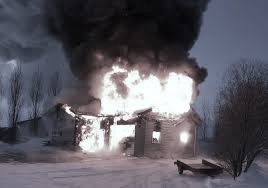
One February morning in 1962, I was on my way to the village skating rink when thick smoke began to billow from a roof just over the train tracks. With ice-skates clacking over shoulder, I ran though the railway underpass to get a closer view of the fire. A small crowd was gathering on the pathway below the burning shack. Orange flames were enveloping its roof and licking from the windows. The tar-siding was hissing as it bubbled. On the other side, the volunteer fire crew was unrolling the hose from the firetruck. Mercifully, no one was trapped inside the house.
In the midst of the onlookers was Herman M. From murmurings, I gathered that the burning house was his. I kept glancing over at him. He was watching dumbly with arms folded. Hatless, his bald head and usually ruddy face, looked strangely white…
I was looking at the fire when a cry went up. Someone yelled to clear a space. Before jumping back, I glimpsed Herman lying in the snow. A man in railroad denim was kneeling down, cradling his head. Herman’s eyes were closed.
Seconds later, a woman burst through, screaming. It was his adult daughter. She fell sobbing on her father’s chest. Lifting up the sleeve of his red wool jacket, she wound something around his wrist. I was not Catholic but guessed the something to be a rosary.
The man holding his head shouted for someone to get the priest. Two older boys took off breathlessly towards the Catholic church at the top of the hill. Moments later, the black-garbed priest, holding one boy’s shoulder to support himself, was edging down the slippery path…
I can’t recall whether I turned away in response to censoring words––or had enough sense to exit the scene without being told. Catholic or non-Catholic–– any boy should have known better than to gawk at someone receiving his last rites…
Soon afterwards at the skating rink, I heard that Herman had died of a heart attack––right there in the snow outside his burning house. Before hearing that, the epiphany had already come to me. Herman M. had become the first villager with a foul-smelling name to be revealed as fully and equally human… It did not require another death for the same revelation to be gradually applied to all the others…
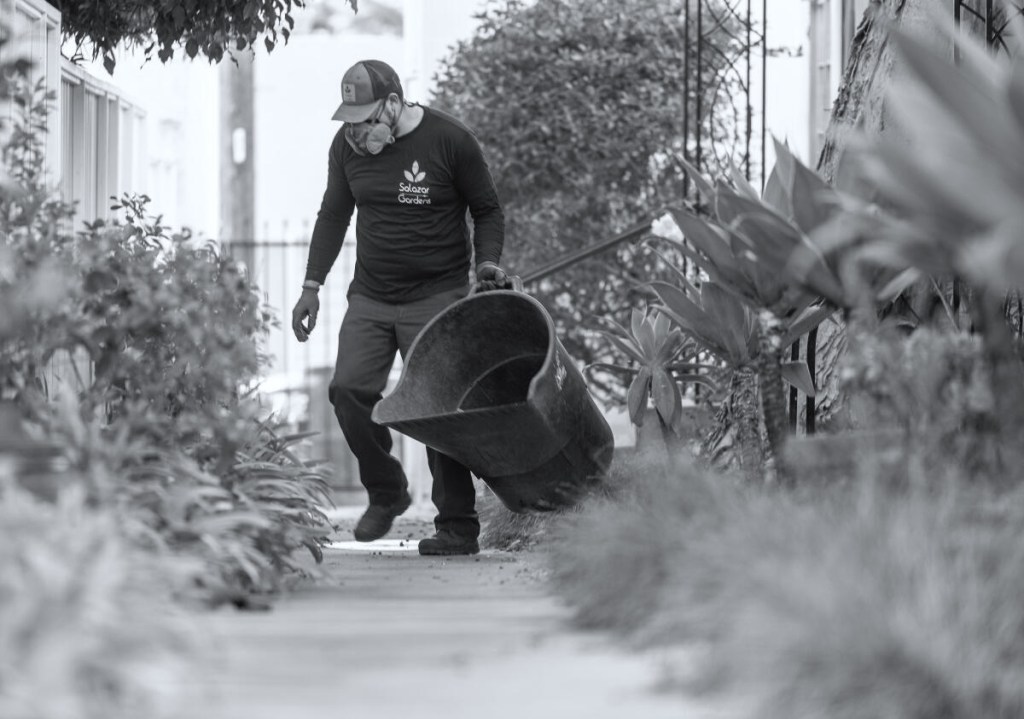
Those recollections lead me back to Stephen Miller. The potential impact of the bigotry at the core of just one person is breathtaking. Miller’s animus against poor immigrants is now potentially devastating to the lives of millions. Yet even more breathtaking it is to consider how fate turns on a dime…
What if little Stephen had had a special fondness for empanadas prepared by a family cook? What if he’d been separated from his mom in a shopping mall then reunited by a kindly Latino security guard? What if he’s been struggling in the deep end of the pool before being pulled out by a yard cleaner? What if he’d witnessed a Latina housemaid collapsing with a seizure?
A thousand such little scenarios can be imagined. Any one of them could have revealed to Stephen Miller his common humanity with those less advantaged by birth. But that was not to be…
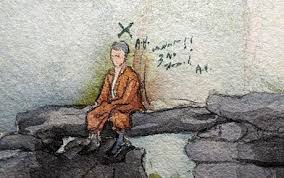
In thinking more broadly about how some incidental nipping of a toxic bud would have changed the course of history–– there comes to mind Adolph Hitler:
There has been much speculation about the origin of his virulent hatred of Jews and Slavs. The most plausible one by my reckoning is Hitler’s first encounter with ‘foreign looking’ people in Vienna–– where he first experienced city life. He probably had a visceral reaction to passing Orthodox Jews on the street. They spoke his native German but probably looked sinister to the insecure young villager trying in vain to succeed as an artist. Out of one little man’s fear and revulsion grew the germ of hatred that would engulf the world…
In some alternate world of the multiverse, one might imagine young Adolph, stumbling drunk across a Viennese street, right into the path of a speeding streetcar. Suddenly, he is pulled back by a stranger. The alternate Adolph then looks up into the concerned eyes of a bearded man in a fur hat, dressed in black…
In that instant, that alternative world is sprung into a fundamentally different trajectory than this one…
-2025, February
 Coprolites in Amber (etc.)
Leave a comment