Among the many despicable plans of the Trump administration is the proposed gutting of American public broadcasting services. The MAGA Republicans charge that PBS and NPR couple bloated budgets with “liberal bias.” Even Big Bird of ‘Sesame Street’ is suspected of being a “woke socialist.”
It is not surprising that hard-line conservatives in Canada have copied big brother in hurling similar charges at our own national broadcaster. Fortunately, the call to “defund the CBC” has not yet gained much political traction. Still, it may well be that a majority of those who defend the Canadian Broadcasting Corporation as a cherished institution are no longer tuning in…
Since the mid-1930s, radio transmissions of the CBC have blanketed the dominion from its east-west necklace of cities to its far-flung hamlets of the far north. It has aimed to reach even the most isolated Canadians with programming that “informs, enlightens and entertains.” In the decades before satellite and internet, CBC was often the only signal on the AM radio band for rural Canadians. In driving through empty stretches of highway, that one voice on the radio dial could be an articulate companion or a yappy hitchhiker. Today, there is a universe of alternative voices to tune into even on the loneliest drives…
For many years, I was a CBC radio addict. Except when living overseas, from my early twenties until retirement hardly a day passed without at least one fix of it. In early years, I set my clock radio to wake to the CBC news and set my watch by the long dash of the daily National Research Council time signal. In later years, my car radio was perpetually tuned to CBC AM. Although its voices sometimes irritated, I rarely switched off.
Rooted in college days, my CBC habit grew in 1974 upon transplanting from the east to the west coast. For the first months in my adopted Shangri-La (AKA Vancouver), CBC radio served as a reminder that I was still in Canada. When I wasn’t shelving books in the downtown public library (my first job), I was staring at my ceiling of my single room listening to 690 on the AM band. More than once, the volume elicited bangs on the wall from a cranky girl in the same rooming house.
In those first weeks in a new city, CBC radio served as a less dismal refuge from loneliness than pubs or shopping malls. Turning on the radio momentarily lifted the mood–– rather like the effect of whiffs of perfume at the portals of a shopping mall. After entering a mall, the tweaks of stimulation usually give way to a gloom deeper than the captivity of dingy walls. Unfortunately, a surfeit of CBC radio was not always less depressing than a visit to a mall…
A favourite program in 1974 was the CBC Vancouver afternoon show, ‘Three’s Company.’ The main attraction was the alluring voice of its female co-host, one Ann P. About a year later, I saw her in person at a poetry reading at a union hall in East Vancouver. Frizzy haired and in tight jeans, she was even more desirable than imagined. In a grim coincidence, that poetry reading in September 1975 would be remembered for the disappearance of poet, Pat Lowther, who had been scheduled to read. Her husband, who gave a reading at the session, was soon thereafter apprehended for her murder…
That same fall, I had hopes for creative writing. I was temporarily living on unemployment insurance benefits in a two-room bedsitter with an electric typewriter under a towel on the kitchenette table. By that time, my default CBC station had shifted from the AM to the FM band. Classical music was thought more edifying than talk radio. It also served as background to reading the musty Penguin literary classics gleaned from second hand bookshops.
Between reading and staring into space with CBC FM in the background, the towel was seldom lifted from the keyboard. Pachelbel’s Canon–– the closing theme of Bob Kerr’s ‘Off the Record’––still has vaguely guilty associations…
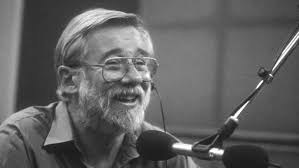
Procrastination through CBC radio began in college years in the earlier 1970s. When term paper deadlines were looming, too often I succumbed to the low-key charm of Peter Gzowski, host of ‘This Country in the Morning’. Twenty years later, I was still blaming him for my mid-morning laziness. Whenever at home for whatever reason at 9:10 AM on weekdays, it was always easier to turn on the radio than to get my ass into gear.
Still, I recall several engaging moments with Gzowski over the years: such as when he choked up in 1973 when memorializing the tenth anniversary of the JFK assassination. Then there was his boyishly effusive interview with Leonard Cohen in 1994 on the legend’s sixtieth birthday. I cannot remember exactly what I was putting off on either of those mornings, but no doubt, I was guiltily fidgeting…
Among the culture shocks upon returning to Canada from Africa in 1988 was tuning into ‘Morningside.’ Until that moment, a decade away had seemed like a century. But Peter Gzowski’s breezy banter––drearily familiar as if heard the day before––reminded of how little had changed…
Such guilty associations were not exclusive to weekday morning programming. At 6:10 PM on workdays through the 1990s, my lesson planning was often interruption by the jazzy flute of Moe Koffman. Thereupon followed at least an hour’s distraction by Barbara Frum’s: ‘As It Happens’. Similarly on Sunday mornings, when I needed fresh air, too often I fell captive to Michael Enright’s ‘Sunday Edition’…
Yet no CBC programming has more dreary associations than that of Sunday afternoons of the early 1990s. In those years, my low seniority at the college where I would work until retirement usually assigned me to teaching ‘survival’ English classes. Preparation for my own survival through the gruelling weeks fell upon the weekends. Too often I put off that mindless work until Sunday afternoons––about the time of ‘Cross Country Checkup.’ Unfortunately, there was less dread in listening to Rex Murphy, the pompous Newfie host, than in cutting up pictures for teaching aids.
On those Sunday afternoons when I was especially keen for self-punishment, I continued listening beyond the 4:00 PM news. That was the start of ‘Writers and Company’ in which the host, Eleanor Wachtel, engaged in precious conversation with literary guests. Her plumy voice was one of those which tend to kill high-schoolers’ interest in book-learning…
Indulging in middlebrow rather than lowbrow distraction afforded no more consolation than listening to radio rather than watching TV. ‘Cross Country Checkup’ was certainly more informative than ‘Hollywood Squares’––but no more, it seemed, than Cheerios is a better breakfast choice than Froot Loops…
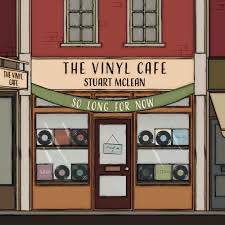
In late January 2002, along with legions of CBC listeners, I was touched by the tributes to the late Peter Gzowski. He was lauded as one of those Canadian talents who had resisted the seduction of a bigger career in the USA. Particularly memorable among the tributes was that of his former protégé, Stuart McLean. At the time of Gzowski’s passing , McLean had already established his own CBC radio creds with ‘The Vinyl Café’. His popular variety show would continue nearly up until his own untimely death in 2017.
I caught only a few episodes of ‘The Vinyl Café’ and none in entirety. What I did hear sounded rather like a Canuck version of the NPR’s ‘Prairie Home Companion’, hosted by Garrison Keiller. MacLean’s ‘Dave and Morley’ stories were in the same folksy humour vein as Keiller’s ‘News from Lake Wobegon’ anecdotes. He even seemed to imitate the Minnesota drawl. But for many CBC radio listeners, McLean was a veritable Stompin’ Tom Connors of storytelling: a true-blue Canadian authentic…
In eulogizing Gzowski in 2002, McLean recalled an episode in which Gzowski had a giggling fit after blowing cigarette smoke at a “sleeping cricket.” That anecdote seemed typical of CBC radio humour: innocuous but lame. Sometimes wincingly so…
In that regard, the ‘Royal Canadian Air Farce’ (1973-1997) comes to mind. Its troupe of would-be satirists mimicked the voices of Canadian politicians. Perhaps due to a limited repertoire, they did recycled spoofs of Pierre Trudeau and Joe Clark long after the departure of both from the political scene. The troupe’s longevity seemed to be more about securing their CBC pensions than pleasing audiences. Another CBC radio political satire offering from the same era was ‘Double Exposure.’ Performed by the duo of L. Cullen and B. Robertson, their repertoire of voice impersonations was wider and the topics more current than that of the Air Farce. Perhaps my more positive impression of their show has much to do with its time slot on low-stress Saturday mornings…
In any case, these impressions are fossilized from the 1990s. Although I do recall hearing ‘The Debaters’ on the car radio in the last final years before retirement, I am unaware of the current fare of CBC radio comedy. With or without voice impersonations, I hope that politicians are still fair game. Lampooning of leaders in publicly funded broadcasting is something to be cherished.
As for the uneven quality of CBC political humour: the material has never been easy to work. As stereotype has it–– Canadians––including our politicians–– are seldom flamboyant as are notable neighbours to the south. That is not to deny there have been quiet eccentrics like Prime Minister Mackenzie King (1874-1950) who fancied seances for communing with his dead mother. But there is no record of a Canadian pol fulminating against ‘enemies’ in the middle of the night from the seat of a golden toilet. Perhaps Canadians should be grateful for duller politicians even though they make for lamer jokes…

Except when living outside Canada, my main source of daily news until retirement was the CBC radio ‘World Report.’ It was often a tense reliance. My cursing at the radio became louder and more frequent over the years. Comments on CBC reportage pepper my journals––expressing a range of reactions from annoyance to rage. The issues that provoked my reactions are legion– but these few (chosen at random) are typical:
In 2000, I closely followed news and commentary about the mob invasions of white-owned farms in Zimbabwe. Having lived there in the 1980s, I knew that redress of the historical inequity in land ownership was overdue. Yet I was certainly not alone in foreseeing that a land-grab by Mugabe government cronies would result in a collapse of the country’s commercial agriculture.
When CBC radio followed up a report of violence against white farmers with an interview of a Zimbabwean post-graduate student in Toronto, I perked up. For upwards of fifteen uninterrupted minutes, the student spouted Mugabe-style screed. “We appreciate your shedding light on the situation,” said the female interviewer. She was either too polite––or too charmed–– to challenge him.
Even more patronizing was a 2012 CBC report dealing with teenage aboriginal fathers in Saskatchewan. A 15-year-old whose 13-year-old girlfriend had given birth, was described as “waxing Shakespearean in his joy.” Nevertheless, the boy reportedly made little effort to see the mother or his baby daughter thereafter. The tragedy, according to the reporter, was in the shortage of funding for counselling the boys to become “better dads.” Avoided was any mention of how education in birth control (for boys who can’t keep it in their pants?) might prevent the heartbreak of children bearing children. But might such hard truths offend communities presumed too ‘sensitive’ to bear them? There were several such boats CBC reporting never dared to rock…
No CBC reportage grated me more than its coverage of Israel/Palestine. Especially beginning in 2000––when Ariel Sharon stirred the hornet’s nest and set off escalating cycles of attacks and revenge––CBC reporting made little pretence of impartiality. Not that tragedy is quantifiable–– but in the political economy of journalistic attention–– a Palestinian victim’s life was effectively valued at less than a tenth of that of an Israeli’s.
By the mid-2000s, CBC had followed American networks by moving its bureau from Tel Aviv to Jerusalem, as if in acceptance of Israel’s (disputed) claim to its ‘holy city’ capital. Almost every report filed thereafter ended with “Mike Hornbrook in Jerusalem”–– which I took as a taunt by the pro-Israeli bureau chief. His voice often sent my blood pressure soaring, but I rarely switched off…
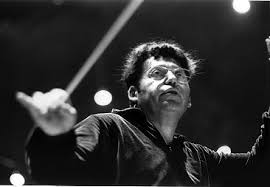
Against all such grimness, I recall the pleasure of programs like ‘Ideas’–– one of the longest-running shows on CBC radio (1965-present). The 10:10 PM start was usually after my bedtime but over the years, I managed to catch many fascinating discussions. When on late shift (periodically from 1990s-2010s), I would listen while driving home–– then catch the rest of the episode on the kitchen radio. On the following mornings, I sometimes made notes of my impressions:
For example, in a 1997 reference to a discussion of the ideas of eminent critic, Northrup Frye, I wrote: “In the squelch of windshield wipers, I hung on to his every phlegmy word…” In reaction to an ‘Ideas’ interview with Richard Dawkins in 2007, I noted: ‘Thrilling it was to hear “Darwin’s Rottweiler” heaping scorn upon “the petty and parochial god of Abraham…”
Another excellent program was ‘Quirks and Quarks’ which covered topics ranging from anthropology to zoology. Scheduled around noon on Saturdays, the fascinating interviews of scientists by host, Bob McDonald, held me in the kitchen long after lunchtime. More than one report on cosmological discoveries had me heaving with regret for my mickey-mouse English/Philosophy major…
Yet even the most stimulating talk on CBC radio did not compare with the pleasure of its music programming–– especially on the FM service. While I appreciate Jazz only to the extent of enjoying it low in the background, CBC FM offered Jazz uninterrupted by commercials or tedious talk. Programs such as ‘After Hours’ are remembered for accompanying summer nights in the 1990s under stars on the deck of our coop unit on Burnaby Mountain. In the same era, ‘Saturday Night Blues’ taken with a few beers also comes fondly to mind. Admittedly, something is revealed about the marriage of a man who sat up alone listening to radio, late into the night…
While I first came to CBC FM to escape AM chatter–– I stayed mostly for the classical music. There was some talk–– but it was brief and illuminating. Hosts such as Jurgen Gothe, of ‘Disc Drive’ and Bob Kerr (previously mentioned) of ‘Off the Record’ shared their encyclopedic knowledge of music in a soothing fashion. It may have been Kerr’s afternoon program that inspired a sublime moment in November 1996 about which I made the following journal entry: ‘Before a pale yolk autumnal sun, a Mobius ring of blackbirds twisted and undulated to the strains of Liszt’s Hungarian Rhapsody…’

For decades, I kept to the habit of starting my days with the early morning news on CBC AM. Yet in the months before retirement, I took pains to switch off before the start of the local morning show. It was not the innocuous interviews of the ‘The Early Edition’ I had come to dread –– but it was rather the very voice of the program’s long-term host.
He always opened his show with a cheery greeting. Yet many times before that initial utterance, there was the sound of a nervously drawn breath. As much as he crowed about loving his job–– I became convinced that he longed for retirement as badly as did I.
He was about my age. His voice was first identifiable as the CBC sports reporter based in Toronto. When he took over ‘The Early Edition’ in 1997, I was probably not alone among regular listeners incredulous that a jock from back east could be suitable for the Vancouver morning show. His primary qualification appeared to be CBC seniority.
Yet over the next few months, he seemed to reinvent himself for a west coast audience. He retained a jock affability but became politically correct to a fault. Perhaps I was alone in suspecting that was a façade. I even suspected he was counting the days until his pension fattened enough for a bail-out.
Which of us would outlast the other began to feel like a competition. A few times, he had joked about the lure of retirement. I kept hoping for his announcement–– but he hung on. When I decided to jump on an early-departure incentive, he was still going strong. The morning in late 2014 after I made my decision, I could no longer bear listening to ‘The Early Edition…’
He did not retire until 2017. I got that information on the CBC online news site. His final days on ‘The Early Edition’ were apparently filled with tributes by his audience and surprise celebrity guests. I felt a little envious reading that… Then in July 2024, came the shock of an obit, also posted on the CBC news site: ‘Beloved Vancouver broadcaster has died.’
Sadly, Rick C. got only seven years of retirement. Heart disease and cancer took him at the age of seventy-three. Tributes on several Canadian news sites noted his long career, his charitable contributions and love of family. My reformed impression was that he lived primarily for his work at CBC radio. I was appropriately shamed.

My morning habits have not much changed with retirement. My day still begins around 4:45 AM with a cup of strong tea and the morning news. Just as it was during my overseas sojourns, my news-source of choice is now the BBC. Yet I do not depend on short-wave radio as I did in Africa. My current connection to the BBC World News is through an iPhone connected to the internet and played though Bluetooth-connected hearing aids. We still have a kitchen radio, but it is no more used than the postage stamps in the drawer beneath it. Even on the car radio, I no longer listen to the CBC.
While I scroll daily through the CBC news website on my laptop, the only CBC broadcast news I hear is a five-minute podcast occasionally called up on our Amazon Alexa Dot speaker. The voice command is: “Alexa, give me today’s news.”
So, the question is raised: what is the future of public broadcasting? In the era of podcasts and internet streaming, perhaps over-the-airwaves broadcasting has become as outmoded as letter writing since the advent of email…
Still, it is hard to ignore the growing threat posed by corporate media which manipulates consumers like junkies–– wiring them to their algorithm-selected content. Even pushed to the periphery, media not driven by profits and private agendas might preserve some measure of comity amid the social fragmentation. That is as long a willingness to fund public media is still shown in polls…
The survival of CBC–– born of twentieth century technologies and ideals–– depends on adaption to twenty-first century technologies and realities. Fortunately, in some fashion it has begun to do so:
CBC is increasing offering its more popular programs in the form of podcasts. Lately, I have been listening to the ‘Front Burner’. That podcast delves behind topics in the news in a format similar to that of the ‘Daily’ of the ‘New York Times’. Even as a hinterland imitation, ‘Front Burner’ is a decent alternative to the metropole model. CBC perennials ‘Ideas’ and ‘Quirks and Quarks’ are also now linked to internet platforms. On ‘Spotify’ about a dozen CBC podcasts are available. With rapidly depleting time now rationed, I will probably not check out them all. Still, I wish them all well–– even those like ‘As it Happens’–– with its past associations ensuring my avoidance.
It is sobering to be reminded that the world of my youth is now as distant as was the Victorian era at the time of my birth. The time when CBC radio was “Bringing Canada together”– its slogan from the 1970s–– is now that distant from the present.
Yet even back then it was hard to believe that the voice of Peter Gzowski, was bringing together in a common spirit fishermen in Newfoundland, wheat farmers in Saskatchewan and homemakers across the breadth of the dominion… Even then, I suspected there were a lot of listeners like me––reluctantly drawn in while avoiding something more important…
Still, idle young men today find on the internet–– far more insidious company that anything radio ever broadcast. Having been spared the internet in my youth–– I offer this sincere tribute to even the most dreaded ghosts of CBC AM…
-2025, June
 Coprolites in Amber (etc.)
Leave a comment