1
It can be revealing to recall the evolution of one’s political persuasions. For example, my early notions about Cuba were formed in utter ignorance of facts:
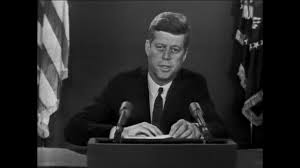
The country came first to attention through the historic address of President JFK watched live on TV in October 1962. Kennedy announced that the Russians had sneaked nuclear missiles onto an island, the name of which the sounded like “cuber” in the presidential accent. Kennedy warned that the missiles could strike: “…as far north as Hudson’s Bay, Canada.” Like many 11-year-olds of the era, my imagination was already rife with images of enveloping mushroom clouds. For weeks thereafter, there was hardly a waking hour without some thought of air-raid sirens, fallout shelters or the imagined blinding light in the instant before evaporation…
Of course, the world survived the Cuban Missile Crisis. As it faded from the news–– the impression was left that the Russians were not solely to blame for pushing the world to the brink of annihilation. From snippets of overheard adult opinion, I gathered that the real culprit was Fidel Castro–– the bearded communist in charge of Cuba.
Not long thereafter, his name came up in regard to a sudden hike in the cost of candy bars. In reluctantly handing over a dime for a chocolate bar which formerly cost five cents, I asked the bulldog-faced clerk at the village variety store if the new price was temporary. Shaking his head, he pointed to the magazine rack: “Cost of sugar’s way up,” he said gruffly.“You can blame Castro for that!”
That may have been in the same month in which a cover of the weekly tabloid, ‘Midnight’ (seen in the same magazine rack), featured Castro. Above the photo of the man who narrowly failed in blowing up the world–– but succeeded in doubling the price of candy bars–– was the headline: ‘Confession of Castro’s homosexual lover!’ I was not sure what was being insinuated but supposed some depravity even worse that communism…
A first glimmer of cognitive dissonance about Cuba came a few years later. A news story in the provincial ‘Telegraph Journal’ reported that a cargo of Canadian wheat bound for Cuba had been strewn with broken glass. Under the heading ‘Sabotage?’ the article speculated about how the shipment in Montreal harbour came to be contaminated. A spokesman for the Mounties said the sabotage was likely the doing of some unknown group, hostile to Canada’s trade with Cuba. Someone working in the docks said it could have been “the CIA…” In the first exposure to that sinister-sounding acronym, it occurred there was a lot more about the CIA and Cuba I ought to know…
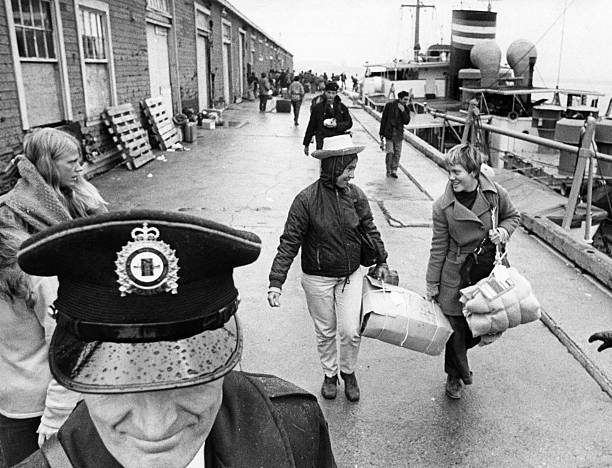
In February 1970, a Cuban freighter docked in the harbour of Saint John, New Brunswick, came momentarily to international attention. Cuban ships were not uncommon in the commerce of that east coast port–– but along with its regular cargo, the Luis Arcos Bergnes had ferried more than two hundred young Americans back from Cuba. They belonged to the Venceremos Brigade–– an offshoot of the leftist Students for a Democratic Society (SDS). The Venceremos volunteers had reportedly spent several weeks cutting sugarcane and learning about Cuban socialist culture “in solidarity with the Cuban revolution.” An even larger group of fresh volunteers would depart for Cuba on the same ship.
On that afternoon I was attending high school, just a few blocks from the scene. Having read newsletters of the SDS chapter based at the provincial university, I was keen to check out the buzz. After classes, I headed uptown.
Greyhound buses lined the curbs as arriving volunteers mingling with those returning from Cuba. Many were hunched under heavy backpacks. Despite the winter chill, a few sported straw sombreros. I had never seen so large a crowd nor one so excited…
Spotted on the periphery of the Venceremos hive were well-dressed men, a few of whom looked conspicuously tanned. A few others appeared on the side street near parked cars with American license plates. Only later did I connect those sightings with reports of a contingent of FBI agents in town–– monitoring their fellow Americans… Yet most memorable from that afternoon were two encounters on my way home:
As I was headed up King St. to catch the suburban bus, a trio of Cuban sailors chatting together in Spanish were ambling down. In my double-take, a Black sailor in grey wool hat, greeted me with a booming “hola.” We both briefly stopped up.
“Welcome to Canada,” I said.
Reaching into his pea-jacket pocket, he fished out a cigar–– proffering it with a grin.
“Gracias, senor,” I accepted it, then mimicked smoking with gusto. Lacking any more Spanish, I asked: “You like Castro? Good man?”
He looked embarrassed. At the same moment, his two comrades waiting further down the sidewalk, called him to move on…
Minutes later at the bus station, I sat across from a returning Venceremos volunteer, waiting for a bus to the U.S. border. His short hair seemed incongruous for a supposed devotee of Che Guevara. After I identified myself as a high school student, we struck up a conversation.
“So, what was it like in Cuba?” I asked.
He spoke about the vibrancy of Cuban culture and the satisfaction of non-exploitive labour. I was a little wary of the proselytizing tone–– but fascinated by the detail… I was probably providing good practice for his many debriefing sessions to come until I asked:
“Did you smoke any good weed down there?”
The brigadier frowned–– but continued in didactic mode. “Well, before the revolution there was dope–– narcotics––used to keep people down. Now for pleasure the Cuban people dance, they play music; they drink a little rum. They don’t use dope. They’re free.”
I felt foolish–– but still committed his answer to memory…
Fifty-six years later, I wonder what became of that Venceremos volunteer. Indeed, many brigadiers went on to illustrious careers. Among the alumni are prominent American academics and authors, two former mayors of Los Angeles and the founder of ‘Mother Jones’ magazine. Even Bernardine Dohrn of the radical Weather Underground did a sugarcane cutting stint in Cuba.
Regrettably, I never got to Cuba–– neither as a volunteer machetero nor even later as a tourist. Still, Cuba figured prominently in what became a political awakening:
In the mid-1970s, I travelled solo (and mostly overland) from Mexico to Argentina. The plan was to build on a few Spanish courses taken in university. But as the weeks progressed, the journey became an education more impactful than all my undergrad studies… Over five months, I wandered through markets, cathedrals, and museums from Mexico City to Mendoza. During evenings in cheap pensiones, I took voluminous notes: some of which were transcribed and posted on this site (‘On the Gringo Trail’, Parts #1& #2).
In the 1970s, right-wing regimes were in power throughout much of Latin America. In many countries I visited, the left was severely–– even genocidally–– repressed. Upon crossing the southern border of Mexico, I was quite aware that only activity more dangerous than trafficking drugs was engaging in leftist politics. Yet throughout the journey, I saw images of Che Guevara discretely displayed. Some were on tiny stickers, slapped on the corners of faded posters, possibly in dead of night. Other tiny Che icons dangled from rear-view mirrors of buses–– alongside baby shoes or crucifixes…
In many chats with locals, after the superficialities–– politics very often came up. Typically, those conversations were with friendly seatmates on long bus or train trips. By avoiding sitting beside fellow gringos, I had opportunity to try my Spanish and learn about local attitudes. Riskier topics were breached in lowered voices…
One notable encounter was in Guatemala, just a few weeks into my travels. While winding towards Guatemala City, my bus seatmate was an economics student with an impressive command of statistics. With both of us keen to practice one another’s idioma––our conversation was a mix of English and Spanish. He asked about the state of desarrollo [development] in Canada. While I was unable to provide specific answers, he countered with revealing facts about Guatemala which I later wrote down:
He cited that 60% of the population was analfabeta—illiterate. 70% of investment capital was in foreign control and 80 % of wealth in the hands of 2% of the population. As for the majority of campesinos–– they worked from dawn to dusk, bare-footed, their backs strapped with staggering loads. The typical daily wage for unskilled labour at the time was the equivalent of $2, American. The student concurred that the lot of los indios indigenes was scarcely better than that of their ancestors who built the pyramids in the Peten jungle.
Towards the end of the conversation, I asked: “Cuba also had a long history of exploitation. What do you think about the Cuban way of lifting up the poor?”
After a glance around the bus, he leaned closer and whispered: “Fidel y Che tienen huevos grandes!” Then with a laugh he added that ‘huevos’ [eggs] was Guatemalan slang for ‘cojones.’
Afterwards, it occurred that there could have been a government informer on that bus. At the time a right-wing caudillo, General Laugerud, was in charge of Guatemala. His regime was being challenged by the Ejército Guerrillero de los Pobres–– the Guerrilla Army of the Poor. Decades later, I can only hope that that student escaped that fate of so many Guatemalan ‘desaparicidos’ [disappeared].
That conversation would underscore my impressions of Guatemala City, over the following few days… While obtaining visas for travel southward, I stayed in Zona #1, near the plaza major. Every government building was guarded by soldiers in US Marine-like helmets and uniforms. After dusk they patrolled with automatic weapons at the ready. Compared to the vibrant countryside, Guatemala City was grey and tense.
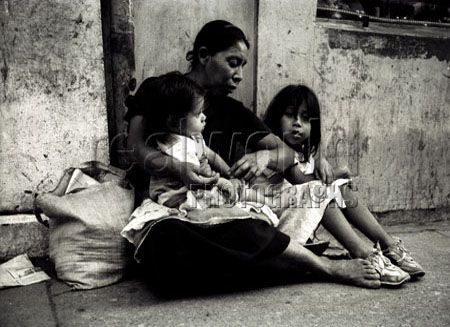
Indian women in ropa typica huddled on the curbs with ragged children. Kids no older than five would rush out to passersby. Their little hands either proffered petty items for sale or were cupped empty in begging. On every night of my stay, a boy with deformed legs lay sleeping on the sidewalk in front of my pension. One evening, a trickle of urine ran across the sidewalk from under his dirty blanket.
In seeing that–– among many more tableaux of grimness–– I thought of Cuba. In natural resources the island was probably poorer than Guatemala. Yet from all I’d gathered about post-revolutionary Cuba–– no little girl would ever be seen begging on the street after dark. No crippled boy would lie neglected on the curb. In Cuba, children attended school in tidy uniforms. In Cuba, everyone had enough to eat. Respect was not accorded by rank or privilege. Such reflections––which would reoccur throughout the journey–– tended to mist over the eyes…
Yet there was a little ambiguity. Memorable in such regard was a chat a few days earlier with a Cuban American. He was among the wintering gringos in Panajachel––the (now) retirement enclave on Lake Atitlan which was then a haven for low-budget tourists. We first met in a local café with a book exchange. We first talked about G.G. Marquez’s ‘One Hundred Years of Solitude,’ which was wildly popular on the gringo trail…
When we ran into ran into one another again in a restaurant, he spoke of travelling in India and running an organic farm in Vermont. I assumed he was a back-to-the-earth hippie with vaguely progressive views. But when I mentioned my impressions of gross inequality in Guatemala, he grew suspicious. I should have known better than to opine that Guatemalans would be far better off under socialism…
“Are you fuckin’ kidding?” he sneered. You don’t have a clue about communism. Castro completely destroyed Cuba!”
I had enough common sense to change the subject. At the same time, I realized it was unlikely that anyone growing up Cuban American, would be immune to his prejudices. Even though my views about justice/injustice were almost fully gelled–– I was not hostile to contrary opinion. In any case, I wasted no more time among sojourning norteamericanos. I decided to get as far into Latin America as my yanqui dollars would take me…
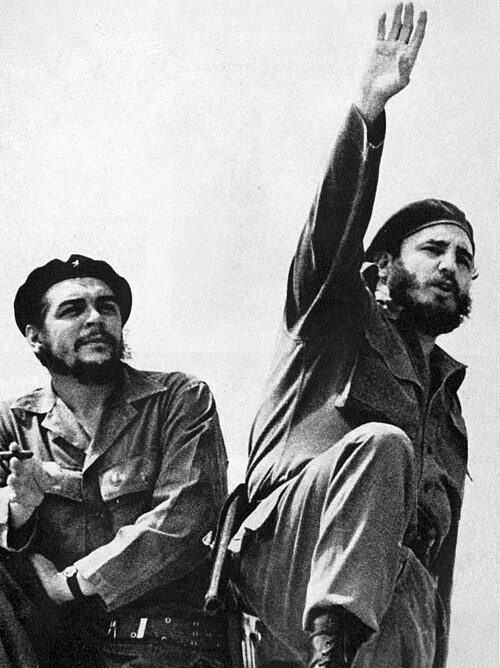
In late spring 1976, I returned to Canada with impressions which fuelled subsequent readings of Latin American history. Particularly memorable was ‘Open Veins of Latin America: Five Centuries of the Pillage of a Continent’ (1971) by Uruguayan journalist, Eduardo Galeano. I was entirely in accord with his view that: ‘The Latin American cause is above all a social cause: the rebirth of Latin America must start with the overthrow of its masters, country by country.’ It seemed clear that after the bloody coup in Chile in 1973, only Cuba remained in having freed itself from the imperial “master…”
At the time, I planned to enrol in a Latin America Studies program. Although Cuba had yet to open up to tourism, I was keen to do a ‘study tour’ there. Yet by fall of that year, those plans were on indefinite hold. My attention had turned to preparation for a ‘volunteer placement’ with a Canadian NGO… By January 1977, I was in Nigeria, teaching English. That two-year stint was to lead to further teaching assignments in Africa through the 1980s.
In that period, Cuba was never far from the news. In 1979-1983, Castro was head of the Non-aligned Movement. In that role, he gained broad support in Africa for championing “liberation struggles” and strongly opposing apartheid in South Africa… In aspiring socialist countries (e.g. Tanzania), he was referred to in the honorific ‘Cde. Castro.’ That abbreviation for ‘comrade’ was used in deliberate contrast with references to a Mrs. Thatcher and a Mr. Reagan… I also recall spirited discussions about “the “model of Cuban socialism” among African colleagues and students. When praise bordered on reverential, I tended to play devil’s advocate.
In those years, I certainly did not depend on local sources for international news. Through the BBC World Service and ‘the Guardian’ I was well aware of Cuba’s economic woes. There were also ongoing reports of Cuba’s military adventurism: of its soldiers getting bogged down in civil wars in Angola and Ethiopia…
Then there was the 1980 Mariel boat lift. Castro labelled all emigrants as ‘escoria’ [scum] and used the mass departure as opportunity to send away “social undesirables.” By including the mentally disabled and gays along with criminals––Castro undeniably exploited machismo bigotry. News about such cynical tactics was certainly disconcerting. Yet I still believed that no other leader of the global south had the cojones of Fidel in standing up against imperialist bullies…
2
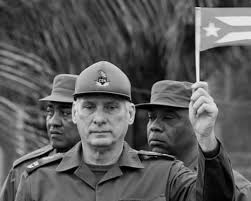
Sixty-seven years after the revolution, Cuban President Diaz-Canel wears combat fatigues similar to those of the late El Comandante Fidel–– but comes across as a grey bureaucrat. Since he succeeded Raul Castro in 2021, Cuba has suffered hyperinflation while its key industries (now including tourism) are failing. Its shrunken economy is near paralysis. Yet the current crisis–– the worst faced in decades of crises––cannot fairly be blamed on the Cuban government. As throughout its history, Cuba’s greatest existential threat is from the leviathan bully, ninety miles to its north.
2026 began with Trump’s dramatic application of his ‘Don-Roe Doctrine’ in Venezuela. The ease of his military decapitation of the Maduro regime apparently convinced Trump that he can bring Cuba to heel without a single American boot on the ground. After seizing control of Venezuela’s oil assets, his administration blockaded oil supplies to Cuba. The energy-lifeline of a nearly moribund economy was thereby choked off.
On a recent CBC Front Burner podcast, Journalist Jon Lee Anderson (who wrote an acclaimed biography of Che Guevara) likened the American oil embargo to the squeezing the throat of a comatose patient. In the same week ‘New York Times’ reporter, Frances Roble, said on the ‘Daily’ podcast that Trump is on the verge of succeeding in what eluded his eleven presidential predecessors. “He is making the communist regime say uncle!” It was hardly surprising that Roble is Cuban American.
Since the 1959 revolution, the supporters of the old regime and their descendants have schemed to regain power in Cuba. From their Miami base, they have lobbied successive American governments for the overthrow of the “communist dictatorship” in Havana. Up to present, their outlandish plots (including several Castro assassination attempts) have been thwarted. Yet the “free Cuba” lobby has persisted in the style of AIPAC–– punching far above its weight in Washington. In Trump and Secretary of State, little Marco Rubio–– right-wing Cuban Americans finally have the champions of their dreams.
I would like to believe that a majority of Americans are appalled by their government’s boot on the neck of a proud but suffering people. Yet one may wonder how many Americans are paying any attention. Unfortunately, incuriosity about the world beyond the US borders is a common American trait. As José Martí, the nineteenth century Cuban national hero, noted about American arrogance: “The conceited villager believes the entire world to be his village…” For “villagers” of our time who do pay attention to news about Cuba: the reporting they receive is almost invariably hostile. Many among the proudly benighted might even be shocked by Cuba’s dramatic achievements:
Until the early 2000s, Cuba’s health care system was the envy of Latin America. Its life expectancy was among the highest in the western hemisphere. Cuban doctors and nurses volunteered throughout the developing world. Now with chronic power cuts, hospitals are barely functioning. The petroleum squeeze has idled many factories and farms. A population which has one of the highest literacy rates in the world (higher than some US red states) is now struggling to eat.
Meanwhile, one wonders what memory of the impetus for Cuba’s 1959 revolution remains in a people so crushed by economic despair. For most Cubans, the pre-revolution era is ancient history. Some younger Cubans may even have rosy images of the Batista era. Amid the present dreariness–– ritzy nightclubs frequented by American glitterati must seem seductive…
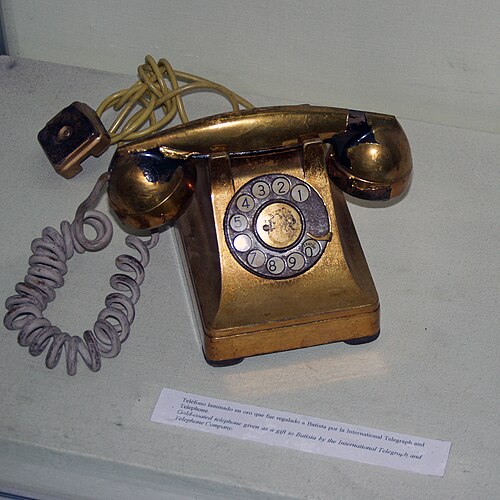
Yet lest it be forgotten––Fulgencio Batista’s Cuba really was the “whorehouse of America.” In the 1950s, Americans really did pick up fourteen-year-old Cuban girls outside of casinos run by the Mafia. Cuban men really did grope in sewers for coins tossed by tourists… As portrayed in ‘The Godfather Part II’–– there really was a golden telephone gifted to Batista by the chairman of IT&T…
As for the drama of the revolution itself: a dwindling number of elderly Cubans probably do retain vivid memories of the wild excitement felt in January 1959. As the revolutionaries rode into Havana, they really were met by cheering multitudes. There was even a moment of ‘Fidel-mania’ during Castro’s first visit to New York. As typical with American popular culture–– that fascination with a charismatic young revolutionary was superficial–– and extremely short-lived…
Once back in Havana, Castro acted swiftly to consolidate power. The casinos were shuttered, and the Mafia booted out. Large landholdings and many businesses were nationalized. Thousands of middle-class Cubans––including the family of Marco Rubio–– fled to the USA. Batista collaborators were summarily executed. Along with the executions (five hundred, by some estimates) Castro jailed opponents of the new one-party state and took control of the media. As Mao Zedong famously (or notoriously) put it: ‘A revolution is not a dinner party…’
Without excusing the ruthlessness, one might consider a few key enemies of the Cuban revolution. Many owners and shareholders of banks, sugar mills, and oil refineries seized without compensation were prominent Americans. Their dispossession effectively poisoned American-Cuban relations thereafter… Meanwhile, in the consolidation of power inside Cuba, Castro and his inner circle had to manoeuvre through a murky political environment. Survival of the new socialist regime probably entailed playing off opposing factions and cutting deals in manners which would be appalling to social democrats.
Of course, Castro was not a social democrat. As a Marxist-Leninist, he seemingly adhered to the belief that only a ‘dictatorship of the proletariat’ can resist the counter-revolutionary forces which predictably conspire against it. He was ideologically opposed to multi-party democracies such as that in Chile prior to 1973. Still, Castro was a comradely supporter of President Salvador Allende–– a socialist who upheld the democratic order in Chile until overthrown in a bloody (CIA orchestrated) coup. In the last photo of Allende before his death, he is holding an AK-47––a gift from Fidel. Some members of Allende’s own party–– those who survived the subsequent bloodbath–– would bitterly remark that he should have taken up that gun sooner…
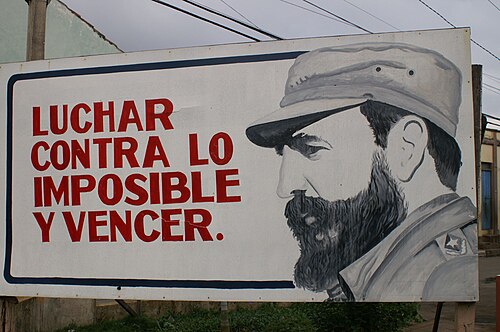
Castro’s reputation has certainly been tarnished in recent years–– even among many of his old well-wishers. There have been accusations that the public image of a frugal and tireless public servant was a fraud. ‘The Double Life of Fidel Castro’ (2014), ghostwritten for a disaffected former bodyguard of Castro, depicts him as a corrupt tyrant who led a lavish life. Supporters of Fidel dismissed that book as a hit job by Miami Cubans. It was hardly a coincidence that the book was released at the time President Obama was moving towards thawing American-Cuban relations (later to be reversed by Trump)… Then there was a listing in ‘Forbes’ magazine which included Castro among the top 2% of global billionaires. Issue can be taken with the assumption that as head of Cuba’s Communist Party–– all state property ‘belonged’ to him. As earlier suggested, Castro had powerful enemies…
Admittedly–– even with all these contradictions–– I still admire the young Castro who dared poke Uncle Sam in the eye. In his heyday, he was adored by millions––especially in the global south. He brought Cuba into the limelight of the world stage as a symbol of resistance.
Undeniably, his regime dealt harshly with internal dissent. There were condemnations by Amnesty International of the long-term holding of Cuban political prisoners. Yet even Cuban Americans could not explain away Castro’s base of ardent support. At mass rallies, he could hold a crowd’s attention––often speaking for hours. Upon his death in December 2016, hundreds of thousands of Cubans amassed in mourning…
But all that is history. The question now is: how much of the Castro’s revolutionary spirit is left is a country squeezed to near suffocation? Quite recently, the distinctly uncharismatic President Diaz-Canel did defiantly proclaim:“Surrender is not an option.” Yet how long can he possibly hold out? If not decapitated from leadership like Maduro–– will he be forced to say “uncle?”
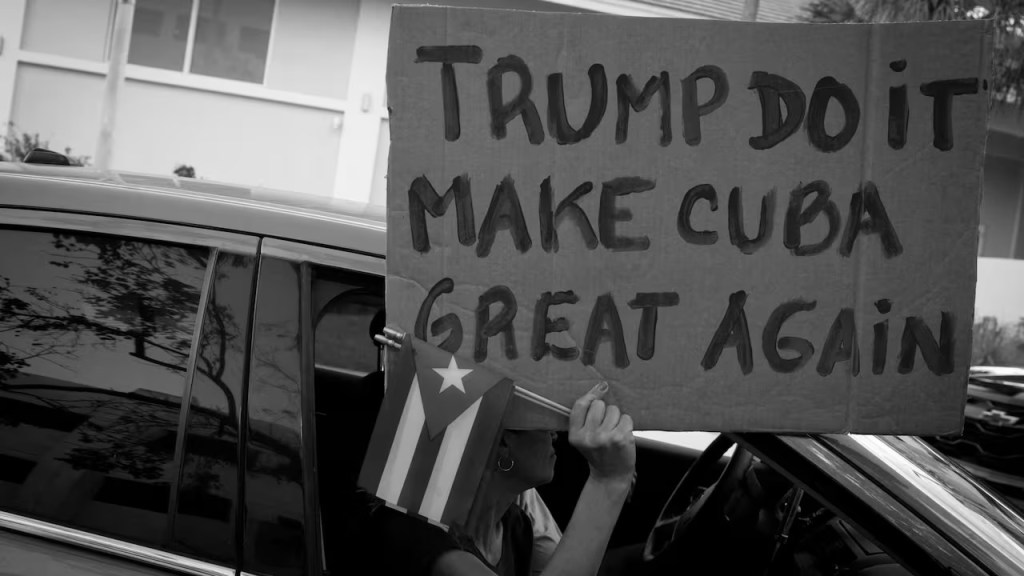
I began this piece when Trump was crowing about Cuba “running on fumes.” I suspected then that the collapse of Cuba might occur before I finished writing this… As of today, the answer is nigh as to whether President Diaz-Canel will be forced to say “uncle.”
Three days ago, he confirmed that Cuba was engaged in talks with the US government aimed at “finding solutions to bilateral differences.” A headline on today’s ‘New York Times’ website stated that: ‘Battered Cuba, Seeking Lifeline, May Open Itself to Outside Investment.’ Meanwhile, it was reported that Cuba was experiencing a complete electric grid blackout due to lack of generator fuel…
Perhaps the Cuban president is trying to maintain as much of national sovereignty and dignity as desperation will allow. As to whether he accedes to submit to similar terms as Venezuela’s acting president, Delcy Rodríguez, remains to be seen. He is no doubt aware of outcomes implicit in Trump’s recent threats: “We’re gonna put Marco in charge down there,” The Don added: “It may or not be a friendly takeover!”
At the moment, Trump and little Marco certainly have their hands full in the Straits of Hormuz and neighbouring environs. Yet once a glorious victory is declared in the Middle East, Trump will no doubt turn back to his Don-Roe ambitions…
It is hard to predict what a Cuba take-over will look like. Maybe little Marco (with the help of little Jared) will restore Cuban casinos and hotels to Batista-era splendor. Making Cuba America’s whorehouse again–– even if not in a literal sense–– could be part of the plan… The only certainty is that with the son of Cuban American ‘gusanos’ in charge––Fidel and Che will be rolling in their graves…
What is inexcusably shameful is the reaction of much of the world to the strangulating oil embargo forced upon Cuba. Erstwhile friends of Cuba–– each for their own self-serving reasons (Canada included)––have been meek witnesses to a monstrous crime. One is reminded of kids in a schoolyard watching timidly while a bully mercilessly pommels a smaller child. Each kid fears he might be next…
If Trump breaks the spirit of Cuba–– who’s next? Whatever the fear of retaliation––we need to stand together and confront the bully. Even tiny nations acting alone–– but with cojones–– sometimes have the power to do so…
-2026, March
👍🏼 😐 😬 🥱 👎 💩
 Coprolites in Amber (etc.)
Leave a comment