A few months ago, I was reprimanded by an old friend for an offhand comment about medical assistance in dying. In our chat at a Vancouver café, he had mentioned he was helping another friend with an application for that legal process known in Canada by its acronym–– MAiD. His friend was slipping into dementia. The poor fellow was desperate to get approval before losing the compos mentis needed for legal consent…
I commended my friend on his kind-heartedness. But I also thoughtlessly blurted that applying to the government to end one’s life was “a little creepy.” I immediately realized my word choice was insensitive. My friend was deeply invested in helping someone without close family who was facing a terrible fate.
In apology, I assured my Vancouver friend that I was thoroughly supportive of the availability of MAiD for those for whom it is a last resort. I also said I personally believed that permanent and intolerable pain renders a life unlivable. Yet I admitted uncertainly about whether MAiD is the best option for dying on one’s own terms. Before we moved to a safer topic, he urged me to check out a few websites on end-of-life preparation. Since his colon cancer surgery, that friend is determined to leave nothing to chance–– and urges fellow geriatrics to do likewise. With a touch of queasiness, I gave him that promise…
Much more recently, a friend in Victoria B.C.–– someone I’ve known since youth–– had devastating news. The esophageal cancer for which he had been aggressively treated had spread to his lymph nodes. He texted: ‘MAiD is an option. I strongly suspect that will be my end, probably in the next year or two…’
The shock of that news triggered a deja vu of eighteen months ago regarding a friend in Michigan. Since we were teaching colleagues overseas in the late 1990s, we had maintained regular contact. In a FaceTime call in mid-2024, he revealed that all the options for treating his metastatic melanoma had been exhausted. He said he still hoped to live long enough to vote against Trump in the November election. As it turned out, he achieved that with only three weeks to spare. Shortly after the American Thanksgiving, his sister emailed that he had died after a “difficult last few days.”
Long before his cancer diagnosis, that American friend suffered the complications of a genetic neuropathy disorder (CMT). However disabled, he was one of the most content persons I have ever known. He made it a little past the age of seventy-five–– which he had jokingly claimed to be his goal. Had physician assisted suicide been legally available in his state–– I doubt he’d have considered it. In many conversations, we’d talked about dying––usually in the shared spirit of dark humour. He made it plain that whatever cancer had in store from him–– he was ready to endure it as long as his frail body held out…
Haunted by the report of his “difficult last few days,” it struck me how much he had in common with my friend in Victoria. He was white, middle class and well-educated. Also like my friend in Victoria–– he was non-religious. Yet in the throes of terminal cancer, he chose to painfully cling on through the final hours before a ‘natural’ death. In stark contrast to that choice, my friend in Victoria with terminal cancer was seriously considering assisted dying….
With these dear friends in mind, I felt obliged to better understand the controversy around a dreadful choice that I, too, might be unlucky enough to face…
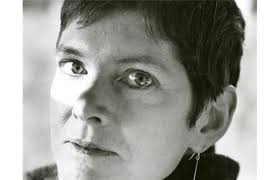
The legality of MAiD in Canada was established in a 2015 decision of the Supreme Court. In Carter V. Canada, the court unanimously ruled that the prohibition on assisted dying was unconstitutional. The foundation of this ruling was laid twenty-two years earlier in the wrenching case of Rodriguez v. British Columbia:
In 1993, a 43-year-old Victoria woman suffering from advanced Lou Gehrig’s disease appealed the provincial court’s rejection of her attempt to establish a constitutional right to assisted suicide. In a taped address to the Canadian parliament, she asked: “If I cannot give consent to my own death, whose body is this? Who owns my life?” The Supreme Court of Canada denied the appeal of Sue Rodriguez in a 5-4 ruling. However, her controversial case brought attention to an agonizing issue which, formerly, was all but taboo in public discussion.
Following upon the 2015 Supreme Court reversal, the Canadian parliament passed a bill (C-14) laying out conditions for legalizing medically assisted suicide in all the provincial and territorial jurisdictions across the country. The regulations–– as currently structured–– came into effect in 2016.
Since its legality, nearly eighty thousand people in Canada have opted for MAiD. Also, since 2016 (according to Google AI), the number of medically assisted deaths has increased annually. As of 2024, it ranked as the fifth cause of death in Canada.
Health-Canada and medical providers insist that eligibility for MAiD is strictly managed. Approval requires diagnosis by at least two physicians of a grievous medical condition causing intolerable suffering. As already implied herein, consent requires mental competency. (In certain conditions of deterioration, a waiver of the final bedside consent may be allowed). Cases of mature minors and those involving mental illness are currently prohibited. These restrictions are being reviewed–– yet any loosening of qualification for MAiD is highly controversial…
In somewhat morbid curiosity, I checked out the MAiD ‘process’ on both the Health Canada and the British Columbia government websites:
Applicants are classified according to whether their natural death is reasonably foreseeable or not. Track #1 applicants can proceed quickly to MAiD whereas non-terminally ill applicants are classified as Track #2. They have a minimum 90-day waiting period after approval. Once all the paperwork had been signed off, the person requesting MAiD may choose the date and the setting. At any time between the approval and the moment of the final procedure, the person can change his/her mind. When the recipient is ready to proceed, a doctor (or nurse practitioner) arrives at the venue with the prescribed drugs. Relatives or close friends may be present–– depending on the person’s last wishes.
The medical protocol itself involves three drugs: a sedative, a powerful anaesthetic and finally a neuromuscular blocking agent. The drugs are usually administrated intravenously but there is a (seldom taken) option of drinking a strong solution of Secobarbital. Deep coma is soon followed by stoppage of the heart. In either procedure, death occurs within five to ten minutes.
Many who have attended the administration of MAiD attest that their loved one died peacefully without any signs of distress. However, opponents have drawn attention to the similarity between the drug protocol and US death penalty executions by fatal injection. Doctors who perform MAiD flatly reject that comparison. That have pointed out that not only are the drugs different–– but they are administered with utmost care for the comfort of the recipients. Incidentally, the online BC Health care information site notes that under basic Medicare coverage: ‘there is no charge for MAiD drugs…’ One supposes that information is intended to assure. I find it just a little creepy…
Unsurprisingly, the political opponents MAiD have amplified and exploited any rumours of supposed abuses. Still, there have been cases which deserve public attention. Among them are reported offers of MAiD to a few who made no enquiry about it:
One such instance is of a former Paralympian who complained to her caseworker about delays in installing an in-home chairlift. Another was of a disabled vet who had talked to his counsellor about his depression. Then there was the 84-year-old woman in a Vancouver emergency ward, seeking treatment for a sudden back pain. She claimed that MAiD was the first option presented to her…
The reports of such cases are typically followed by an apology by Health Canada. There is an accompanying assurance of disciplinary action along with emphasis that policy and procedural reviews are regularly conducted. Judging by polls, the public doesn’t seem too rattled for such reports. Support for MAiD among Canadians is apparently above 80%.
Yet since its inception, MAiD has been subject to fearmongering. The US right-wing media portrays medically assisted dying in Canada to a “euthanasia program” targeting the frail and elderly. Its legality supposedly reflects Canada’s degeneration towards “totalitarian socialism.” Comparisons are routinely drawn between MAiD with the institutional killing of the old and infirm in Nazi Germany. Of course, such comparisons are as cruel to the families of MAiD recipients as they are disrespectful to the victims of mass murder.
In my searches, I found several testimonials expressing gratitude for the brief restoration of the MAiD recipient’s lost autonomy. Family and friends claim that their loved one died with dignity which a continuous suffering to a natural death would have denied…
I do wonder about the official nomenclature: ‘medical assistance in dying.’ It sounds like bureaucratic phraseology crafted to avoid scaring or offending. On the other hand, I appreciate the challenge of finding a euphemistic expression for a process that concludes in a voluntary death. There is no softening of the fact that MAiD requires willingness to end one’s life by suicide.
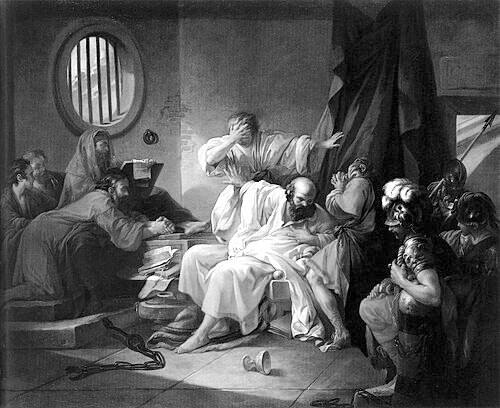
From a non-religious perspective, suicide need not be stigmatized. One might consider the honourable samurai of medieval Japan, committing ritual seppuku after defeat in battle. Then there was the very honourable Socrates, in 399 BCE, ending his life with a cup of hemlock.
Of course, such examples give no comfort to the religious. In the major religious traditions, suicide is gravely immoral. Many of those who would consider MAiD an option to end intolerable suffering must wrestle with the dictates of their faiths. However, from the legal perspective, MAiD is a compassionate medical option–– rather like abortion. People in need may choose it or reject it. It is offered without judgment of individuals’ personal beliefs…
It must also be noted that in absence of a compassionate alternative to end intolerable suffering–– far too many people take their own lives in desperate ways. Those who rail about the “victims” of MAiD conveniently neglect those driven to suffocating in a plastic bag, hanging from a closet door or (commonly in the USA) blowing out their brains. The result is often life-long trauma for those left behind.
Of course, it must be emphasized that suicides–– especially among the young–– are usually desperate acts taken in absence of help. There are certainly tragic lapses in the health care system. Lives are too often lost which could have been saved. Plainly, more effective counselling and support services are needed. There probably have been some approved applications for assisted dying which could have been referred to services for assisted living. Even one such tragic case is too many…

Suicide was decriminalised in Canada in the early 1970s, but criminal offence remained for another party abetting a suicide. Since 2016, with the passing of Bill C-14, doctors performing MAiD have been regarded as carrying out their duties as in any other medical procedure. Still, opponents of MAiD accuse its providers of violating their Hippocratic Oath. Undeniably, the ancient oath, (as translated into modern English), clearly states: ‘I will not give a drug that is deadly to anyone if asked (for it), nor will I suggest the way to such a course…’
However, medical practitioners who provide MAiD can find support for their agency in strains of moral philosophy. E.g.: John Stuart Mill famously posited that certain actions which cause harm can be justified if the lesser harm is intended to alleviate a much greater harm. On that utilitarian principle, medically assisted suicide might be justified for the “greater good” of relieving intolerable suffering.
Some medical ethicists have drawn on the philosophy of Søren Kierkegaard. In ‘Fear and Trembling’ (1843) he describes a ‘Tragic Hero’ type forced to abandon one ethical commitment in favour of another with a higher ethical imperative. Such moral choices are often as anguished as they are unavoidable. The doctor who performs MAiD foregoes traditional Hippocratic commitments (‘cause no harm’) in order to fulfill the patient’s request to end his/her intolerable suffering… That may be regarded, in a Kierkegaardian manner, as a ‘tragically heroic’ moral choice… While Kierkegaard has been described as an “existential Lutheran,” many would strongly reject any attempt to justify assisted dying within a Christian faith.
The Catholic Church in Canada notably regards MAiD as a “grave violation of the law of God” and condemns it in every aspect. The late Pope Francis characterized it as reflecting a “culture of waste.” That seemingly reflects a theological position that suffering in dying is a unique experience in every individual. Apparently for the devout, the experience can even be intensely spiritual–– harkening to the suffering of Christ…
Yet for those who would choose MAiD–– mortification of the flesh to the last breath is the very death they wish to avoid…

According to Health Canada, more than 2,300 doctors and nurse practitioners are currently providing MAiD across Canada. Most do so quietly but there are a few who are public advocates:
Notable among the public faces of MAiD is Dr. Stefanie Green, of Victoria, BC. Along with working as a MAiD practitioner, she serves as the President of the Canadian Association of MAiD Assessors and Providers. She is on the clinical faculty at the University of British Columbia and has been extensively interviewed in both Canadian and international media. Her 2022 book, ‘This Is Assisted Dying,’ has sold very well.
Before Dr. Green transitioned to the provision of MAiD, she worked exclusively in maternity and newborn care. As she had wryly remarked in one interview, her medical focus shifted from: “delivery in–– to delivery out.”
In her interviews, she comes across as soft-spoken and thoughtful. She seems to regard herself primarily as an educator. Her ‘Solace BC’ website provides extensive information about MAiD to prospective applicants and their families. Her photo on the site shows her sitting pensively on a beach behind her dog with a ball in its mouth. Another site in which she is featured advertises ‘Gentle Touch Circumcision.’ Her provision of that service adds a rather curious twist to delivery in/delivery out…
Incidentally, Victoria BC, where Dr. Green practices, has the highest MAiD usage in Canada. It is the only city in Canada, apart from Toronto, which has a hospice-like venue specializing in MAiD. The MAidHouse website informs that the undisclosed location offers: ‘a compassionate space for end-of-life care’ which ‘reflects the unique spirit of Vancouver Island…’
MAiD now accounts for 7.5% of deaths in the city where Sue Rodriguez controversially chose to die illegally by assisted suicide thirty-two years ago. The live and let live (or die and let die) seems to reflect the Victoria’s demographics. No city in the dominion has a higher percentage of comfortable and educated elderly folk. Moreover, Victoria is the most secular city in the province where more than half the population have no religious affiliation…
In scrolling through this information, I could not fail to be reminded of my friend in Victoria who is considering MAiD. He has always claimed his city to be the both the most laid-back and forward-looking in Canada. Admittedly, over the decades I’ve found his home city a bit too cozy and insular for my inclinations…
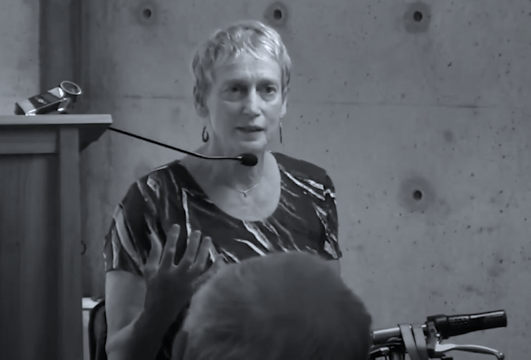
Perhaps the most outspoken advocate for MAiD is also a British Columbian. Dr. Ellen Weibe has practised Family Medicine in BC for upwards of forty years. Along with being a MAiD practitioner, she is a staunch supporter of woman’s rights and reproductive health. Like Dr. Green, she is a professor of Clinical Medicine at University of British Columbia and has given many lectures and interviews on MAiD.
She has been involved with two notable controversies. In 2017 she was accused by a Jewish nursing home of “sneaking in and killing someone.” She was in fact attending to the wishes of a grievously ill resident who had been approved for MAiD but couldn’t be moved. In that case, Dr. Weibe was cleared of any wrongdoing by the BC College of Physicians and Surgeons.
In a more recent case, a grieving Ontario woman went public with her anguish over the MAiD her 26-year-old son had received from Dr. Weibe. The mother insisted that her son went “doctor shopping” in British Columbia after his MAiD application was turned down in his home province of Ontario. She believed that her son, who suffered from blindness and peripheral neuropathy, was not grievously ill. She was only informed of his death after the fact. Although Dr. Weibe acted within the law, the case generated much negative controversy–– especially in American conservative media…
In attempt to get a fair impression of Dr. Weibe, I searched through media articles and videos summoned by a Google search of her name. Among the many in which she is featured, an interview she gave to ‘Good Morning Britain’ in October 2024 was particularly informative. That TV guest appearance was on the eve of the passing of a bill in the British parliament which would legalize a version of assisted dying in the UK.
As Dr. Weibe matter-of-factly answers questions about MAiD in Canada, the hands of both the male and female interviewers appear to tightly grip their coffee cups. That morning’s topic was obviously not the usual breakfast-time fare. A few exchanges:
When asked what MAiD recipients have in common, Dr. Weibe replies: “Many are people used to being in charge. Being in control of their lives, they want to be in control of their deaths… Many usually just want to skip the last two weeks or last two months of a horrible disease.” She adds that some research has pointed to another commonality in many MAiD recipients: “a low level of spirituality.” Then with a touch of irreverent humour, she quips: “Yeah, that describes me.”
When asked whether relatives are in attendance during the final procedure, Dr. Weibe answers with a smile: “Well, ‘who do you want to invite to your dying?’ is a question we ask beforehand.”
When presented with the fact of opposition to MAiD by advocacy groups for the disabled, Dr. Wiebe counters: “I have been in a wheelchair for the last thirty-two years. The idea that because I’m disabled, I should lose my rights that undisabled people have is outrageous.”
Effectively blocked on that front, the interviewer, moves on: “You’ve assisted in the dying of more than four hundred and twenty people. How do you feel about this in general?”
Dr. Weibe declares that she feels emotionally connected to the tragedies of lives that have ended too soon. But she emphasizes that the tragedy is in the disease and in the suffering–– not in her assistance in ending the suffering. She goes on to speak of “providing for” many old people who have had a fulfilling life and who die in the fullness of gratitude. She concludes with another smile: “It’s just part of life in general. 100% of us are going there.”
The interviewers, probably as intended, are left momentarily speechless.
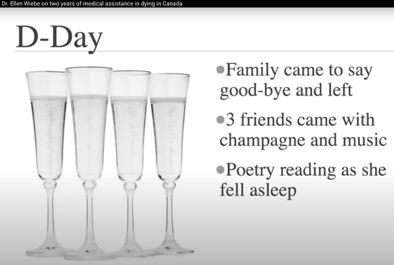
Curious to hear Dr. Weibe before a more sympathetic audience–– I watched a lecture she gave in 2018 to a ‘Dying with Dignity Canada’ meeting. (It is available on YouTube). From her electric scooter beside the lectern, she speaks to the successive screens of her PowerPoint presentation:
Among the challenges of delivering MAiD, she criticizes unnecessary onerousness of the paperwork. The PowerPoint screen illustrating that–– shows a random strewing of forms. As for a geographical challenge she mentions: “we have to fly up to places to provide.” It was notable that more than once in her lecture, she uses ‘provide’ intransitively.
Regarding the difficulty of delivering MAiD to people in religiously affiliated institutions, Dr. Weibe speaks of her experience with serving patients of Vancouver’s St. Paul’s Hospital. If they are near death or too frail to be moved, the challenge is to quickly find a venue to receive them. Apparently, some patients ready for MAiD had been referred to the reproductive rights clinic where she had previously worked.
“They’re giving me people I can take to the abortion clinic,” she says to the audience’s uncertain titters of laughter.
The ‘Quality at end of life’ screen offers a justification for MAiD in four neat bullet points:
It provides an “insurance policy” against the fear of a painful death, it ends unbearable suffering, provides dignity in the act of dying and spares the recipient “social death.” The latter, she explains, allows a person to participate as a social being with some autonomy to the final moments of life.
One screen, titled ‘D-Day’, is illustrated with four glasses of champagne. In exemplifying how the recipient can choose the setting of his/her final exit, she describes the scene of one of her MAiD deliveries that was marked by toasting, music and a poetry reading.
“One of the wonderful things about MAiD,” she grins, “is when someone comes to me and they have just had a horrible diagnosis. The cancer’s back–– it’s in your bones, in your brains, your lungs. The worst possible news they’re just received. And they come to me when they’re still feeling quite OK and I say: ‘Yep, you’re eligible!’” They are so grateful. They have a way out…”
She then exemplifies: “One of my patients who had booked her death came to me a few days before. I asked her how she was feeling, and she said: ‘you know I was scared and now I’m not scared anymore.’ Then she actually died on the day she had booked her death!”
Dr. Weibe highlights her lecture with such anecdotes of her MAiD recipients–– each with a poignant story. Among them is a ‘Hanna,’ approved in Alberta, but unable to find a provider and a venue due to provincial restrictions there. She concludes on a positive note: “We’ve has a lot of wonderful changes since Hanna died–– and we need some more!”
As she reverses her scooter and exits the podium–– the ‘Dying with Dignity’ audience clap enthusiastically.

In October 2024, the daily ‘National Post’ ran a profile of Dr. Weibe under the title: ‘The kindly doctor who has helped more than 400 patients die…’ Mentioned was her youthful confliction with a strict Mennonite upbringing. While wary of the reporting of the self-appointed voice of the Canadian right, I was struck by a quote in the article that somewhat matched my impression from the videos: ‘Her face lights up as she describes MAID as the most fulfilling work she’s ever done.’ How is it, I wondered, that a 73-year-old Canadian doctor seemingly feels such passion about assisted dying?
I also wondered how she regards Jack Kevorkian. A generation ago, he was the controversial face of medically assisted dying in the USA. In the 1990s, he illegally assisted in the euthanasia of a hundred and thirty terminally ill people. He used experimental devices such as his self-named ‘Thanatron’ and ‘Mercitron.’ Eventually he was convicted and jailed of second-degree homicide… Kevorkian was also a talented composer and jazz musician. Then there was his ghoulish artwork. Fighting for the right to assisted dying, though, was his crusading mission. To some Americans he was a hero. To many others he was ‘Dr. Death.’
I would never suggest that Dr. Weibe is of the ilk of Kevorkian. She works within prescribed regulations. Her MAiD advocacy is for the existing laws to be properly implemented. She (along with other MAiD providers) would probably argue that lack of access is denying the choice to all those who deserve it. Still, it is jarring to hear the excitement in the voice of a doctor talking about helping someone to die…
Both Dr. Weibe and Dr. Green very briefly appears in ‘In My Own Time’ (2024), sponsored by ‘Dying with Dignity Canada.’ The video-documentary profiles stories of four MAiD recipients. One is a man with a severe neurodegenerative disorder who does a bucket-list skydive a few days beforehand… At the very end of the hour-long documentary, several MAiD doctors (young and old, male and female) are asked to describe “in one word” why they do what they do. Among the words elicited by the interviewer are: ‘fulfilling’, ‘caring,’ ‘empathy,’ ‘choice,’ ‘a gift,’ ‘grace,’ ‘peace,’ ‘joy,’ and ‘love’…
Dr. Weibe’s word is ‘honour.’ No doubt she is a person of honour and integrity. Regarding her ofttimes breezy tone in talking about MAiD–– perhaps like Dr. Green, she is simply demonstrating a ‘liberated’ acceptance of death as a process as natural as birth (‘delivery in/delivery out’)…
As for my gut reaction to these online glimpses and snippets: she is not a guide I could ever imagine rowing me across the River Styx…

Perhaps the most controversial video made ostensibly in support of assisted dying is ‘All is Beauty’ (2022). The 3-minute video shows an attractive woman whose life was soon to end by MAiD, celebrating with friends on the west coast of Vancouver Island. In a background of ethereal music, she appears on a beach–– drawing circles in the sand. In a night setting, she sits amid colourfully costumed dancers and ghostly sky lanterns rising from a candle-lit forest.
“Even now,” she says in the voice-over, “as I seek help to end my life, with all the pain, and in these final moments, there is still so much beauty…”
The short video does evoke beauty––but a beauty rendered eerie by its context. It was sponsored by Simons luxury shoes of Montreal. Until protested, it was used in their commercials.
Even more controversial was a revelation that came after the death of Jennyfer Hatch, the 37-year-old featured in the video. Several months earlier, she had contacted CTV News under a pseudonym. She reportedly complained about not receiving adequate treatment or palliative care for the connective tissue disease (Ehlers Danlos syndrome) from which she had chronically suffered. Apparently finding insufficient support in B.C.’s health-care system, she had applied for MAID. She got the approval within weeks. It is hard to watch ‘All is Beauty’ again with that in mind…
The regulations governing MAiD do make clear that applicants must be informed of a range of options for relief of their suffering. Accessible community services and palliative care are reputedly emphasized as alternatives to MAiD. Such counselling has become especially important since 2021, when regulations were modified to allow MAiD for ‘Non-RFNDs.’ That is Health-Canada bureaucratic shorthand for cases meeting the condition of intolerable suffering when natural death is not reasonably foreseeable. Despite the reputed safeguards, it is still possible that for some Track #2 MAiD recipients, their frustration in seeking help was the last straw before their application…
A group called ‘Living with Dignity’ has positioned itself in counterpoint to ‘Dying with Dignity.’ Its members advocate on behalf of those presumed vulnerable to being unnecessarily driven to seeking MAiD. The group is not opposed to the legality of assisted dying in principle but is against its broadening beyond Track #1. Their mission statement declares: ‘We believe that so-called Track #2 MAiD endangers the lives of people with disabilities who, in moments of weakness, will be pressured to request MAiD rather than continue to demand adequate financial and social supports.’
‘Living with Dignity’ advocates for the old and the poor along with the disabled. All too often, vulnerable people fit into those three categories at the same time… It should be obvious why severely disabled people feel particularly threatened by MAiD. Especially those who are poor, feel its legalization is a first step on the proverbial slippery slope. Many fear its potentially being encouraged as a cost-saving alternative to supporting the disabled in a decent quality of life.
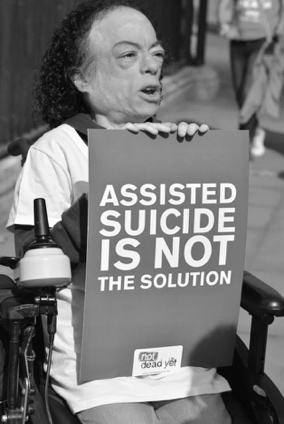
Among the many disability activists who have protested assisted dying legislation is the British comedian and actress, Liz Carr. Her name came up in the ‘Good Morning Britain’ interview with Dr. Ellen Weibe. Carr’s 2024 BBC documentary on assisted suicide was archly titled: ‘Better off Dead.’ Other disabled activists protesting assisted dying legislation have worn tee-shirts captioned with the ironic: ‘Not Dead Yet.’ That may be taken as a defiant affirmation that “disabled lives matter.”
Some polls have shown that disabled people report a higher satisfaction with their lives than non-disabled people. (That was certainly true of my late friend in Michigan). While this finding has been called ‘the disability paradox’–– it is only a paradox to those who would assume it would be impossible to live happily with a severe disability. Of course, terrible accidents or diseases do make an extended life seem unbearable for some victims. Yet for others, even a severe disability can present itself as a challenge which–– to the extent it is overcome–– confers meaning and purpose.
Still, many disabled people do require specialized support services. The deterioration of the quality of their lives tends to result not from their disabilities–– but from decline or loss of such supports…
In her British TV interview, Dr. Weibe pointed out that very few MAiD recipients in her practice have been poor or disabled. But there is concern that that may change. One can understand why a younger quadriplegic person, for example, may prefer MAiD to the prospect of thirty years in a rest home among the elderly… That would be a preventable tragedy.
One such person was commemorated in ‘Remembering lives lived,’ a section of the ‘Living with Dignity’ website. She was among the more than thirty people who might not have gone through with MAiD had better support been available to them. Also, among the profiles is that of Jennyfer Hatch–– the young woman featured in the ‘All is Beauty’ commercial…
Thirty individuals among the eighty thousand who have opted for MAiD since 2016 represents a tiny percentage. But with more Track #2 approvals, perhaps the numbers of those tragedies will grow….
Recent data shows that Canada has the highest percentage of deaths by assisted suicide in the world. Without being alarmist, one may quietly ask: what does a broad acceptance of MAiD reflect about Canadian society?
Many would argue that the MAiD legislation shows compassion and respect for what Sue Rodriguez in 1994 called “who owns my life.” But outside the alarmist opposition, sober concerns have been raised about the Canadian model for assisted dying–– especially for Track #2 policy.
Prof. T. Lemmons, a bioethicist at the University of Toronto, commented: ‘…how our societal and legal endorsement of a broad MAID practice may already be impacting on what we think our elderly, and people with disabilities should do when they struggle and solutions to their suffering are complex and not immediately forthcoming; and how this will impact how they themselves think about what they should be doing when faced with old age, fragility and disability…’
He suggests that we need to very carefully balance the freedom of control over our bodies with the danger of devaluing of the lives of the old, the frail and the poor… I would go further and opine that a culture in which the most vulnerable feel themselves disposable–– cannot deem itself civilized…
Meanwhile, there are progressive-minded critics who would even propose an alternative to most Track #1 MAiD approvals. They argue for more publicly funded hospices and better palliative care allowing people to die naturally in relative comfort. Kathryn Mannix, a palliative care doctor and author, gave a report critical of the assisted dying legislation in the UK. She believes that most intolerable suffering results from psychological distress rather than from unmanageable physical pain.
In her book, ‘Dying, Death, and Wisdom in an Age of Denial’ (2017) she wrote: ‘…We should reclaim dying… Just like giving birth, it is a natural process – and one that is much more gentle than we imagine...’

So, what was my own takeaway from this informal research?
If pushed, I suppose I could sum it up in five words: ‘There but for the grace.’ In a fair-minded Canadian manner, I believe that one can support the legality of MAiD while not supposing it an option one would take oneself. I do have serious doubts about Track #2 MAiD. At the same time, I believe that no one can ever really know whether they would consider assisted dying without being faced themselves with intolerable suffering…
Personally, I have a very low tolerance for loss of autonomy. At the most basic level, I cannot imagine relinquishing self-feeding or personal hygiene maintenance. As one who doesn’t pray, I can only fervently hope (all fifteen digits crossed) never to face the option of a means to quickly end the intolerability of loss of autonomy. If so unlucky, I would rather––in the manner of Socrates––imbibe a hemlock-like solution without need for a doctor’s presence.
Even in nearing the age of seventy-five, it is all too easy to suppose that life will just continue as it is… As my friend in Vancouver (the one keen on end-of-life prep) jokingly remarked: “We have to keep reminding ourselves that are down to our final few thanksgiving dinners…” As for my friend in Victoria considering MAiD: whatever choice he makes will have my whole-hearted support…
Finally–– whether true or not––it is a comforting thought that: ‘Death is a natural process… that is much more gentle than we imagine…’ All too soon that will be revealed–––– if only for the blink of an eye…
2026, April
Update: The proposed ‘Terminally Ill Adults End of Life’ legislation in Britain, which was passed by the House of Commons, stalled in the House of Lords. In late April, the bill effectively died.


Leave a Reply