Though several years of my childhood, ‘Showers of Blessing’ droned daily from the kitchen radio. That was the signature hymn which opened an eponymously titled broadcast every weekday at noon on CFNB radio, Fredericton, New Brunswick. The program was hosted by a local preacher who sang in a shaky baritone accompanied by piano, played by his wife. Between spiritual numbers, the affable-voiced preacher offered prayers––typically requested for elderly shut-ins. The half-hour religious broadcast coincided with the mid-day meal. Heard at the kitchen table, the hymn’s refrain was even harder on a delicate stomach than the smell of burnt liver…
After the recent popping up of that distant memory, I looked for info about the hymn which had once tormented my noontimes. As suspected, it was composed by an evangelical preacher. Daniel Webster Whittle (1840–1901) was a New Englander “born again” after losing an arm in the American Civil War. Thereafter, he wrote lyrics of several rousing evangelical numbers.
‘Let There be Showers of Blessing’ was apparently inspired by verses from the biblical book of Ezekiel: ‘I will cause the shower to come down in his season; there shall be showers of blessing...” Rain falling on parched ground supposedly reminds the faithful in dire need of the possibility of ‘grace.’ Yet there is a caveat. The Old Testament deity seemingly dispenses it according to his mercurial whims…
With that background, I searched for recordings of that classic hymn and found several on You-Tube. Most were by white evangelical choirs from the USA. The dominant impression of those performances was of lips moving in doleful faces. The voices were almost as dreary as that of the radio preacher of sixty years ago. Not even one clip could be borne in entirety…

Then I came upon a performance of the hymn by a Christian choir from south India. The three hundred voice choir was comprised of both male and female singers, young and old. Instead of uniform choir gowns, they wore an array of Indian and western apparel. Following the hand of their white-bearded choir master, they swayed gently back and forth. Their faces beamed, and some members waved their arms in supplication of the deity they implored:
‘Show-ers of blessing, showers of blessing we need––
Mercy drops round us are fall-ing–– but for the showers we plead.’
It was initially disarming to hear that drearily familiar refrain so joyfully sung. But in watching the video again, I saw trance-like docility in too many faces. It occurred that the members of the Indian choir were just as likely as the white American choirs to be “born again” Christians.
There then came oddly to mind, an illustration in an evangelical tract once glanced at on a street corner before its deposit in the nearest trash bin. It showed white children kneeling with their teddy bears for bedtime prayers. At the same moment, I thought of the opt-repeated biblical quote that true believers must: “become like little children…”
That was supposedly the counsel of JC himself. Of course, no one who deliberately follows that spiritual guidance would endeavour to revert to a child-like mentality. Even those who take the bible literally could point out JC’s fondness for parable. “Becoming like little children” is likely taken as trust in divine care in a manner that comes as naturally as a young child relies on its parents. Such wholehearted trust is supposedly the mark of the most genuine faith. Yet how can such submission be possible without surrendering at least some capacity of adult reasoning?
Without getting mired in St. Thomas Aquinas, I certainly acknowledge that thoughtful Christians have long struggled with reconciling faith with reason. In contrast, many present-day evangelicals hardly bother. Many seem to revel in defiance not only of science––but of common sense.
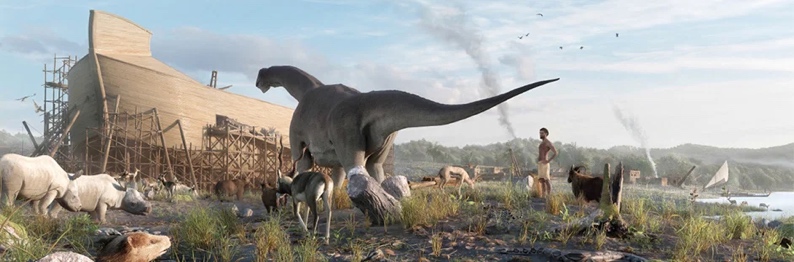
‘Young Earth creationists,’ for example, are evangelists who claim that a supreme being created the world in six days, six thousand years ago. Granted, they do sometimes try to prove their beliefs through bizarre semblance of empirical research. For example, some have offered ‘scientific’ evidence for the divine creation of fossils. Others have mounted ‘archeological’ expeditions in search of the remnants of Noah’s ark…
One creationist has actually built an ark replica in Kentucky–– supposedly following biblical details. The monstrosity is showcased as a family entertainment destination. Even Noah’s floating menagerie is depicted on its decks––one of which features dinosaur pens. Old time religion bounteously provides for enterprising hucksters…
According to Google AI, about 40% of American adults believe in creationism. That statistic may reflect as much about American hubris as about adult brains stunted near (or below) the Piagetian concrete-operational stage. Of course, one may well doubt the honesty of all those who profess literal belief in the anthropomorphic Old Testament deity. I would argue that such a belief requires a child’s imagination.
I can personally recall when “the heavenly father” seemed as real as the white-bearded saint of the north pole. I especially remember a summer afternoon when ‘he’ revealed his presence quite dramatically:
A little cousin and I had been throwing stones at a hornet’s nest from which we had been warned to stay away. At the same time, we were ignoring the danger of an approaching thunderstorm. When a line of hornets streamed out of the nest, we darted away–– but not fast enough. I felt a white-hot jab in my neck, heard my cousin’s yelp (he was also stung) and a clap of thunder––seemingly in the same instant. In my terror, god’s wrath felt as real as the hornet’s sting. Running home in the rumble of thunder, I actually braced for a hurled lightning bolt to strike my back. I was no older than seven…
Can the Old Testament god be so palpably real to any non-schizophrenic adult?
I can appreciate how ‘gods’ (emphasizing the plural) in certain tribal cultures may seem as real to adults as to children. Even in my old age, animistic spirits of forests are far more readily imaginable than the Abrahamic deity. That could possibly be due to the instinctive awareness of the greater possibility of unseen predators in the undergrowth than in the sky… In any case, I am far more tolerant of the superstitions of Papua New Guinea than of those embraced in the nearest evangelical church.

Still, I am not categorically hostile to evangelical Christianity. By my lights, there are two competing versions. A few who proclaim “Christ is king” invoke a benign Jesus. But most evangelicals–– particularly white Americans–– apparently worship a thoroughly repugnant one. He is a fanatical Jesus––urging his faithful to prepare for the “end times.” His chosen people are exclusively born-again Americans and non-Arab Israelis. In the shorter term, he is crusader-in-chief for “Judeo-Christian” civilization. He is a warrior Jesus, feared by (leftist) enemies, foreign and domestic. He is a mean-spirited Jesus: protecting the rich while championing social policies which crush the poor. His most fervent followers are the hard-core of the MAGA movement…
This Jesus may have been first conceived on America’s shores by the witch-burning puritans. Today his power extends well beyond white evangelical Christians in the U.S.A. He is ascendant in Latin America as well as in hard-right political movements throughout the western world…
Still, a few evangelicals within the shrinking body of ‘liberal’ Christianity revere a very different Jesus. The alternate Jesus is usually associated with his ‘Sermon on the Mount.’ According to the New Testament, in a gathering by the Galilee shore the ‘messiah’ spoke of love for enemies and proclaimed that the meek shall inherit the earth…
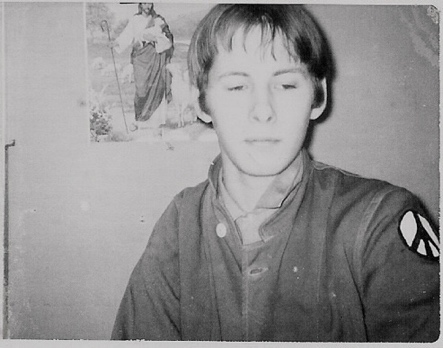
Briefly in mid-teens, I had a picture of the beatific Jesus tacked on my bedroom wall. In later years, I acknowledged his inspiration of some of the most admirable people I have ever known. Notable among these were non-evangelical Christians steeped in the social gospel of the 1960s. They were selflessly dedicated to uplifting the poor while not in the least given to proselytizing their faith.
I was never drawn into the fold but have always been an outside sympathizer. His waning influence–– while not surprising–– has certainly been disappointing…

Apparently, more than 75% of humanity “believe in god”–– however ‘god’ be defined. I would strongly prefer a world in which the 3:1 ratio were reversed. Yet I most certainly do not regard three quarters of the global population necessarily more benighted than the one-quarter segment of non-believers. ‘Religious VS non-religious’ does not explain the differences between the skewing towards the extremes of selfishness/unselfishness. I would contend that the greatest ‘saints’ of humanity through the ages are not those canonized by the RC church…
I do wonder why I am not inclined to believe. Even in old age, ‘Pascal’s Wager’ i.e., betting on the supposed chance that there is eternal reward for the believer–– makes no sense to me.
Informal research on what seems a gut-instinct has only confirmed the obvious. My skepticism of non-empirical claims is off the charts. Moreover, my profile checks all the boxes of those unlikely to believe in god or join in a religious congregation. As for the latter, I would find a service for those seeking fellowship to affirm non-belief almost as creepy as a gathering of speakers in tongues…
At the same time, I resist the label ‘atheist’ or even ‘agnostic.’ Declaring opposition to ‘theism’–– or even being uncertain about it––seems to lend its meaning undeserved clarity. I would rather concede that post-childhood, a “leap of faith” became as impossible as perceiving a sound outside my range of hearing.
In describing that disposition, I still favour an expression recalled from an undergrad class on philosophy of religion. In an oft-cited essay, moral philosopher, R. M. Hare, explained the irreconcilability of faith and reason not in the usual terms of their being two different spheres of ‘knowing.’ He rather described claims of faith than transcends reason as requiring a “blik”–– some indefinable tendency. Simply put: I do not have that religious ‘blik.’
Still, I have a dilettantish interest in religious history, culture and art. A highlight of travel has been innumerable visits to cathedrals, temples and mosques. In art galleries, I linger far longer before Pre-Renaissance religious paintings than before modern art. Both Gregorian and chants help me relax. I have a soft spot for old Christmas carols and religiously inspired choral music. ‘Jesu Joy of Man’s Desiring’ unfailingly leaves me misty-eyed. Can believers be any more deeply moved?

A boyhood friend, a former rock and roller, came to Jesus after waking up in a drunk tank. He went on to become a Pentecostal preacher. From readings about St. Teresa of Avila to anecdotes like that of that of my long-lost friend––I have always been curious about claims of epiphanic revelation. I am fascinated by the notion that the “sin of pride” may be swept away in a revelatory instant. ‘The Tower’–– depicting a figure plunging headlong from a turret struck by lightning–– had always been my favourite Tarot card. Still, skepticism stubbornly holds.
Perhaps the closest I have ever come to a ‘mystical’ experience was through a moderate dose of powdered psilocybin. That was taken a few years ago in latter day experimentation with what was missed in youth. Many trippers on psilocybin report transcendent beauty or even ‘spiritual’ revelation. Yet what was unconcealed to me was very dark. The darkness was like that of death-foreboding dreams.
In the hallucinatory phase, it seemed I was grasping the raw state of matter beyond mind. Therein, mind was nothing more than freakish epiphenomena of active cellular networks, evolved through the blind design of biological evolution. Amid these physical processes was my consciousness–– soon to be absent. Its absence would be utterly inconsequential in the cosmic moment before the return of all self-replicating cells to inert matter…
That glimpse of ‘reality’ was devoid of and ‘spiritual presences. There was no visitation of a sacred indigenous mushroom spirit let alone a guest appearance by Jesus… My ‘vision,’ rather, was of blind-force emptiness… Afterwards, I concluded that the experience evidenced much less about a spiritual awareness deficit than about my having peculiar serotonin uptake receptors…

Rather more revelatory over the last couple of years have been conversations with old friends who knew they were dying. One had received as a child, a full-immersion Baptist baptism in a Kentucky creek. Over the months of his cancer treatments, we had lengthy phone conversations about preparing for and facing the ultimate mystery. He joked that if there were a great beyond, he was sure to be severely scolded for his apostasy by his hillbilly maw-maw…
That friend was severely atheist. He sometimes proclaimed his non-belief in the manner of an altar call avowal of faith. Round his neck, like a rosary, he wore a miniature Buddha. It was a replica of one worn by his devoted Thai wife. Yet he also spoke fondly of the Jesus of the Beatitudes. Perhaps near the very end –– images of both the Buddha and the gentle Jesus passed through his mind…
Another late friend was the son of a liberal Anglican clergyman. In earlier days, he described himself as ‘spiritually inclined’ but not religious. Yet in failing health, he grew sympathetic to claims about supernatural phenomena. He was particularly taken with ‘analytic idealism’, as forwarded by philosopher, Bernardo Kastrup. My friend considered that standpoint allows supernatural entities (including god) a phenomenologically ‘real’ existence in human minds even though the metaphysics of reality is essentially unknowable…
Still, that old friend’s text messages were often dark. A few weeks before his death, he wrote: ‘I had heard that people with a terminal illness find a new vision of life that does not fear death, so I tried to trick myself into grasping the certainty of death… But no new vision. Even now.’
The permanent non-existence of those two irony-loving old comrades is still not quite possible to accept. Still harder to accept is that my turn is soon to come…

What was especially dreary about ‘Showers of Blessing’ on the radio as a boy, was thinking that for the elderly audience–– hearing that hymn was the high point of their day. I could hardly imagine lives so barren. The reference to “mercy drops” struck me as especially dismal. Those words seemed to encapsulate the lives of wizened creatures with nothing to look forward to. I supposed “mercy drops” for them would be an unexpected visit to their rest-home bedside. Maybe the visitor would bring a ‘sunshine box’ or even a volunteer kitty to pat. Could clinging to life in such a state, I wondered, be any better than being dead?
Now here I am. While spared as yet the health crises faced by old friends, I am haunted by speculation as to whether I could bear up to their suffering. Could I resist desperately begging for drops (or crumbs) of mercy? I can’t be sure.
There is the strange example of Phineas Gage, the 19th century labourer who survived an iron rod thrust through his skull. He completely recovered–– but with a personality utterly transformed. I would guess that nothing short of such a brain-splitting accident could cause my religious conversion…
But I have been deeply blessed by the gods of randomness. When my number comes up, hopefully, I will go out overwhelmed by gratitude… Supposing that the questioning habit persists to the very end––perhaps I will ask myself: ‘Is this it? Well, it’s not so bad, after all… So, what’s next?’ That question will almost certainly be left hanging.
A final thought on the performance of the Keralan Christian choir: How refreshing it was to hear such vivacity infused in that gloomy old hymn! Although immune as a mongoose to the message––admittedly, I was momentarily charmed…
-2026, September
***********************************************************************
👍🏼 😐 😬 🥱 👎 💩
 Coprolites in Amber (etc.)
Leave a comment