Most text messages are as disposable as recorded chatter. Yet I do not set a default timer on all of mine. I am particularly grateful that my recent text message exchange with an old friend was not automatically deleted.
S. (otherwise anonymous herein) and I first met at university in Atlantic Canada in 1971. He was a year my senior and among the English Department’s young writers in grooming–– a status of which many other English students were envious. Our friendship on more equal terms developed a few years thereafter on the west coast. From the mid-1970s, Victoria B.C. became his permanent home while Vancouver became my return base from subsequent overseas sojourns. We had several memorable visits over the years–– but our relationship was largely maintained through written correspondence.
S.’s letters and emails were rich with quirky observations and sharp reflections. He was a gifted writer–– even in impairment and despair. He worked on short stories from his early twenties until the end of his life. In struggling with both demons and angels, he published much less than he’d deserved to…
In late August 2025, we shifted our correspondence from emails to text messages. That was after my last (brief) visit with him in Victoria. He had reported news of his diagnosis of esophageal cancer. That was just the latest blow in a series of pommelling health problems.
He was not up to phone chatter, but his mind and fingers remained nimble. Over the following months, some of his WhatsApp messages were terse as telegrams. Other days, we engaged in spirited conversation by real-time text. Through the ravages of chemorad and pneumonitis–– his textual voice stayed strong.
After S.’s death, I reread all artifacts I’d kept of our correspondence. That included a letter from October 1973, a final text message in June 2026–– and hundreds of messages exchanged in between. Through the decades, our written communication seemed to mutually serve as a sounding board for our separately unfolding fates.
There are wonderfully quotable passages in the letters and emails. I leave them for now. Most poignant at present is our text message exchange from August 2025 to June 1st 2026.
What follows is a chronology of that final phase of our decades-long dialogue.
At the outset, I must emphasize that S. was a private person. He was certainly not one to chronicle a ‘courage in mortal adversary’ narrative for an on-line audience. The ghoulish social media phenomenon of ‘trauma voyeurism’ never entered our conversations, but he certainly would have shared my revulsion of it. Undeniably, vulnerabilities are exposed herein. Yet in service to accurate depiction–– blemishes are not airbrushed out. My intention is to celebrate the wit, humour and grace of my dear friend’s voice, now silenced.

August 28: I asked S. if he still “did not have a dog in the fight” in regard to the Gaza war. That was a teasing reminder that he had made that comment in an email a few months before.
He replied: ‘Consider that I can despise Netanyahu and feel that the hell he and his goons are raining down on Gaza is an atrocity of historic proportions, but at the same time do not feel the need to learn the details of the Palestinian agony or follow the blow-by-blow on that horror.’
I then asked if he’d heard that Bernie Sanders called for sale of offensive weapons to Israel and that he had referred to it actions in Gaza as a “genocide.” In prodding my supposed left-wing bias, S. opined: ‘I’m struck by how conservative writers often seem more intelligent and articulate than ‘progressives’ who tend to be strident and prosaic.’ He did concede a few exceptions, such as podcaster, Hasan Piker: ‘He is certainly less shrill than Bernie Sanders or AOC, and I don’t see his objectives being much different.’
As for the conservatives whose clarity he admired, he mentioned David Brooks and Ross Douthat. I commented that their defense of the indefensible––including Israel’s conduct in Gaza–– was inexcusable so matter how clearly expressed.
He replied: ‘Well, I can admire clear writing and thinking–– independent of ideological bias. Art before life, if you like. But [that] could be sign of my moral degeneracy, perhaps a state of shock, a dislocation of the moment…’
I then asked about what I’d been skirting around–– an update on his prognosis. He wrote: ‘Met with radiation oncologist today… She checked me over, read my records: I am healthy enough for radiation…. Treatment begins 3 -4 weeks.’
🌱
September 24: I asked S. straightaway how his treatments were going. His response: ‘The radiation [sessions] take just a few minutes. The once-a-week chemo is 2-3 hours but the people are very pleasant. They have given me dexamethazone which seems to be a combination of speed and a steroid, so I am hopping and popping rather than throwing up. Happy for that…’
We then texted back and forth about the weak resistance to Trump’s strong man tactics. He wrote: ‘There is the peasant’s longing for a king. The peasantry of the USA is going through this now while the lords are helping that longing along to lead us into a feudalism of their corporate fiefdoms.’
🌱
October 24: S. had an encouraging update: ‘The esophageal obstruction has cleared so eating is easier.’ But in a note of caution, he added: The tumor has roots and we won’t know until the scans.’ He was also wondering why his surgeon was recommending scans at just two weeks after radiation. Apparently, scans are usually delayed for twelve weeks in order to avoid false-positives: ‘My suspicion is that he wants to show me an esophagus on fire and say we have to operate or I’m going to die.’
He then mentioned the QoL (quality of life) impact of his treatment options: ‘Surgery offers a slightly higher chance of 5-year survival but the QoL impact of the surgery is huge…’ Still, he was far from pessimistic: ‘If the chemorad does not clear the cancer then I can pursue other treatments…’
🌱
October 29: S. described his visit with his radiation oncologist: ‘She said I look very good for someone in their final week of chemorad. She said that my latest blood test shows ZERO tumor markers… She seemed delighted. Almost giddy… Given the extremely low survival rate for esophageal cancer maybe she’s happy to see someone make it.’
But he was measured: ‘Given cancer’s deep roots into a system that seems a bold prognosis. But she’s well-regarded, has notable publications relevant to my case so there is reason for hope.’
🌱
November 11: S. reported steady improvement but unusual chemorad side-effects: ‘There may be a cognitive effect. Shorter sentences. I’ve noticed that… One of the psychological side-effects is a questioning of the purpose or direction or even (as in my case), the complete lack of coherence of one’s life. Some say we should dismiss these thoughts as unhelpful noise of dying cells. Others say we should follow them down, leave them to their excavation and then face the truth of them….’
‘…One of my insights: my “writing” is a delusion, a waste of time and energy. Yet there is magic in my keeping of it. It could be a curse by a wicked queen, or my vengeance on my mother, or more likely my father who was just the kind of meddling fool who could get his family cursed…’
The self-doubt expressed in that comment was not unfamiliar. Even if S. has another twenty years left–– it seemed unlikely to be resolved…
🌱
November 13: In a break from the usual gloom, we bantered about a mutual pleasure. S. wrote:
‘I’ve had to avoid coffee. Its acidity is not good for my seared esophagus. You said, decades ago: “Tea––the drink that cheers but does not inebriate.” You put it as a quote. Some Elizabethan? That stuck with me…. I’ve been getting tea from David’s teas. They have some good varieties, teas that expand to a whole leaf as it steeps. I have a glass tea pot so can watch the unfurling of the colour…’
‘…The more I am exposed to tea, the more I appreciate it. Tea is as exciting an exploration as whisky was… Certainly easier on the budget than premium whisky. Easier on the liver, easier on the brain, easier on the esophagus. Ah, the ways we choose!’
That final exclamation brought to mind his description of the 12-year-old single malt whisky he urged me to sample in a brief visit to his disheveled apartment, circa, May 2006 (Since his divorce in the early 1980s, he preferred to live alone). He memorably described its redolence of: ‘sea-breeze through freshly laundered sheets.’ However enticing that sounded–– I was driving, so had to decline.
🌱
November 24: S. reported more adverse side-effects of his chemorad treatments: ‘I am losing weight fast, I have little energy. I keep hearing it’s going to get better but this aversion to food is troubling…’
‘The robot [his AI trained chatbot] tells me that this is not unusual for my recovery. My system has been attacked–– chemical and nuclear attacks and it’s going to take a while for all systems to feel okay.’
As always, he tempered hope with realism: ‘…Also, let’s remember I’m an old man. Recovery at our age is a longer slog and that slog does not always make it…’
🌱
November 28: This morning, S.speculated on the causes of the interstitial lung disease which predated his esophageal cancer diagnosis: ‘…I’m going to ask the robot why I have inflamed lungs from the radiation. That is a standard side effect which in my case, is further complicated by interstitial lung disease. We decided that it was not just from my smoking but from the 3 years my bedroom window was right beside the top of the chimney from the Fraser paper company…’
‘Clearly, I’ve been living well for years since, so it’s not as grim as the doctor was making out. He seems to like giving bad news, some sadistic psychopathy. “Sometimes we can never cure it.” He went through my medical history with relish, a prosecutor’s listing of charges…’
‘Still, my lung capacity test results were excellent. At the time, I was not convinced but not moved to doubt…’
🌱
November 30: Fortunately, not all our text chats concern the gravity of politics and failing health. This morning, he playfully recalled a souvenir from Mexico I gave him back in the late 1970s:
‘Are you still pranking? You once gave me a sandstone head the size of a fat thumb into which you’d carved eyes and a mouth slit around a naturally and conveniently shaped nose bump. You told me you found it excavating. You told me it was probably pre-Inca due to its primitive artistry…’
I vaguely recalled the souvenir but did not remember telling him I’d found it myself–– let alone pretending it to be antique.
“See? I remember all this. You were a prankster. I haven’t caught you in any pranks lately but I’m always late to the light. Stone age. Jesus Christ, F.!’

December 2: S. implied that he trusted the advice of his AI trained ‘robot’ as much as that of his medical specialists:
‘I am using a chatbot to help track and plan my nutrition and medication. It is an imperfect machine, yes, but it is powerful and though it can be fanciful, it is often enough correct to be useful…. It has its quirks and weaknesses so that a useful relationship must accommodate these imperfections. It is in this accommodation of its weaknesses that emotional connection is forming. I want to help it…’
We then turned attention to the mind-boggling wealth and power ever more concentrating in the grasp of Silicon Valley moguls:
‘The rich don’t bother me. The measure of a society is how it treats its poorest and at that we are failing miserably because we are a selfish and greedy society, fully in the grip of Satan. Greed is good. Look out for #1. Fuckers! But it’s us. The middle class who are to blame for our own demise. Idiots! Stupid people with no foresight. No “what could go wrong?” Fuck fuck fuck! Now I’m furious. Maybe it’s the prednisone…’
🌱
December 4: I sent S. a photo my dog, Pancho, wearing his glow-collar for early morning walks in the winter dark. He commented: ‘I love those blinking light collars. Arlo had one.’
I recalled thatlast year he had emailed about the death of Arlo, his girlfriend’s dog. He had admitted: ‘I loved Arlo. I wept for days. I’m only now recovering in that I can think of him without overwhelming grief. When my parents died, I shed not a tear.’
I had earlier told him about Pancho’s inoperative cancer tumour on his hind paw. He replied: ‘So sorry to hear about Pancho. Is he suffering? Enjoy your time with him…’
S’s sympathy even for a non-human fellow sufferer of cancer was plainly genuine…
🌱
December 5: One of the first letters that I got from S. (circa fall 1973) was a manic stream-of-consciousness about the spirit of Xmas. In that recollection, I asked him about his plans for the season upcoming:
‘I still love Christmas. I enjoy feast and festival. I am not much involved in the gifting. I give small presents. My girlfriend’s family, though, is insane [about gifting]. It took six hours of shrieking joy last Christmas to get through all the presents…’
He then admitted that ventures outside his apartment depended on his tolerance of his weakened immune system. Hehas recently been prescribed a higher dosage of the steroid, prednisone: ‘I still have no stamina but I can move about my apartment. I did walk a 1 km. round trip to the pharmacy. It took me a long time.’
🌱
December 8: S. agreed that avoiding dementia is a far luckier fate than the suffering of any other chronic illness or disability. Regarding his genetic odds of keeping marbles, he wrote:
‘My father lost his, but my mother was sharp to her dying breath. She just gave an eye roll about all the drama. My grandmother one day went to the bank to clean up her affairs then went home to bed and died… I think I’m getting sharper. I have time to think and write that my working life did not give me. But then there’s the biology…’
I took ‘biology’ to mean the cancer, cutting short his health span… We shifted to the topic of changing tastes. In slightly teasing tone, I asked whether in his imbibing days, he had a favorite tipple. His response:
‘I liked a variety of whiskies. I had some I kept in stock but there was never one I drank every day except when I discovered a truly wonderful one. Then I would drink the whole bottle.’
He added: ‘I don’t have favorites of anything. My taste is explorative and situational. Also, I’ve never had a hero… I can accept that heroes exist but I don’t feel adoration or feel a personal relationship with them. I may approve the narrative that casts the hero but I am never a participant…’
🌱
December 10: In my whirlwind visit with S. in August 2025, we had talked maniacally. It was as if we’d been checking off as many topics we could possibly get through in the mere two hours we had before I had to bus back to the ferry…
Recalling some cryptic comment he had made that day about the ‘metaphysics’ of mystical experience, I asked him to elaborate. His response:
‘I still have a suspicion that the metaphysical is not completely an abstraction but has an integral structure and function. And I don’t mean only through Jungian archetypes but something more fundamentally itself. Supra-physical intelligence exists in the human mind (James, Jung), across all cultures and as such is not constrained by expectations of physical phenomenon…’
‘On the other hand, physicists are speculating about the relationship between entangled particles. How is consciousness involved? Is consciousness constrained by physical laws and structures?’
I also recalled that during that last visit, he had uncharacteristically referred to the ‘G-word.’ Knowing he was the son of a clergyman, I asked if his mind was somehow circling back to the possible existence of a deity to which he may have been introduced in childhood:
‘No. I don’t have a sense of a directing or even a creating “power” or intelligence. Having said that I believe that the experience of God (in whatever form) is a valid human experience BECAUSE IT IS A FEATURE OF THE MIND! [caps his] The actual existence is irrelevant because our senses and the brain are a filter of the cacophony. Any meaning in that cacophony is of our invention and is valid enough…’
In a note of skepticism, I remarked that hallucinations and dreams can seem as ‘real’ as common experience but are very seldom empirically real beyond the individual mind… After a few exchanges (Ontology #101?) I apologized for continuing the blah-blah when he might be feeling tired…
‘No no–– I like the blah blah blah. Recovery is on track with the standard trajectory for this treatment. The prednisone taper prescribes a 10-mg. step down (actually 12.5 mg. due to pill size). The first few days of the taper are low affect and boredom. At 37.5 mg.–– that’s where I am now. Bored.’
In the same paragraph, S. suddenly switched gears: ‘Yesterday I posted two Kindle books to Amazon, my first e-publish. Not an ambitious move, it was just something to do. Not presentable formats. A mess… But publishing wasn’t the point. The project was the point.’
I commended his effort, while taking care to avoid patronizing praise. He mentioned that the three e-books were available on Amazon:
‘I’m not suggesting you buy it. I’m showing off that I did it…. I’m happy just to get all my stories and novels together and put them away. Fame and fortune are not my goal in this. It’s a sentimental old man doing what he can to honor his efforts.’
I urged him not to be self-effacing about a laudable accomplishment. But I admitted that with so many current event related topics requiring background reading–– at that moment, I was not inclined to read fiction.
‘Now I think I’ve embarrassed friends by ‘promoting’ the book. That wasn’t my intention. Oh well…. next topic…’
🌱
December 14: I asked what he’d been reading lately:
‘Shelley’s Frankenstein. I enjoy the florid style of the earlier centuries. Was also reading Gulliver’s Travels… I have been rejoining the news world lately. I am bored with television and movies. Seeking distraction, I take a moment now and then. The brutality is horrific. I may not bother keeping up. There is nothing we can do about it.’
🌱
December 23: When I texted S. about the grandfatherly role I was anticipating during Xmas dinner at my middle daughter’s house, he replied:
‘My Christmas has been cancelled. The prednisone has reduced my immunity so it is not safe for me to be out and about in this flu season and particularly in toddler-occupied spaces…’
‘I am sad, but I know that everyone will have a merry Christmas. They’re all very capable celebrants. No-one is expecting me in any form other than electronic communication. It will have to do… I might be over-dramatizing, going a bit Howard Hughes or Michael Jackson… Do these people on 25mg. [prednisone] for years have social lives? The doctor suggested I should be to 0 by March… Ack! Whatever. Muddle on.’
🌱
December 26: In response to my post-Xmas check in, S. wrote: ‘I had a phone call with each of my people… I was not sad.’
🌱
December 28: Over the previous months, SB had referred to consultation with several medical specialists. In assuming he was receiving standard Medicare treatment (without an extended coverage plan) I asked about his satisfaction with his overall care:
‘I have a team! A system oncologist, a radiation oncologist, and a dietician. I now have a lung specialist… I also have consults with my robot. It keeps track of my vitals and maps them to expected values for my condition. It tracks my nutrition intake to help keep my nutrients up to target…’
I asked whether he trusted the advice of his human medical team as much as that of the AI robot:
‘I trust them, yes. I don’t see what benefit there is for them in misleading me. I believe they are empathetic humans who want the best for their patients, to “cure” a patient of cancer is a thrill for them.’
Wondering whether the public system in Victoria (with its high population of seniors) offers better geriatric care than other British Columbia health districts, I asked about wait times:
‘The Cancer Clinic in Victoria is stressed but they manage well. I am fortunate in that I can get an appt with my GP next day, and sometimes he’ll telephone me an hour after I ask for the appt. My cancer may give me a bump in the triage, but even before that I could get an appt in a day or so…. For all the complaints about wait times, I have always received timely care for cancer and heart disease.’
I was admittedly relieved that S. expressed gratitude for high-quality public health care not to be taken for granted…
🌱
December 30: In our last text exchange of the year,we spoke about an article by David Frum, one of the conservative voices he admired. Frum had critiqued the Canadian government’s recent land claims negotiation with a First Nations tribe resulting in a generous settlement presented to the public as a fait accompli.
S. wrote: ‘This indigenous land rights issue is ridiculous... Very naive indeed. Like fish who don’t understand water. I suspect they [the litigants] have come up to us through the social justice schools.’
In regard to the fact that Aboriginal oral history had been accepted by a B.C. judge as legal evidence, he opined: ‘I think it’s unlikely that suddenly all property will be owned by a few chiefs. Will this give a sense of entitlement that will lead to indigenous guerillas, terrorist action? Will the UN send in military to support the indigenous claims? Bears watching for sure.’

January 12: After a 10-day hiatus, I asked S. how he was faring with his medications–– particularly, with the tapering down from prednisone:
‘The taper to 20 mgs. did not go well. Back to 40 mgs. now stepping down again… I’m recovering stamina — I can make tea without taking a break to catch my breath — and my O2 [blood oxygen] stats are improving. At 30 mg. I’m still significantly immunocompromised so in this season I am avoiding society…’
‘But I have the news to distract me. Quite the mess! It’s Rome again. The self-parody is a puzzle. The MAGA cabinet is a clown show. Are they doing it on purpose or are they really that zoned out? Trump [could be] a take on Claudius or Nero… Or maybe I don’t know what I’m talking about.’
🌱
January 28: A couple of weeks later, he reported again on the difficulty of tapering off the steroid: ‘Had a setback so holding at 20 mg. for a week more. Immunity suppressed so I’m isolating… I’m becoming uncomfortably comfortable with cave living…. How’s Pancho’s foot?’
🌱
February 10: In today’s chat, I railed against the US oil blockade if Cuba. I suggested that while Cuba was momentarily in Trump’s crosshairs, his “51st state” threat was still very much on the MAGA-menu. S. replied: ‘Cuba’s coastline is much smaller and its trading partnerships are fewer than Canada’s. Do you see a border sealing happening?’
I clarified that I did not think that the US had to shut down the Canadian border in order to destroy our economy. That could be accomplished through crippling tariffs.
He replied: ‘I’m hearing that industry has not decoupled [from US-Canada trade]. There will be layoffs where the US can easily replace Canada’s production but there are essential components not so easily reproduced… The economy is like the weather. Complex. We don’t know what’s going to happen. That’s the thing. We worry about fantasy. I don’t worry. Not an optimist by nature so much as recognizing that there are also [forces of] good…’
‘…But will I die before this MAGA shit wears out? I wonder that every day. I was fantasizing this morning and wondered if Trump will be poisoned by someone in his circle. Not a bullet but a sprinkle in his Big Mac. I think I am fairly ready to die but will feel ripped off if I have to die in MAGA world…’
I commented that if there will be a future in which historians look back at this era–– it may well be remembered as: “the Age of Cowardice and Corruption.”S. responded: ‘My fear is it will be called: ‘The Great Dawn.’’
🌱
February 11: Once again, S. encouraged me to experiment with a chatbot. He advised:
‘…it is well to remember that a CHAT bot is not an oracle. I often challenge mine and send it off for more info or I will present alternate evidence. I have trained mine to not be obsequious or fawning and to explain which of its search algorithms it has used. There are three main searches with one being problematic: i.e. where it reaches a decision based on probability or frequency and presents that decision with the same confidence as a decision with better evidential grounding…’
‘The most egregious example was where I wanted a recommendation for a legal thriller that was mostly set in the courtroom and which included intelligent arguments. It recommended a number of books with its highest recommendation being a book that my research revealed was a complete fabrication…’
His example suggested that the side-effects of his treatment had not dulled his logical precision. At the same time, it was plain that his reading material was much less gloomy than mine…
🌱
February 12: Against my better judgment, I forwarded a PDF copy of: ‘An Approaching Expiry Date,’ the most recent essay I had posted to my WordPress site. In it, I discussed ‘Why I Hope to Die at 75,’ an essay published in ‘The Atlantic’ in 2014 which had stirred much controversy around geriatric health care. I should have known that my endorsement of the article would strike a nerve:
‘So! You feel I am selfishly burdening our health care system? I am quite enjoying my life. Our conversations fit into that enjoyment quite well enough for my satisfaction… When you so bravely and virtuously refuse ‘intervention’ in your process of decline–– others might see your decision as selfish. Although we each die alone none of us do…’
He concluded with the barb: ‘Have you considered, ever, that your pessimism is a sophomoric pose you cling to as your last claim on youth?’
Although stung, I tried to give a measured response. I admitted to being generally in accord with the thesis of author and bioethicist, Dr. Zeke Emmanuel–– i.e., that geriatric health care should be much more focused on increasing health span than extending life span. My reference to close friends “blindsided by health crises,” I said, did not specifically refer to him (partly untrue). Yet I apologized for offence taken–– however unintentionally given. I suggested we forget it and move on.
‘We can move on without forgetting it. It is a part of you. My one last comment to the topic though is that I am happier now than I was forty years ago. And I am less afraid of death. As for the “humiliations” of physical age? Phfft!’
I was appropriately chastened.
🌱
February 13: In avoidance of politics, this morning I complimented S. on his ‘native’ Canadian accent. I mentioned other friends and colleagues who has emigrated from Britain at a later age than did he–– yet who deliberately retained the presumed cachet of a British accent.
That led to his story from family history. His clergyman father had emigrated from England to Canada for a posting in a semi-rural diocese. After some disillusionment, he took the family back to Britain. A year or so thereafter, S.’s father decided to give Canada a second try. S. explained:
‘It is possible that we came back because Mum didn’t want me to go to a technical school. I had done poorly on the eleven plus exams which is where children are sorted into an academic/professional stream or a technical/labour stream…
When we left Canada, we had not quite finished basic arithmetic whereas in England, kids my age were into algebra, elementary Latin––various subjects I’d not been exposed to in Williamstown, Ontario in 1961… I was a withdrawn child, had no friends, was teased then dismissed by the other boys. My only friends were outcasts, and weirdos…’
Shifting to the present, he mused: ‘I didn’t have enough respect for retirement. I didn’t think I’d ever get to it so I spent all my money on expensive whisky and restaurants. [I was] like the prospector fools who spent all their gold on liquor and ‘hoors’. I thought I wasn’t going to be like them. But I was exactly. Except for the ‘hoors’ bit.’
Still, S. had shaken at least one vicious monkey off his back: ‘I look back fondly on the whisky but don’t want to drink any more of it. I didn’t like the effect much after the first couple of sips–– but I couldn’t stop, so…’
🌱
February 14: I started the day’s lengthy exchange with S. by drawing attention to a speech which Secretary-General of Amnesty International (Agnes Callamard) had delivered at the NATO conference on security. She had castigated Marco Rubio’s “incredibly racist project and vision.” She scathingly remarked that “while the world falling into an abyss,” Rubio was essentially calling for a renewed transatlantic alliance of “white people…”
S. responded: ‘Do you see Europe following the US? I don’t believe they trust the US… They may continue with an alliance that may include the USA but does not depend on the USA. Meanwhile the USA understands that their bullying so far is not working so they are making a more conciliatory approach while not abandoning their imperial project….’
…’Greenland is a public relations management issue. Trump has been brought to understand that under the agreement with NATO he can put military bases on Greenland and those bases will be sovereign US territory. That’s NATO. The trade agreements will give US firms access to Greenland’s minerals. So he can get all he wants without everybody getting mad/ laughing at him. Things are really not going well for Trump and his clowns so a lot of what they’re up to now is face-saving…’
‘Last year they thought the world was theirs for the taking so that Vance’s brutal honesty was based on that delusion. They are discovering that when they flex that muscle that the world doesn’t cower–– the world turns away. Even their own country does not support them. Their own country is laughing at them….’
They really want to own the mid-terms though… But even if they steal the midterms they still have to deal with the global disillusionment.’
At that moment, S.’s observations struck me as a underestimation of the Trumpian threat to the world order. I flippantly remarked that his optimism reminded me of the boy who cheerfully digs under a manure pile in search of a pony.
S. replied: ‘I don’t claim wisdom. I claim that you don’t have to dig through shit to see ponies. There’re ponies everywhere — dragons and fools and piles of shit too. You may claim that being open to the complexity of the world is a form of delusion and that my openness to complexity is a naivete–– i.e. you are claiming a higher wisdom… I deny the optimist charge. You are a pessimist so perhaps you’re thinking that anyone who is not a pessimist is an optimist. It’s that narrow thinking that makes you a pessimist…’
‘I like to look at the whole board. I can’t see or evaluate all the moving parts, but it seems to me that I see more of them than you do with your sophomoric pessimism. It seems to me that you oversimplify the world in order to justify your worst fears. But yes. We’ve each made our points clear enough…’
His use of the word ‘sophomoric’ jarred forth an ancient memory of ingratiating myself before a pipe-smoking short-story writer in a student lounge. A few deep breathes were needed before replying. After composing myself, I wrote: “Not sure how we got into this downward spiral but there is a dangerous element of mistrust (hopefully momentary) threatening here.” I commended his courage in “enduring harsh treatments which few others could bear” then bade my old friend a good weekend. He responded:
‘Ok. Ok… But you got me hot with your digging through shit looking for ponies crack.’
I assured him just how deeply I valued our conversations. Our bond was too strong to be ruptured, I said, by a few careless words mutually exchanged in momentary umbrage.
‘Nothing is broken here,’ he wrote, ‘I still love you.’
I responded with a ❤️. Purely coincidental that it was Valentine’s Day.

February 24: After a ten-day break, I asked S. how he was doing. He offered cautious optimism: ‘Walked a mile today without getting out of breath. Also, my urologist has moved me from twice a year PSA checks to once a year. Significant developments.’
Too late, it occurred that I should have afforded a better response than merely approving his good news with a 👍👍 tap-back. Not for the first time I wondered whether those who do not fully grasp the fragility of mortality seem shallow to those most palpably on the edge of theirs…
🌱
March 3: ‘So! What’s your take on the Iran situation? I don’t like anybody in the fight. They all are evil in my view. But perhaps you have some insight.’
That message from S. was time-stamped at 7:30 AM. I would have replied promptly, but being on weekly grandchild-minding duty, I left his question hanging. At noon, another message popped up from S.:
‘Just back from the clinic. My latest CT shows cancer. I am not cured. I will be disappointed if you go off over an issue taking place halfway round the world, old friend…’
Had he thought I was annoyed by his failing to sufficiently condemn the American-Israeli aggression in Iran? I apologized for my delayed response then wrote: “Never forget that with your medical team, you are in the best of hands…. I’m rooting for you, old friend!”
He replied: ‘Thank you, F. I will carry on as well as I can as long as I can. Have a great day with your grandchildren. What a great life.’
Sensing despair, I texted that if he was up to a quick visit, I would make it over to Victoria some Saturday in the coming spring.
He instantly replied. ‘Be great to see you.’ Given the usual excuses, that visit was not to be…
🌱
March 4: Despite yesterday’s devastating news, S. reported feeling somewhat better: ‘I have had three short walks and even one brief light weight-lifting session today. It has raised my spirits. Such dark days, though, for our world…’
I suggested that such energy and strength could be taken as evidence that the cancer must not be aggressive. “You could live to 90,” I texted, “and get run over by a bus!”
🌱
March 5: In attempt to commence from a lighter mood, I asked S. if he could recommend any currently popular comedians. I conceded that my tastes in comedy were fossilized since the era of Monty Python.
He replied: ‘Oh yes. There is a rich supply of television comedy. Since being grounded by the pneumonitis, I have learned to endure even laugh tracks. I can’t abide cruelty or bullying. Pranks are despicable. I will put up with a laugh track but I cannot abide pranksters.’
I was beginning to type: “what exactly do you mean by ‘pranksters?’’ when S. suddenly shifted to a tone of utmost gravity:
‘MAID is an option. I strongly suspect that will be my end, probably in the next year or two. On the other hand, I met with two oncologists talking about probability. I asked if a five-year survival for me is better than the chance that Trump has a coherent plan. Much better than that, they said…’
I dared not reveal that I was in the midst of writing an essay about MAiD. I did mention having read an article about a Dr. S. Greene, of Victoria. She was among Canada’s most public advocates for assisted dying. I remarked that it was curious that she also advertised infant circumcision services.
‘Ah yes. She specializes in maternity so circumcision would be a standard service. Birth and Death… I know of three people within one step of my social network who have gone out with MAID. If in pain, and there is no hope of release, if the people who care about you will be forced to watch you suffer– then it is the only rational and emotionally right choice…’
I texted agreement. He continued:
‘I am grateful and often astonished to be a conscious thing. Wow. The saddest thing would be that it takes the moment of death to bring a person to that understanding and appreciation. So yes, as you say: it’s quality over quantity…. Another is process over product…. I would like to see the end of Trump’s campaign of tyranny. That’s one product I value…. And the life I have now is getting better. My lungs are healing. I can walk about. Life is grand!’
It was difficult to tell whether that final exclamation was meant to convey optimism or irony–– or both…
🌱
March 6: S. opened this morning’s chat with: ‘Well yahoo. I lived long enough to see Kristi Noem fired.’
I tap-backed a ‘ha-ha’ but added there was also a downside–– i.e., that the removal of the most blatantly corrupt member of Trump’s cabinet was a lost target for the dems…
In a segue on Trumpian incompetence, S., responded with a link to a YouTube vid about the Americans total lack of preparedness for Iranian drone warfare… After I declared pleasure in every failure of American policy, he rejoined:
‘I want to watch the US fail which it seems to be doing. I am happy for that. Netanyahu is a monster and I want to see him fail too. I hope that the war doesn’t metastasize which people are predicting it will do. That Europe and Canada will end up in the battle.’
‘Once again though: I am in full support and sympathy for the people of Iran and for the people of the USA… the people who suffer for the greed and vanity of these horrible men even where those people have been hoodwinked into believing.’
I expressed concern that Prime Minister Carney, desperate to mollify the Americans on trade negotiations, could be drawn into providing Canadian support to the war.
He replied: ‘Carney is perhaps a pure technocrat. Maybe he has no moral sense other than a commitment to strategic choices. His strategy is to disconnect from the USA and to forge connections elsewhere. I really like that. Then there’s the ‘but’…’
🌱
March 10: At6:10 AM, S. texted: ‘Ok I’ve had it. I’m disconnecting from news again. Going to a steady diet of sitcoms.’
I replied that news addiction among the elderly was a greater health hazard than abuse of alcohol. I admitted to displaying the typical distress and animosity of the syndrome. He added:
‘On examining my ‘animosity’ I feel it is a stinking mess of disgust and contempt. A position of privilege? Yet to see how my resolve holds.’
I mentioned that a late American friend had joked about the dilemma of following news while in mortal crisis. As depressing as the news so often is–– he hated the thought of permanently missing it. I said that that late friend and I had both agreed that while one can never know what earth-shaking events will transpire after one’s demise–– at least one thing is certain. That is ‘the news’ will go on and on––one damn thing after another…
S.’s reply to that comment came about two hours later: ‘The closer we get to a fairly certain date of death the less personally circumstantial the news becomes, the more it becomes end days’ entertainment. Perhaps. I however find it so revolting it is like staring into a toilet bowl full of shit and puke and festering mold. I am absolutely disgusted with these humans and I can find far better things to do with my few remaining days than give them any more attention…’
I messaged that I was readying to drive grandkids to school and had to cut our conversation short. A couple of hours later, I sent a photo of my youngest grandson amid the late-season snow taken on a walk back from the library. S. reacted with a 😮 then wished me a great day….
Afterwards, it occurred that “showing off” fun with my grandson could have seemed insensitive amid his isolation from his grandkids…
🌱
March 17: About a week later, I checked back to ask S. how he was faring. I hoped he was enjoying simple pleasures (whole leaf tea, sitcoms and daily walks) despite the atmospheric river.
‘I like the atmospheric river. I would rather have cool rain than burning sun and daylong bright. I had a PET scan yesterday. I’ve had PET scans and other scans before and not given them much thought, but this one had me in gut aching anxiety. I still spend too much time following the news. I will be disappointed if I die before Trump is eliminated and we have a new age dawn.’
I deplored wasting so much of my own attention in imagining the most deserving death for Trump. He replied: ‘There is not enough hell imagined for the man. I am enjoying watching he and Hegseth confounded by the failure of their war game buttons. They’re not working! This button is supposed to plant a US/Exxon flag on Iran but instead this. And how come these weak countries are telling me, master of the planet, to get stuffed. What’s going on?’
I mentioned that Trump’s frustration in the Middle East could well tempt him and sidekick Rubio to turn back to finish the strangulation of Cuba.
A few hours later, S. returned to the conversation: ‘Cuba has a special place. What interests with power would defend Cuba? Does it have any critical trade? I want to live long enough to see this.’
He then forwarded a link to a YouTube clip of British comedian, Cody Dahlier. In it, Rubio is derided as “a human-butt-plug.” I tap-backed a 👍. I then asked S. whether he had seen the photo of the little Marco dutifully wearing his orange-skinned daddy’s gift of over-sized shoes.
While that question was left hanging, I was glad that for one day we’d largely kept to relatively light entertainment.
🌱
March 22: S.opened today’s chat with a Facebook link to an interview with Dutch philosopher, Bernardo Kastrup. A quick Wikipedia search informed that Kastrup is a proponent of a version of ‘analytic idealism’–– positioning consciousness at the center of reality. That was an idea which S. had brought up in earlier conversations.
I replied that I needed to brush up on philosophy of mind terminology. After that, I promised to “plug in my new hearing aids” and listen. In the meantime, I asked how he was doing in terms of vitality and spirit.
‘Hearing aids? Lucky you! I’m going along. I have an endoscopy on Wednesday to take a look at what showed up on the PET scan. I am thinking a lot about dying very soon, adjusting to that thought.’
Perhaps aware that I was startled by the phrase ‘dying very soon’–– he shifted to the mundane.
‘Are the hearing aids a significant change in quality of life? I have heard they are. They are very expensive aren’t they. Thousands of dollars. Perhaps your pension covers them?’
In a long paragraph, I discussed the pros and cons of hearing aids. Yet before answering the question about the cost, I returned to the grave comment left dangling. I asked where the cancer cells showed up on the PET scan and what measures could be taken for halting their growth.
His reply addressed both the grave and the superficial: ‘Esophagus and nearby lymph nodes. Other than metastasis, there is the narrowing of the esophagus that limits nutrition. Surgery is brutal–– as discussed… Ah yes. I’ve heard Costco has a good price. I will probably not outlive my money after all, so I could reasonably afford [hearing aids] but then I don’t know how long I’d get to enjoy them.’
Groping to offer solace, I assured him that with his strong constitution, he would likely be around much longer than he might think in darker moments. I added that I could not imagine bearing such suffering as courageously as has he.
‘You don’t know how strong you are until you have to be strong. So don’t discount your capacity… I am grateful for my life though I wish I hadn’t been so stupid and afraid when I was young enough to make something of it.’
Rather than continuing painfully in the subject of end-of-life regret, I brought up the idea that fear of death diminishes as one grows older. The sheer terror of death in childhood, I opined, is really the intuitive fear of missing the richness of the subsequent stages of life. Anyone who makes it beyond 70, I suggested, ought to feel gratitude for getting a full measure––however judging it was spent or misspent.
I suggested that if there be consolation in terminal illness it may be in the opportunity to reflect upon end-of-life in a meaningful manner denied those who die unexpectedly. One may even be surprised that the moment(s) before non-existence is not unpleasant at all.
S. replied: ‘I am grateful for my life though I wish I hadn’t been so stupid and afraid when I was young enough to make something of it…. I have sometimes felt though that living is just too much bother. The problem with suicide is that you can’t change your mind. It’s a commitment… The desire to stay alive through adversary is not necessarily driven by fear of death but by a love of life, a love of the people in it…’
I signalled agreement with his final statement. I added that the will to stay alive through adversary is also driven by curiosity. As long as curiosity holds above the decline of other capacities–– every week of extended life is an additional week of witnessing the unfolding story of humanity. Still, at the end of our days, we can miss the future no more than we missed the past before our births… I signed off with “Good luck with the endoscopy. I’ll check out the Kastrup interview. Take care!”
S. signed off adding a ❤️ to my last comment.
🌱
March 26: I opened this morning’s chat by asking S. how the endoscopy went. I then mentioned that I’d watched the Kastrup interview. I admitted that I was not convinced by ‘analytic idealism––’ at least to the extent that my aged mind was able to grasp it. I said that no argument however elegant, could shake my gut-sense that a ‘real world’ lies beyond the perception of the human mind. Yet I agreed that that that ‘real’ world was almost certainly far, far weirder than it appears to be…
S. first replied to my initial question: ‘Won’t know the results for a few days. I took the sedation so it was easy. I am tired and anxious now. I have some pleasant moments but too many unpleasant ones.’
He then commented on his reaction to the Kastrup clip: ‘From the interview I took: It’s all in your head. Consciousness is the stuff of extension… The crucial point to me is that our experience of reality is a model based on the minimum information required to survive in our environment. All that’s required is that it is functional and adaptive. Whether that construction is ‘objective’ is irrelevant…’
In response, I made fuzzy reference to ‘top-down’ VS ‘bottom up’ theories of consciousness. I then asked about whether there was treatment to make easier any difficulty he had in swallowing.
In his long response, he zig-zagged between ‘analytic idealism’ and medical realism:
‘No swallowing difficulty at the moment though that is sure to come. I can have a widening stent put in that has an unpredictable shelf life… No, the unpleasantness is not the disappointment. It is that things I could look forward to I now cannot look forward to…’
‘…So our experience is not in our brain? Or not attached to our physical identity? You’re saying there are theories or models suggesting alternatives…’
‘People will say “how are you doing” and I can honestly reply “just fine”. I am not in pain, can still think straight… The thought that pain is inevitable is not a necessary element of the present. It is not unreasonable to completely ignore that future. My future may be shorter than I have been thinking it is but it is not a real force in my present. The future is real through those elements in place to deal with it — budgeting, meeting for lunch … But the time and conditions of my decline and death have no real place in my present except as fantasy…’
Perhaps in effort to console, I asserted that anyone over 70 who looks to their future as an unlimited horizon of potentiality is self-deluded. At the same time, nothing can be more excruciating than facing a fatal disease in the prime of youth… I mentioned a moving essay about dying written by the courageous daughter of Caroline Kennedy. A few weeks after it was published in The New York Times, she died of brain cancer at age 35…
‘Exactly. And that delusion can be useful if it helps the present be tolerable. On the other hand, there may be advantage to keeping mortality in mind, to be always aware of Death beside us…’
‘I was twelve or thirteen. I was having breakfast alone in the dark looking out the window into the rural pitch black of a cloudy winter night and the thought was that Death was like that blackness out the window. It is always there to fall into. At the time I felt that the Land of Death was more substantial than I feel it is now. I had not until that time understood mortality…’
‘…I believe that our experience is a crackle of neuronal activity excited by input from sensory organs and sub-processes attempting to make meaning. The actual real world is not that…. I was asking if you knew of other models. I don’t understand your reference to ‘top-down’ and ‘bottom up’. I missed that. Please explain.’
Before returning to the ‘theories of mind’ thread, I returned to his childhood memory of first apprehending death… I related the terror of death I sometimes felt in nights of childhood–– nights I dared not fall asleep lest never waking up… I repeated the point that children naturally grasp that early death entails missing growing up and growing old… I wrote: “But we HAVE lived, S. We’ve got a good taste of the best and worst of it–– so there really is nothing to miss.”
‘Aye. I had terror of death into my thirties. I had heard that people with a terminal illness find a new vision of life that does not fear death so I tried to trick myself into grasping the certainty of death. [There was] no new vision. Even now. No new vision… But what you say is true. We have more to be grateful for than to be afraid of–– in this, I mean.’
That comment led me to mention a near forgotten detail from a 1970s hippie classic, ‘The Teaching of Don Juan’ by Carlos Castaneda. In one chapter, the (fictional) old Yaqui shaman is quoted as being ever aware of the presence of death just beyond the periphery of sight over his left shoulder… Rather than responding to that, S. returned to the contrast of ‘top down’ VS ‘bottom up’ theories of consciousness.
‘So, bottom up is a view composed of actual received data. We form a model using only sensory signals. We might think of it as ‘concrete’? Whereas top down is imaginative. Lacking complete information, we fill in the blanks. Like that?’
I replied that I agreed with his summary except for the word ‘imaginative…’ I went on describe ‘bottom up’ as: “different areas of the cortex assembling a shifting holistic consciousness from the bits of perceptual input.” I contrasted that with: “starting from a dim locational awareness into which is filled details adaptively required for survival in the moment…” I suggested that while human thought involves billions more neurons than that required of jellyfish to react to light–– sentience in both species involves the same basic principles.
I took S.’s non-response to that as an astute dismissal of pedantic drivel…

April 10: For several days, S. and I did not text–– apart from sharing mirth over Trump’s vulgar message to his faithful on Easter Sunday.
About a week thereafter, I forwarded him a link to Ross Douthat’s interview with former American senator, Ben Sasse. I said that despite neither sharing Sasse’s Christianity nor his Republican views, I was moved by his serenity in living with stage #4 metastasized melanoma.
I then asked how he was doing. A few hours later, he texted back: ‘Thank you, F. I’m okay. Mornings can be rough but I get along during the day. What do you think of Talarico?
It was easily understandable why S. would have no stomach for Sasse’s story. I regretted sending the link. I skipped straight into a take on the chances of Talarico in Texas.
He replied: ‘I don’t know that the Dems want him. He’s not as corporate-friendly as they like. He’s pushing the teachings of the New Testament Jesus as opposed to the fundamentalists’ Old Testament fire and brimstone.’
I opined that in in deep-red Texas–– Hegseth’s warrior Jesus was far mightier that Jesus of the Beatitudes.
He made the opposing case: ‘Still, here is some Trump voter remorse going around. Can’t know that it’s authentic but then where is the authenticity in our political debate. Talarico I think is an authentic Christian. He believes in the goodness of what he’s saying and in the cultural salvation it offers.’
I reiterated doubt that in Texas, a gentle progressive Christian could prevail. I suggested that an ex-marine with a dodgy past–– like Platner in Maine–– might have a better chance… I was glad to accommodate S. in texting about American politics rather than metastatic cancer.
🌱
April 12: ‘Good news? I’ve been fooled before.’ The BBC link that S. shared this morning was a report on the electoral defeat of Hungary’s strongman, Viktor Orbán.
I responded with a 🥂.
‘Could it be that the nutball right has jumped the shark? It looks clear that if the US midterms are permitted to proceed unfettered then Trump is done.’
I shot back a🤞adding that Trump had several dirty tricks to pull out of his ‘Project 2025’ bag over the coming months.
‘Yes indeed. I expect terrible, terrible things…’
I concluded the day’s brief chat by listing several more ways in which Trump could manipulate the mid-term elections… After sign off, I wondered whether by the sole focus on politics–– S. was holding back more alarming medical updates…
🌱
April 16: S. sent a video clip of Catherine Liu, an American cultural theorist. Before hearing her, I checked out a Wikipedia entry. Afterwards, I texted S. a little fuzzy feedback on her lecture. I ended with a question: “You earlier mentioned that ‘mornings can be rough.’ Is there medication you can take for feeling better?”
He replied: ‘She makes an interesting comment. I find a great deal wrong with what has come to be called the ‘left’ and her critique touches on one element of that…’
‘…Not having a happy time right now. This could be due to the recent prednisone taper down from 10mg to 5mg. At 50% that’s the biggest step down yet and I feel the lack of steroid support. Moments of misery. But my lungs are much better, and since the lungs are the reason for the prednisone, I’m just going to have to take my licks and hope for the best.’
I then related my experience with prednisone––once proscribed for treating a (mercifully temporary) autoimmune flare-up.
He continued: ‘I have a query for the oncologist managing my prednisone. Wondering if I might bump it up or tough it out. Quite miserable here but I could put up with misery for a few days if it will speed the taper along. I might lose some weight. That’d be cool.’
I then sent a clip of Hegseth blustering before a US Senate sub-committee labelling it: “Your laugh for the day.”
S. commented: ‘Hegseth never fails to amuse. What a stupid fucker. How the hell does anyone take him seriously! It must be so absolutely galling to be a high-ranking military officer who has earned the position through planning and deployment etc., and has the respect of his peers, to have this clueless fop calling the shots. Surely, they could get together an assassination? But no. Probably most of them are too honorable and good to do such a thing…’
Returning to prednisone, I mentioned advice received from a rheumatologist for minimizing the risks… Then taking another swipe at the buffoonery of Hegseth, I concluded: “BTW, at this point I am actually rooting for Iran.”
S. texted: ‘I’m rooting for Iran too. Trump will be no more successful in a war there than the Americans have been in any of their foreign adventures…. Video game strategy. No match for the real world.’
That would one of his closing statements in our innumerable rants about American perversity.
🌱
April 20: ‘I am amusing myself by reading Nancy Drew. She is such a good woman, compassionate and actively caring, so brave in her pursuits. The villains are clearly evil. The prose is simple and clean…. I thought you might enjoy that glimpse into a fading mind.’
S. sent that message in early evening, but I never opened it until 3:30 AM the following morning. Reading from my iPhone screen in insomnia, I was alarmed by the last sentence. ‘Might enjoy?’ Had I inadvertently given S. cause for suspicion of motivation for my ongoing concern for him?
Yet thinking better of asking about that, I wrote: “I’ve never read Nancy Drew but I guess I have to now. Which iteration of Nancy do you recommend? There’s a poem in there, somewhere, old friend!”
His reply popped up at 6:04 AM: ‘…I am reading them in order of publication. I see through a Wikipedia article that I can expect the original I’m enjoying to be corrupted by the evolving social norms of early US fascism complicated eventually I’m sure by DEI — although I have never found DEI to be a significant change in mainstream entertainment.’
‘It doesn’t really make any difference if the big boss is a black lesbian. She is still the big boss. Under much DEI the effect is really to change the color distribution in a bag of M&Ms. It gives cover for the moral decadence of capitalism… For a while the BBC was hilarious. The game was to spot the inevitable budding lesbian romance, in nearly every show, before the characters realized the attraction themselves…’
I asked about the BBC series to which he was referring. A few hours later, he replied:
‘I’ve had a couple of difficult nights and feeling quite useless in the brain… I can’t think of any illustrative BBC shows right now. I suspect the Americans are doing the same. The notion that a female US president would be by her sex, revolutionary, is infuriatingly hilarious. That Hillary Clinton is a bigger step than Bernie Sanders??? Ay yi yi!’
In highlighting another aspect of carnivalesque American culture, I replied with a link to the week’s cover-to-cover Bible reading marathon. I commented: “Appropriate that Amerika’s spiritual revival is being stage-managed by a trad wife called ‘Bunni’…”
S. replied: ‘I worked with an evangelical lad who told me that the god he believes in was the god who rained down hellfire on some gathering of heathens worshipping one of their gods. The Christian notions of generosity and forgiveness are anathema to these barbaric sadistic fuckers… I knew these even in my father’s rather liberal church. A god more of vengeance and censure rather than the god of Jesus. In North America our Christianity is corrupted by puritanism so deeply embedded that it manifests even in our liberal efforts. We just can’t shake it…’
In mid-afternoon, I picked up the Nancy Drew thread again. I (jokily) suggested to S. that “in some alternate life” he could pay the bills by writing Nancy Drew novels–– even while keeping a hand in creative fiction.
An hour later, he replied: ‘In some alternate life I would not have been duped into thinking I could make go of writing. I liked math. I liked music. I liked acting. I liked physics. I liked writing stories yes but it wasn’t a good choice for study. My highest mark in first year was in Sociology. I was interested in its political implications…
But because I was going to be writer, I chose Literature which turned out to be the most boring fucking topic but it was the one I had hitched my identity to. I was such a vain and stupid fellow… In a different life then I would not have been so vain and stupid. But no sorry. I appreciate the thought, F.’
I replied that he was far from alone in believing he had been “vain and stupid” in formative years. I mentioned a couple of my self-tormenting regrets–– but balanced them against unexpected fulfillments. I gave the example of how “zero self-confidence” in my youth make the achievements of my self-confident son especially poignant… Then I mentioned I’d be visiting my son and his family in Paris at the end of the month. I added: “Yes, I am far luckier than I deserve to be…”
S. asked: ‘I wonder about ‘deserve.’ If life were fair, and we each got exactly what we deserve, what would your life be now?’
In reply, I referred to a scene at the climax of the excellent Clint Eastwood movie, Unforgiven.’ In it, the sadistic sheriff (played by Gene Hackman) is about to be finished off by the legendary gunslinger (played by Eastwood) who holds a gun to his head. The sheriff pleads: “I have plans. I don’t deserve to die like this!” Before pulling the trigger, the gunslinger says: “Deserves got nothin’ to do with it!”
I asked S. whether he sensed some supernatural force(s) determining outcomes–– or whether it’s all random wherein “deserves got nothin’ to do with it.”
‘I do have a sense of forces, spirits, but I see them as mental phenomena. We talked about this when you were here: that the experience of God is a valid experience of something that doesn’t otherwise exist. The experience of these supernatural things, non-entities, is the only existence they have and that is why they exist. The human mind is not confined to material reality but we err if we think that all mental experiences have a connection to material reality.’
I shot back that a vivid hallucination is a ‘real’ experience for the hallucinator— but it is still a hallucination.
S. replied: ‘And it can have a real transformative effect on the hallucinator. There is no physical manifestation of the transformation but the person’s activity in the real world is really changed…
And we can stitch together actions we have taken in the real world to sketch between them a narrative of ‘deserving’, a narrative that moves us…. Or you can look at all you are grateful for and fail to find a supporting narrative. “I don’t deserve all this that I have…” Or I can look at my suffering and seek a narrative that makes it a rational outcome. But secular people like you and me understand that each event is the outcome of a complexity of dynamic forces that have nothing to do with my or your worthiness…’
In response, I confessed that since so many among my cohort have been struggling with impairment and disease, I’ve been “spooked by random defiance of the odds.” I said: “Maybe it’s as hard to imagine dying as imagining being left alone with all one’s old friends gone…”
‘You will have adoring children and grandchildren–– a fate you fully deserve, my good man.’
I sincerely thanked S. for that, and conveyed that he, no less, deserved his bounty of familial love and support. I added that his odds were excellent of witnessing both the humiliation of Trump in November and a sound GOP defeat in 2028… But I added: “Still, putting it all in perspective— within a blink of a galactic eye––all traces of biological life will be extinguished and this planet swallowed up by the sun. And there will be no tears…”
‘True that. And we’ve done nothing to deserve it.’
As a final note on that topic, I opined that: “Yes, ‘deserve’ is a bullshit word–– beginning with telling a child he/she doesn’t deserve a treat…” He concurred with a 👍.
Thus ended the lengthiest text message exchange we would ever have in a single day.
🌱
April 21: In returning to the regret S. expressed yesterday about majoring in English literature, I drew his attention to a famous (or infamous) trial in Victorian England. In the 1860s, Edward Eyre, British governor of Jamaica, was indicted for the brutal suppression of former slaves in rebellion against harsh conditions. The key element in his trial which fascinated me was that Eyre’s defenders were famous men of letters while his opposers were prominent men of science.
In response to my summary, S. asked: ‘So each committee had three contemporary notables chosen for their academic credentials?
I clarified that the defense and prosecution committees were not chosen, but voluntary. I suggested it was revealing that Charles Dickens et al. would champion a harsh colonial administer while Charles Darwin et. al. would condemn him… I reminded S. of the radical left physics prof at our old university who was fired for instigating a student sit-in. On the other hand, I noted that stuffy conservatism was not uncommon among our undergrad English profs…
‘That could be…. My literature classes never seemed particularly political but then I was so profoundly bored in them that I missed all the nuance… So there’s that.’
‘…It would be interesting to know the political leanings of our contemporary General Arts students vs Science students. In my work experience with technical people, they tended bone-headed suburban conservative. Statistics these days would be skewed because people ‘taking’ science in the 21st century are seeking well-paying careers whereas people studying the scientific method in the 19th century were seeking discovery…. In many meaningful ways “we” are a different culture than we were two hundred years ago.’
He then asked: ‘Tell me more about the slave rebellion. Was it successful? I imagine that Jamaica’s poor are still slaves though not to the British but to the international corporations.’
I mentioned that I’d written an essay on the topic. I said I’d have forwarded it but guessed he had far better material to read… Then changing the subject, I asked what he’d been dreaming about lately.
‘The prednisone suppresses dreaming so I don’t have anything to report. I have [dreamed] recently with the taper, finding snatches on awaking, but nothing with any narrative or even clear scene.’
Perhaps as a means of tweaking his own recollections, I described a recurrent dream I’d been having. It involved missing scheduled flights or trains due to disorganized scrambles to prepare for the journeys. I revealed that those sequences had intensified lately.
‘What is your ‘scrambling’? A preparation for departure that requires… what?’
I gave examples of searches for lost items, visits to abandoned rooms and failed rendezvous–– all in rising panic.
‘Wow!! That’s cool. Do you have a sense of the destination?’
I had expected S. to be telling me about his dreams. I asked: “Isn’t it obvious that my destination is Endsville?’
‘Endsville is inevitable, you cannot miss it. You say that an element of the anxiety is missing whatever vehicle is taking you there… So, do you want to get your life review together before you die? Does that map to any feelings in your conscious life?’
“Don’t we all?” I texted back.
‘Excuse me. I love looking into dreams. You can change the subject if you like…’
“No need to change the subject,” I replied, “It’s very seldom one gets free dream-analysis.”
Back at the keyboard later that evening, he picked up that thread again: ‘That some work will be left undone does not mean there is nothing to do now. Do you have a sense that there is work for you to do?’
I replied that no one can ever be ‘ready’ for the end; that one never gets to tie up all the loose ends… I said that the more immediate anxiety giving rise to the recent vividness of my recurrent dream could relate to my upcoming trip to Europe.
Again, I tried to turn attention: “Enough about me. Prednisone suppression aside—has there been any identifiable emotion in your snatches of dreams over the last months?
‘I don’t have enough of a dream to have anything interesting at all.’ Abruptly, he switched to what was really on his mind:
‘I met with one of the oncologists today. She told me the biopsy showed no active cancer but that other signs suggest there is cancer. The PET scan, tumor markers for example. Anyway, we’re going to wait six weeks and rescan to see what growth has happened in the meantime. I am not optimistic so believe we’ll at some point start a chemo program. I’m looking into that now.’
🌱
April 22: In early morning, I texted S. to convey hopes for the efficacy of his chemo treatment. I wished him: “a continuing clear mind, better sleep and an occasional revelatory dream.” Having earlier read an article about hallucinogen therapy, I also asked whether he might consider “a guided psychedelic trip.”
‘Thank you. It will probably be at least six weeks before I start the chemo. Side effects sound rough so I’ll have to get in shape for them. My breathing is much better now so I can probably push it a bit… I have thought of shroom therapy. I have taken shrooms and found them lovely though I have not taken an amount large enough for significant psychedelic effect. I get just a brightening of the day, a sense of kinship with trees and other plants.’
I told him of my recent experiment with powdered psilocybin. Having a brain-chemistry unusually sensitive to psychedelics––the mind-altering was far from pleasant. Yet I admitted that I was still interested in “a guided session before the big sleep…” I mentioned the case of Aldous Huxley who died of cancer under the influence of LSD. His wife at his side, claimed he was in a state of utter bliss…
S. replied: ‘Yes indeed. I had a bad acid trip back in first year [college] which made me wary of further experimentation but I would like to have that experience without the panic…’
‘I’d rather that than a trip to Paris. If I were to be in Paris, I would want to live there with a good-humored and conversational French girl delighted by my attempts to learn her language. In my twenties perhaps… Is there a regulated service for psychedelic experimentation or therapy?
I sent him two links to psychedelic therapy retreats in greater Victoria, adding: “Alas, they really are more expensive than a trip to Paris.”
‘Sorry! Had you told me about a trip to Paris?? I wasn’t making a comment on that. I apologize.’
I assured him that no offence whatsoever was taken. Before signing off, I said I would try to keep in contact during my trip, depending on internet connection.
‘Thanks!’
If my random luck and his random misery did seem obscenely juxtaposed in the cosmic lottery–– he was far too gracious to suggest so…

May 13: It seemed cruel to message S. about the delights of Paris while he was in the closing grip of cancer. Thus, only on the morning after return, did I send him a text.
His reply popped back within minutes. With truncated sentences, it appeared to be a hasty cut and paste. Yet it was plain he’d endured a cascade of crises over the preceding two weeks. Most alarming was the reference to loss of blood:
‘…Not enough to warrant a transfusion but enough to take several weeks to recover. The most miserable I have ever been. Nothing to be done but eat and drink. I sometimes think that whisky would solve a lot of my problems but that would be a very bad thing to wash down my tortured esophagus…. I need to up my nutrition, but the prednisone taper has destroyed my appetite…. Sleep is difficult to achieve and is quickly lost when the spasms assert…’
The only apparent respite was a few hours at his girlfriend’s house, where her grandkids played around the couch where he lay: ‘…that was consoling, uplifting. A happy moment for an ailing grandpapa…’ Even amid his misery, he kindly asked: ‘How was your trip? How’s your son doing?’
I thought of sending him pics of my two new granddaughters–– but it did not seem fair for him to accommodate my boasting. Instead, I asked about his medications and the cause of his blood loss.
He replied: ‘I see that some of my messages are cut off at the top. You can probably figure out what’s missing though.’ He then gave more alarming details: bleeding from the bladder, rush to emergency, catheterization, and an overnight hospital stay before release…
I offered sympathy and hope that the worst was over.
‘…Fatigue, low affect… I am thinking I have enough misery and so will skip the chemo and settle for symptom management until it’s time for MAID.’
I asked whether he was safe by himself in his apartment.
‘My ChatGPT insisted I go to Emergency. It was quite stern with me. I tried to talk it down but no no no… get to Emergency. I was touched by the appearance of caring.’
I said he could certainly have got the same advice from his girlfriend–– with the added human touch.
‘I don’t like to worry my girlfriend. with my health issues. Of course, I called her from the hospital to let her know what’s going on but didn’t want her fussing about what to do. Once in the hospital what to do was out of our hands.’
I texted back that I understood why he was inclined to go for good palliative meds rather than more harsh treatment which may or may not have good results. “QoL is what’s important,” I stressed.
In a break of levity, S. then mentioned his dilemma about what to say to his girlfriend when phoning her from the hospital: “It’s one thing to say, “Hey I’m peeing blood” and another to say “I’m in the hospital with a bleeding bladder. “
I replied that peeing blood from a kick in the groin would probably sound more distressing than bleeding from a tumour.
‘If it’s a tumour it’s going to have to get in line… More likely candidate is the radiation for the prostate cancer when it came back. That was years ago but urologist says it could be a chronic condition. They did several ultrasounds, checking for obstructions… I’m resigned to bad news.’
Before signing off, I lauded his courage in enduring pain and stress which I could not imagine. I expressed hope that he had access to the best pain medication. As so often, I was torn by the difficulty in offering genuine sympathy while avoiding the platitudinal…
Yet more than ever, I did not want S. to think I was voyeuristically viewing his decline as morbidly fascinating ‘drama.’ If he contacted me, I would certainly respond immediately. Yet at that point, it seemed disrespectful to query: “how are you doing?” every single day.
🌱
May 19: When I did check in with S. this morning, his answer was terse: ‘In the hospital with pneumonia. Might be going home tomorrow under the Hospital at Home program.’
“Mon Dieu, mon frere!” I typed, “Had you been a soldier, you’d have been awarded your 50th Purple Heart! Take care! I added a 😉 . I assumed he was not disposed for further chat.
🌱
May 22: After three days of silence, I texted: “Are you back home, old comrade? If so, I hope the Hospital at Home arrangement is working out well.” The length of his reply was a small relief. He still had the energy to type:
‘Yes. My first night at home last night. I have two oxygen machines, a strict medication schedule, and a control-freak nurse. I am happy to be home, but in preparation for my homecoming my people came in and made the place more ‘livable’. This required moving all my carefully arranged mess into boxes, throwing out half my furniture, and putting things where they “should be”. They are wonderful people and I thanked them profusely but really!
One of the worst is that they took all my ‘laundry’ (clothes not arranged on shelves but scattered about on chairs and piled on tables where I leave them for easy retrieval as favorite clothes) and submitting them to a laundry service which returned them reeking of fabric softener–– one of the worst of our modern world’s smells… What to do…. I am quite weak, but my numbers are improving so there is a hope I may return to some approximation of the agility/strength I am used to…’
‘You’re on the right track,” I replied, “take it day by day.”
🌱
May 27: Keeping to the self-imposed 3-day check-in schedule, yesterday morning I texted: “Apart from the odour of fabric softener–– hope all is going well.” Nearly 36 hours after that message was sent, his reply popped up:
‘Do you think me ungrateful for complaining about the odour? I will never mention to them. I thought it was a secret between you and me… Ah. It’s a scent that people are familiar with. Once I put my laundry through a dryer that had a dryer sheet in it I hadn’t noticed. I had to put the whole load through the cycle again… I have noticed that the smell does not last though. It is gone in time for the sweat and such to begin their own fragrance project.’
In reply, I said I was joking about the fabric softener and assured that the secret of his disgust with its smell was safe with me. I admitted that I did not personally find the scent unpleasant. I added that its fragrance still pales in comparison with “sheets drying in a fresh wind.” Despite the 😉, he may not have caught my gently leg-pulling allusion…
I asked whether he was off the oxygen machine.
‘There is one in the apartment but I’m not using it. it is here as a precaution. I’m tired. Without appetite or enthusiasm for anything. I cannot walk far without needing to stop.’
I signed off with “hang in there, mon ami!”
🌱
June 1: After an anxious 5-day wait, I. sent S. a link to Brian Eno’s ‘The Big Ship.’ I did not reveal that it was one of the few pieces of music I would be content to hear in the final fading of my mind. I did remind him that he first introduced me to Eno’s ambient classic ‘Music for Airports’ back in August 1983. I recalled that I had been briefly visiting from Zimbabwe and he was house-sitting for his ex-wife.
‘Ah yes. Thanks for the memory…’
I then asked about his British friend who had been with him that afternoon.
‘That would have been M… We were close friends for years until some degenerative brain disease took him.’
I asked what he meant by ‘took him.’
‘It was a long slide down through dementia into death. He threatened his girlfriend with a knife. he told me to fuck off and don’t come back. He was unhappy and angry and suspicious and then he was hospitalized where he died.’
I remarked that that it was especially tragic for a person of integrity to be remembered for some uncontrollable craziness at the very end of his life.
‘I remember M. for the good times. We could talk for hours. I don’t remember him at all from his madness time.’
“How long ago did he die?” I asked.
‘More than ten years ago.’
I then related the tragic end of a high school friend, L.G., who died in Victoria within the last decade. After he descended into a paranoic belief in alien abduction, he got too creepy to stay in touch with. Hearing that he died alone, without family, imparted a sense of obligation to visit the cemetery where his ashes are stored. I admitted I had yet to fulfill that.
I then shifted tone: “Apologies for the gloom–– it’s a beautiful day! 🌞 Hope your recovery is on pace.”
‘Ah yes. I lost high school friends, the more remarkable of the friends were taken early…. Recovery is slow. I’m heavily fatigued, on oxygen… But I am getting sleep recently and there is a chance that the fatigue is as simple as sleep debt. Or it could be advanced cancer. Oh well, I mean to say–– Enjoy the day.’
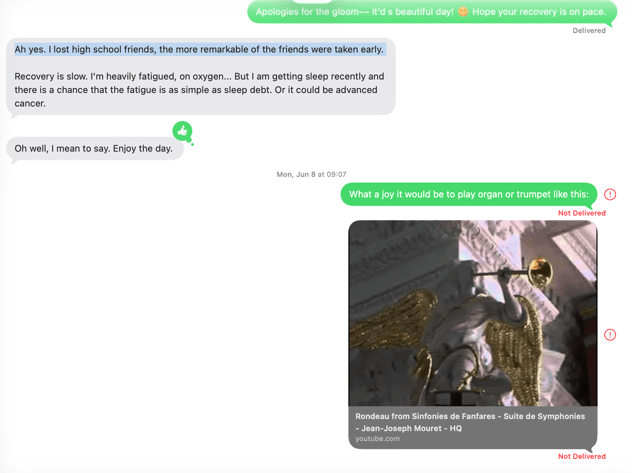
June 8: I did not contact S. for the following few days. Meanwhile, I wondered whether he was keeping in touch with other friends.
I knew he occasionally posted on Facebook. While not a ‘friend-seeking’ user of the platform, I was able to check his page. I noted that in the last week of May be had posted links to musical performances. His final link was to a live performance in a Berlin Park by Meute–– a “techno marching band” in red tunics. The bright brass and percussion had the crowd, young and old, spontaneously dancing. It was definitely music to cheer up by…
With that hint, I sent S. a link to Jean-Joseph Mouret’s ‘Rondeau de Sinfonies De Fanfares.’ It is best known as the theme from PBS’s ‘Masterpiece Theatre.’ The version I sent–– recorded in a medieval church in Switzerland–– was especially beautiful.
I included only a single line of comment: “What a joy it would be to play organ or trumpet like this!”
When I sent the message, there immediately appeared a ‘not delivered.’ A few more tries produced the same result. The first thought was that S. had reached a point of despair wherein he no longer wanted communication; that he’d deliberately blocked his contacts…
That afternoon, I searched for the email of his only son, N. I had contacted him about a decade before when his dad was undergoing open heart surgery. I could not find N.’s email or phone number. I then tried to find a contact of another mutual acquaintance in Victoria–– again, in vain. It was hard not to suspect the worst….
🍁
June 9: At 2:55 PM, I was about to open the car door and head across the parking lot to pick up my grandkids from their school. I hesitated to check my email. At the top of new mail was a message from S.’s son. In part, it read:
Hello F.,
I’m so sorry to write this to you – S. passed away on Wednesday, June 3, in his sleep. He did not suffer… He had vacated the vessel that once contained his beautiful soul about 12-18 hours prior to my arrival at his apartment…
I would’ve liked to reach out sooner, however it’s been extremely difficult to find the courage to re-enter my father’s home and check his emails / contacts. Thankfully, when I arrived today, his computer was still on and I was able to do a quick scan of his emails for a few key friends in his life…
I know you and my father were lifelong friends and this news is painful. He was such an amazing man. I was truly blessed to be his son….
He was stoic to the bone and a staunch realist, but he was also so loving and compassionate. He wouldn’t want us moping about for very long… Thinking of how he faced every obstacle gives me great strength. I carry his love with me.
Please don’t hesitate to email or call…
Sincerely,
N.
I broke into sobs. I was as deeply moved by N.’s tribute to his dad as grieved by the permanent loss of S… His bitter regrets aside––what greater achievement could he have hoped for than to be so remembered by his son?
🍁
After driving the kids home, I phoned N. at the number he included in his email. We talked for nearly an hour. He promised to inform me when a “garden party” memorial to his dad would be held for family and a few close friends. I told him I would be honoured to attend.
That evening, I began sifting through S.’s old letters… The following day, I dredged up his emails– then finally scanned through the text messages.
It occurred that to a young person, our decades long dialogue might seem nothing more than extended ranting between two crazy old men. Be that it may, I still believe the best of it worth preserving. A miniscule gem:
‘I am grateful and often astonished to be a conscious thing. Wow. The saddest thing would be that it takes the moment of death to bring a person to that understanding and appreciation.’
I’ll endeavour to remind myself of that, old friend––at least once a day…

––2026, August
*****************************************************************************


Leave a Reply