Along with too many fellow British Columbians, I could not have accurately identified the acronym ‘DRIPA’ a year ago. I certainly did know that reconciliation with Canada’s First Nations people was a government priority. That was especially needed after abuses of native children in former residential schools came squalidly to light. I was also aware that a resolution acknowledging church and government blame had been unanimously passed in the British Columbia legislature. Perhaps I was far from alone in assuming that legislation pursuant of reconciliation would be approved in the same spirit as the First Nations land acknowledgements, voiced at public meetings like grace before a meal. Then in late August 2025, the unforeseen consequences of the Declaration on the Rights of Indigenous Peoples Act jolted to public awareness.
The abrupt awakening to the new reality of DRIPA, came in a BC Supreme Court decision to uphold a First Nations’ claim to a large tract of land in Richmond, B.C. Although the parcel had been developed as real estate for upwards of a hundred and fifty years, the court ruled that the Cowichan tribe of Vancouver Island had traditional entitlement. Their claim was based on a reference to a fishing encampment in a diary of a nineteenth century British colonial official as well as to tribal oral history.
The provincial government tried to allay the non-Aboriginal property owners’ fears of dispossession, but the precedent was ominous. Among the questions raised: Were the Cowichan set to claim partial––if not full––compensation for land valued tens of billions of dollars? Could hefty recompense for First Nations’ claims be levied on other real estate transactions going forward? With so much of the province regarded “unceded tribal territory–” what other sectors of the provincial economy could be effectively held at ransom? I admit to some degree of sharing in such public alarm.
Yet I do recognize the need for reconciliation on fair terms. As a non-indigenous Canadian, I accept that fairness begins with acknowledgement of historical injustices imposed by ‘settlers’ upon Indigenous peoples throughout the world.
Perhaps the spiritual loss of the formerly designated ‘Indians’ of Canada is uniquely tragic. Unlike the descendants of the pre-Columbian Mexican empires (for example), the far northern tribes were too small and scattered to assimilate the non-indigenous invaders within a new hybrid culture. Over generations, their languages and cultures grew increasingly fragile in the encroachment of the new order. From today’s perspective, the nineteenth century ‘civilizing mission’ behind the establishment of residential schools was pernicious in concept. In practice, it was as brutal as it was unworkable. That is undeniable. Yet along with acknowledgement of historical wrongs, it seems fair and reasonable to ask: what manner of reconciliation is fair and workable for all Canadians?
When the United Nations passed the Declaration on the Rights of Indigenous Peoples (UNDRIP) in 2007, Canada voted against its adoption. The rationale of the (then Conservative) federal government was that Canada would formulate its own legislation for addressing the grievances of its Aboriginal peoples. Just months thereafter, the Federal government initiated the Indian Residential Schools Settlement Agreement (IRSSA).
A Truth and Reconciliation Commission (TRC) was set up the following year. Since residential schools had operated from the 1830s to the 1990s, only a minority of alleged abuses over the decades could be verified by living witnesses. Still, the commission gathered exhaustive– sometimes horrific ––testimony. Finally, the commission made recommendations for redress to ‘survivors.’ About three billion dollars was paid in compensation…
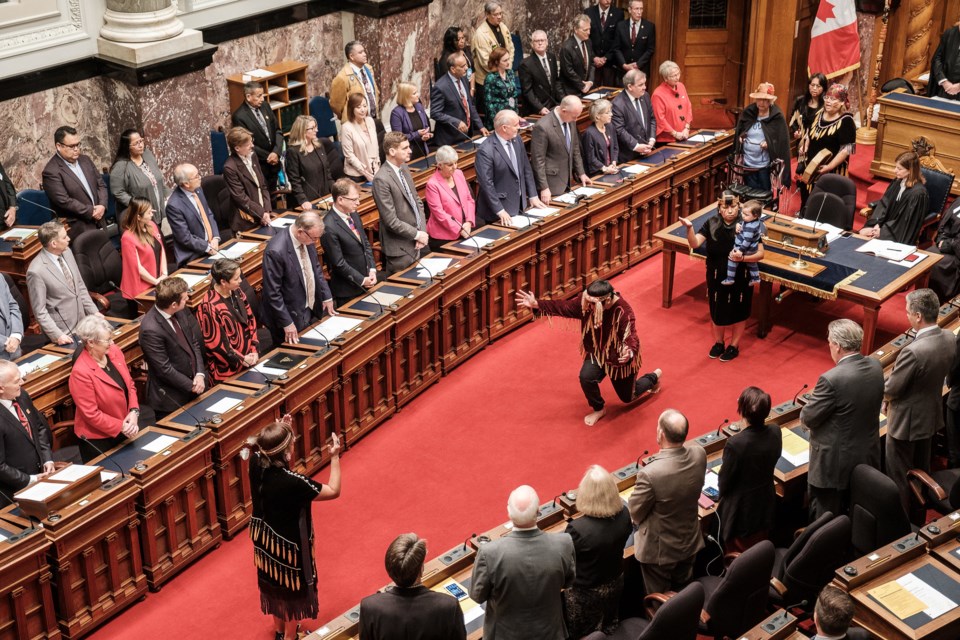
In 2016, the (Liberal) Federal government officially endorsed UNDRIP. The endorsement was initially considered as more “aspirational” than binding. Determination of legal compliance was left to the provinces. With DRIPA, British Columbia was the first province to make the United Nations declaration binding law.
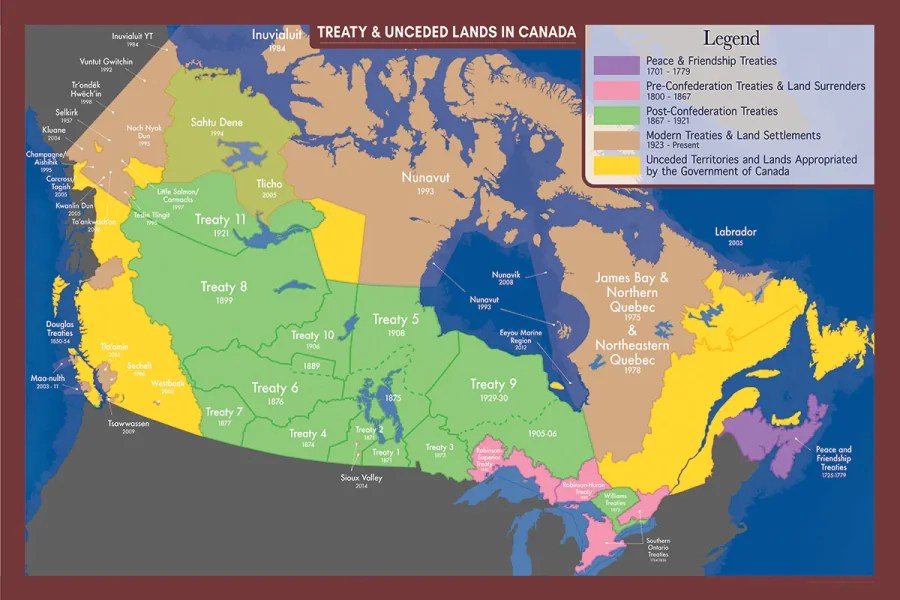
According to B.C. DRIPA legislation, Indigenous peoples must be included in all decision making which impacts their rights. That consultation clearly extends to all development proposals encroaching on treaty land. However, the perimeters of compliance on the 95% of the province regarded as “unceded territory” was left to interpretation and legal dispute.
Then in May 2021, came shocking reports of the discovery of unmarked graves outside the grounds of a former residential school in Kamloops, B.C. A radar survey indicated buried remains of upwards of two hundred bodies. While the local First Nations council decided against excavation, they believed that all the bodies were of children who died while in school residence. Not only were records at the school poorly kept–– but in many cases, the families of the deceased had not been informed of the cause of their children’s deaths. Understandably, the worst is assumed.
The news triggered international condemnation. In response, the Canadian parliament declared the discovery evidence of “genocide”. The federal government formally apologized and committed to further investigation. Within a month, UNDRIP was federally ratified as binding law…
The first tangible outcome was the creation of a National Day for Truth and Reconciliation. The new statutory holiday was first observed in September 2021––just a few months after the discovery of the unmarked graves. That commemoration–– accompanied by a proliferation of orange shirts worn in solidarity––probably marked the apogee of public good-will towards reconciliation. The costlier elements of UNDRIP compliance were yet to be borne.

The first post-DRIPA land claims settlement in British Columbia was negotiated rather than litigated. It was between the provincial government and the Haida Nation of the Haida Gwaii–– formerly known as the Queen Charlotte Islands. The 2024 agreement recognized Aboriginal title over the entire archipelago where about half the inhabitants are non-Aboriginal. Had that ground-breaking settlement affected territory closer to the province’s main population centers–– it would have attracted more public attention…
Meanwhile, DRIPA-based litigation began moving through the courts. In September 2023, the Gitxaała Nation chiefs on BC’s north coast won a case forcing the province to include a “duty to consult” in its mineral exploration laws. Unsurprisingly, the business sector reacted with alarm. Mining and pipe-line construction projects were feared in jeopardy. In response, the B.C. government urged calm and promised new partnerships between First Nations and non-Aboriginal interests. Greater prosperity was touted for all. That was a hard sell…
Yet the seismic reaction in the public was to come after the August 2025 landmark Cowichan Tribes v. Canada decision. The ruling seemed to potentially allow for aboriginal title to be retroactively asserted over any disputed piece of land. Whether or not that fear was exaggerated–– what seemed indisputable was the court’s bias towards the First Nations’ claimants.
Particular skepticism fell upon the conduct of the BC Supreme Court Justice who tried the case. Justice Barbara Young apparently repeated the word ‘disgraceful’ in recounting every action by the Canadian government (since Confederation) cited in regard to First Nations relations. According to detailed reports on the trial, she also repeatedly thanked Aboriginal witnesses for their “bravery” while rejoining their remarks with phases in the Cowichan language. Those phrases were neither appropriately translated into the official language of the court (i.e. English) nor even understood by all First Nations witnesses at that trial.
Writing in the conservative online ‘C2C Journal’ on September 30, 2025 (‘Manufactured Judgments: How Canada’s Courts Promote Indigenous Radicalism’), legal commentator Peter Best concluded:
‘ …Through her choices regarding the use (and misuse) of language, evidentiary standards, accepted witnesses, historical facts, legal precedent and basic logic, Young’s many small and often innocuous-seeming decisions laid the groundwork for a final, astounding and entirely revolutionary decision.’
It would be unfair to single out Justice Young for a bias which seems to be increasingly evident in court rulings involving First Nations claimants throughout Canada. For example, in a case in the Superior Court of Quebec (R. c. Montour, 2023) the presiding judge overturned guilty verdicts against two Mohawk men convicted of smuggling bulk tobacco into Canada. Yet the conviction was stayed on the grounds that the Mohawk right to trade tobacco was granted by “the Aboriginal legal system.” A layman might ask: did the Aboriginal legal system account for twenty-three tractor-trailer loads of tobacco valued at over fifty billion dollars on the black market?
Still, British Columbia has gone farther than other Canadian provinces in pursuit of UNDRIP/DRIPA compliance. Since 2022, all practising lawyers have been mandated to complete an Indigenous Intercultural course. In the same year, the B.C. Law Society adopted a sweeping declaration of intent to integrate “Indigenous laws” into existing legal practices. Not the least difficulty in achieving that goal is in determining Indigenous ‘law.’ There are distinct languages and cultures among the more than two hundred B.C. First Nations groups in B.C. Although there certainly were established traditional practices for dealing with social deviance–– such ‘laws’ were not codified in writing.
That challenge is not to deny the successes of First Nations Courts in B.C. They were first established in the early 2000s in recognition of the highly disproportionate numbers of Aboriginals in Canada’s prison population. These courts try (mostly) non-violent First Nations offenders in pursuit of restorative justice rather than punitive incarceration. In recognition of societal disadvantage in the history of many Aboriginal offenders, judges are required to review background factors (e.g. “intergenerational trauma”) before sentencing. Where appropriate, culturally sensitive rehabilitation is directed.
While this alternative sentencing system has not attracted much attention, in the post-DRIPA political climate it may come under new scrutiny. Given the supposed ‘advantages’ conferred upon Aboriginals by the new dispensation–– many may question the fairness of a First Nations’ offender undergoing a ‘Healing Circle’ ceremony for the same crime which lands a non-Aboriginal in jail.
Of course, there are exaggerated fears about DRIPA compliance. Misinformation may well be circulated with malicious intent. Still, it often seems that the staunchest advocates of social justice for First Nations peoples are blindly turning goodwill towards reconciliation into backlash…
Long before the recent changes in the legal system, effort to redress historical injustice in Indigenous/non-Indigenous relations was underway in Canadian institutions of higher learning:
Recognizing the need to revitalize Indigenous languages and cultures, in recent decades nearly every Canadian university has established a formal First Nations Studies department. In British Columbia, specialized training or study programs for First Nations are offered at every post-secondary institution. Law, land stewardship and Indigenous governance are among the courses offered.
First Nations history is presented with a critical focus. In this approach, the story of Canada is a dark narrative of ruthless colonial exploitation and First Nations victimhood. Such a depiction plainly serves to sharpen the righteousness of social justice activists––both Aboriginal and non-Aboriginal…
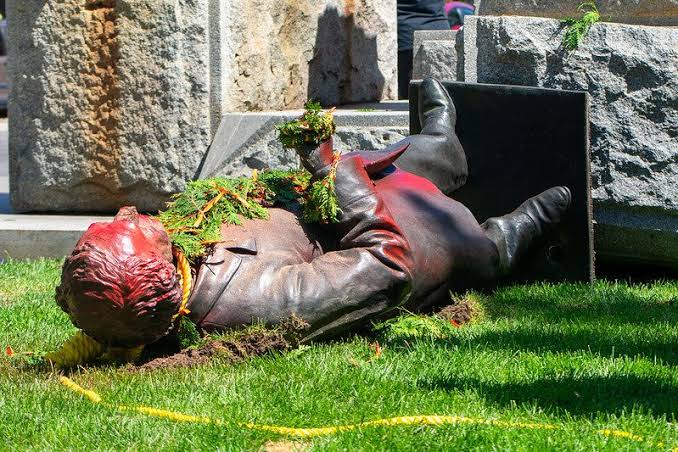
In recent years, First Nations advocacy groups have identified symbols of historical ‘oppression’ and have pressured governments to erase them. A prime example has been the targeting of Canada’s first Prime Minister, John A. MacDonald. In the critical reassessment, the erstwhile Father of Confederation is primarily remembered as the racialist architect of the nefarious 1876 Indian Act. In compliance with that judgment, his statues have been removed from the entrance of the B.C. legislature and even from his birthplace of Kingston, Ontario. His name has been expunged from numerous roadways, schools, and college buildings throughout the dominion. In the reconciliation-sensitive revision of history–– Samuel de Champlain, founder of New France, has fared scarcely any better.
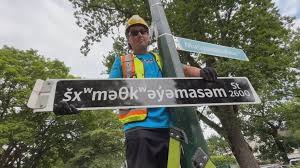
Still, in the positive spirit of reconciliation, the changing of place names to honour First Nations heritage has been generally accepted. One notable exception was in the renaming of a street in the tony Kitsilano neighbourhood of Vancouver. Trutch St. was first named nearly a century and a half ago after the province’s first Lieutenant-Governor. When alerted to the fact that Trutch had been openly hostile to Indians in his day, City Hall quickly assented to the local Musqueam Nation’s demand for a name change. The residents of the former Trutch St. insisted their concern was not about the new Musqueam name but its written appearance. As mandated, the name is rendered in the recently adopted orthography for northwest coast Indigenous languages. Mail delivery was only one of problems of the decipherability of ‘šxʷməθkʷəy̓əmasəm’ in the residents’ new address.
More consequentially, certain language usages generated in critical history academia have been officially sanctified. There is no room for questioning that ‘genocide’ and ‘survivor’ should apply equally to victims of Canada’s residential schools and those of Nazi Germany. In the most fervent critical view, non-Indigenous ‘settlers’ are obliged to recognize that every indigenous tribe–– no matter how small––is a ‘nation.’ Correspondingly, each of those ‘nations’ is deemed to have greater moral legitimacy than the entity ‘colonially known as ‘Canada.’’
In post-DRIPA B.C., government reports often include apologetic acknowledgements of the ‘unceded’ traditional territory of the Canadian birthplaces of non-Indigenous consultants. An excerpt from the preamble to the ‘2024 Harm Reduction Client Survey Report’ deserves to be quoted if only to illustrate its typically patronizing tone:
‘Consistent with the Coast Salish teaching of Thee Eat (truth) gifted to the Provincial Health Services Authority by Coast Salish Knowledge Keeper Siem Te’ta-in, we recognize that ongoing settler colonialism in BC undermines the inherent Title and Rights of BC First Nations and Indigenous Peoples…’
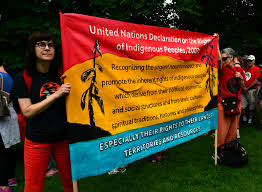
Until recently, non-Aboriginals tended to take such First Nations declarations of sovereignty as performative and inconsequential. Even talk of need for ‘nation to nation’ negotiations tended to be excused as political posturing… That was until First Nations leaders and their lawyers began playing hard ball. While governments earnestly pursue the constitutional “duty to consult,” the negotiating positions of First Nations counterparts seem to be ever more couched in hard demands.
In recent months, National Chief of the Assembly of First Nations, Cindy Nepinak, has been pressing government to act as an “equal partner” in making decisions in development projects on all ‘unceded’ territory. Terry Teegee, Regional Chief of the B.C. Assembly of First Nations, has even suggested that DRIPA entails First Nations “co-governance” of the province. The growing assertiveness of Aboriginal leaders appears to be bolstered by confidence in sympathetic judges–– including those of the Supreme Court of Canada…
One notable case currently before the courts suggests that demand for a First Nations ‘partnership’ in projects is not even claimed on the basic of equality. The case involves the tiny Metlakatla ‘nation’ of the B.C. North coast. The band is asserting aboriginal title right to act alone in a massive propane gas exporting project. If successful, that claim would negate a contract already signed between a company, the city of Prince Rupert and several other First Nations bands. The contract, now in jeopardy, was hoped to bring major economic benefits to the region. In litigating, the Metlakatla is potentially denying both non-Indigenous residents and other First Nations communities a share in the development. On the other hand, some might commend the Metlakatla for their business acumen…
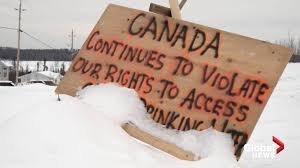
Rhetorical flourish aside, proponents of ‘nation-to-nation’ partnerships envision a future of prosperous Aboriginal communities free of dependence on government. Unfortunately, that laudable goal appears to be very distant. According to Google AI, Canadian federal spending for Indigenous priorities in 2025 was $32 billion. In British Columbia, hundreds of millions of additional funding were provided by the provincial government.
Every new announcement of funding seems to be met by a demand for more. A notable example regards the federal government’s commitment to provide water and sewage infrastructure to all First Nations’ communities. With the passing of the 2013 ‘Safe Drinking Water for First Nations Act,’ $9.4 billion was allocated over the following decade. Yet in that same period, complaints of boil-water advisories escalated. A few communities filed class-action lawsuits against the federal government for alleged human rights violations. In response to demands, the former bill was recently scrapped, and new legislation proposed for $4.3 billion of additional funding. The aim remains to provide both clean water and waste-water infrastructure to every indigenous community–– no matter how small or remote.
Plainly, access to clean water and sanitation is a human right recognized by the United Nations. Yet given the geography of Canada: is maintaining piped water and sewage systems for every hamlet––some with fewer than a hundred residents–– a practical solution to the problem? For villages above the tree line on permafrost the technical challenge is no doubt even more daunting.
However marginally relevant, the Canadian village of nearly two thousand residents in which I grew up–– like many others in the 1960s–– relied on individual wells and septic tanks… On another historical note: in the 1950s, residents of Newfoundland’s outports agreed to abandon their hamlets for larger villages where modern infrastructure could be provided…
Of course, it would be scandalous to suggest that some First Nations people be encouraged to move to larger villages where modern infrastructure could be more easily maintained. The right of a people to live a place where their ancestors dwelt from time immemorial is indisputable. Still, one is tempted to ask those who choose a traditional lifestyle ‘off the grid’: is the traditional spirit of self-reliance honoured by dependence on a distant government? But perhaps ‘a settler’ should know better than to raise such an outrageous question…
The keynote speaker at the 2017 Osgoode Hall law school graduation in Toronto was the Executive Director of the First Nations Child and Family Caring Society. From the Gitxsan tribe of Northern B.C., Dr. Cindy B. is also a prominent First Nations academic and activist.
Holding her signature teddy bear, she spoke of innocence stolen by the atrocities of residential schools. She concluded by asking the young grads to consider careers in the righteous cause of social justice for First Nations…
With my son among the grads, I was in the audience. From my (jaded?) perspective, her pitch seemed to be: ‘Don’t worry about declining jobs in the legal field. There’s plenty of lucrative work to be done on behalf of First Nations!’
I am not quite so cynical as to deny that there could be as many idealistic lawyers working in First Nations cases as there are doing pro bono legal aid. Yet high-mindedness was clearly not the motivation of one Calgary-based lawyer who stole $1.5 million dollars in bogus fees charged to claimants of residential school survivors. Then there was the Ontario lawyer who misappropriated $2.2 millions of reserve settlement funds paid in a land claim class action dispute.
Not all the grifters of First Nations directed funds are non-Indigenous lawyers. In 2025, the former CEO of the Denesoline Corporation, an arm of the Dene Nation of the Northwest Territories, was tried in a civil suit for embezzling over $11 million in community funds. Unfortunately, these are but a few examples of theft of money ear-marked for improving the lives of needy Aboriginals…
Then there are grey area cases–– not involving outright theft–– but misuse of funds by those responsible for managing them. A recent example involves the Office of the Commissioner of Indigenous Languages. In 2021, the office was provided $51.6-million multi-year funding for the revival of First Nations’ languages––an UNDRIP priority. Over the following few years, the government received anonymous complaints about the commission’s operations. Among them was a 4-day conference in Ottawa which cost $10 million. No charges have yet been laid but the transactions of the commissioner is under audit. Incidentally, a study showed that since the establishment of the agency, no measurable progress has been made in the advancement of Aboriginal languages…
As for self-dealing within Aboriginal leadership, I cannot resist citing an example from my own backyard. In 2024, the chief of B.C.’s Kwikwetlem First Nation paid himself more than $900,0000 as chief and economic development officer of his band. There was nothing illegal about ensuring his salary and benefits were paid on tribal land, rendering it tax-free. However, the self-dealt largess did result in complaints from a few of his fellow eighty-one-member ‘nation’.
While many chiefs, their kin and their retainers appear to be prospering–– the vital statistics for the majority of British Columbia’s First Nations people are starkly different. The education and income levels of Aboriginals compared with non-Aboriginals remain markedly lower. Levels of substance abuse and suicide are higher. Most starting is the difference in life expectancy. While the average lifespan for non-Indigenous citizens is eighty-three–– the average of a First Nations person is only sixty-seven.
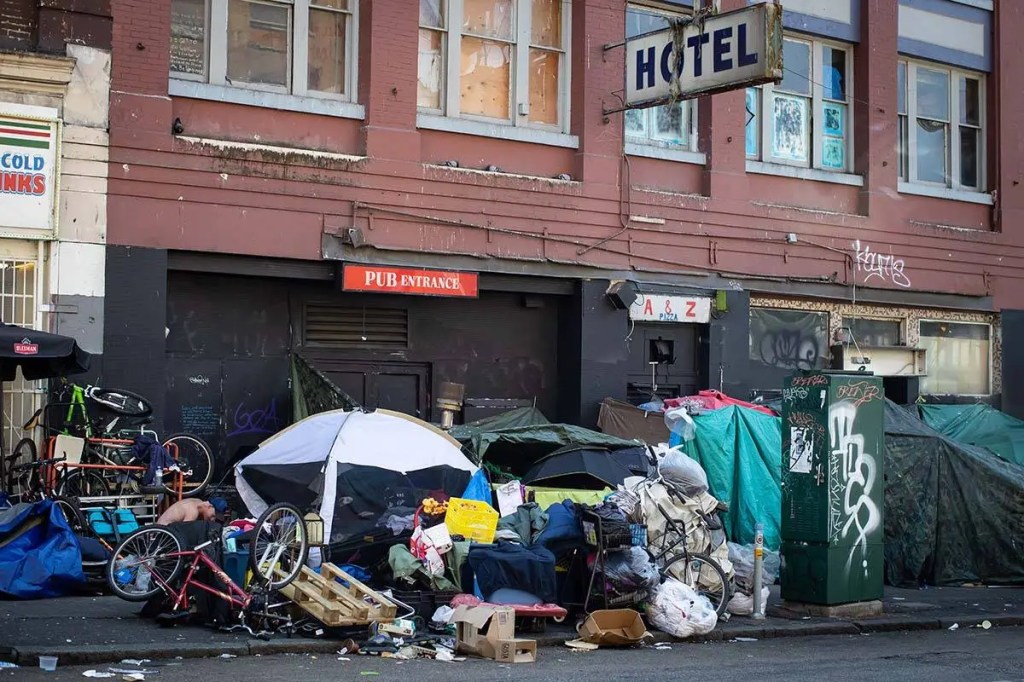
A slow drive along Hastings St.––ground zero of Vancouver’s skid row hellscape––will tragically confirm that far too faces of the homeless and addicted are Aboriginal. Over decades–– despite a succession of studies, programs and funding initiatives–– that fact has not changed. It is hard not to conclude that something is seriously awry…
I cannot make such foregoing observations without asking myself: as an old man distinctly on the left of most political issues–– why, on this one–– have I seemingly lurched to the right?
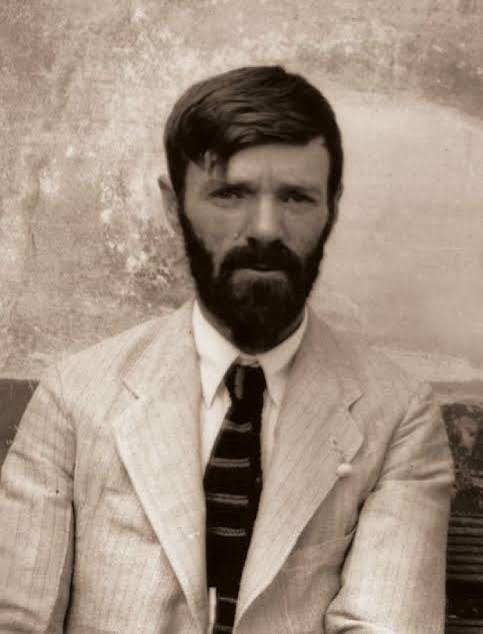
In wondering about this, I recall a passage from ‘Mornings in Mexico’ (1927) by D.H. Lawrence. The celebrated author of ‘Lady Chatterley’s Lover’ and other ‘controversial’ novels in his day was also a travel writer of note. In the 1920s, Lawrence lived in the American southwest and was fascinated by the Amerindian cultures of the broader region. In his travel essays from those years, he recurrently contrasts the sterility of industrialized ‘white’ civilization with the supposed vitality of Indigenous peoples.
In drawing attention to attitudes of ‘whites’ towards ‘Indians’, he observed two opposing outlooks. He suggested that indifference and suspicion of the “healthy vulgar white” was a natural reaction of settlers towards natives. He was less forgiving of the supposed attitude of “highbrow” whites. He derided their patronizing attraction to native culture (e.g. artifacts and dances) paired with a naïve romanticizing of the people themselves…
However dated Lawrence’s terms of reference, his observation may capture a truth about non-Indigenous attitudes towards Indigenous people in Canada today. Our non-Indigenous social justice warriors often seem as naive in their earnestness to redress historical wrongs as Lawrence’s “highbrows” were naive in overlooking the harsher aspects of Amerindian culture. In their patronizing view of First Nations fragility–– the “highbrows” of our day often seem blind to the vulnerabilities of the greater nation…
In such regard, it is not surprising that tribes in both Alaska and in northwest Washington State are seeking to assert Aboriginal rights and title claims in British Columbia. If it looks so easy to take advantage of Canadian judges––why shouldn’t they try their luck?
As for the attitude of the “vulgar white:”
I sometimes jarringly recall the interview in May 1976, in which I first applied with an NGO to teach in the developing world. I had recently returned from backpacking along the Gringo Trail and was fairly-well versed in the history of Latin America. I was able to talk at length about the poverty witnessed amid potential plenty. But then the interviewer asked what I knew about the Dene people. At the time, their traditional lands in Québec were being flooded to make way for the James Bay hydroelectric project. I was stumped. I couldn’t even point out their territory on the map of Canada on the wall beside…
Despite that embarrassment, my application was not rejected. I went on to teach in secondary schools in Africa. While in subsequent years I became somewhat conversant with global development issues–– there was one area for which I had a paucity of concern. That was with the issues faced by the Indigenous peoples of my own country… I may not be quite so ignorant today–– but I still cannot name more than ten of the two hundred and four tribal groups of British Columbia. I hardly know any words in any First Nations’ language.
Why such hypocrisy? Do I feel somehow threatened by the Aboriginals who would seemingly deny my right of belonging to the land of my birth? To what extent have I been blind to my ‘settler’ prejudices?
Perhaps that frank admission risks the credibility of my foregoing observations. Yet it does remind me of the futility of mere diatribe against the unforeseen consequences of DRIPA. I hope that ongoing awareness of a possibly ‘bred in the bone’ bias serves fairer judgment.
However, this closer look has not changed my opinion that reconciliation, as currently pursued, is unsustainable. As previously suggested, the courts and government officials seem to be trapped in an unending cycle. That is, acknowledgement for harm or neglect–– usually followed by monetary compensation. In turn, that is usually followed by some further demand for restitution.
What First Nations leaders and activists regard as just reparation–– too many non-Indigenous Canadians see as shrewd manipulation of the system. What appear to be unending demands and hostile litigations have been corrosive to mutual trust–– the requisite basic for any workable reconciliation. Again, from the (privileged?) non-Indigenous viewpoint–– there would be more trust in reconciliation if were seen to go both ways…
For example, it would be encouraging to hear a First Nations spokesperson admit that Indigenous children have not been the only innocent victims of institutional cruelty in Canada. It would be most welcome for a First Nations activist, speaking passionately about the residential school victims–– to also give the abused British Home Children or the Duplessis Orphans their due.
More reassuring–– from both sides–– would be acknowledgement that the system is itself fragile. Squeeze too hard and it can be bled dry; push too hard and it will shatter. Canada would probably not long survive the separation of Quebec or Alberta. But it certainly could not survive as a nation forced to negotiate sovereignty with over hundreds of tiny ‘nations’–– each claiming its own mini ‘government.’ Moreover, it is no coincidence that the same elements on the American right encouraging Alberta separation–– also see opportunity in the divisions wrought by First Nations litigations…
Finally, if reconciliation in the current form requires erasure of all the gray figures in our fragile common history–– what have we left? With no binding symbols–– what can possibly hold the country together? If we are to divorce ourselves from the past and live only in the precarious present–– we have no future.
Quoted in a CBC news article (December 24, 2025) on the dismantling of statues of J.A. MacDonald, historian J.D.M. Stewart said: “If you start chipping away at your little pieces of identity, pretty soon you’ve got nothing left at all…”
Hopefully, there will be growing public pressure to restore those statues. In order to balance the commemoration, perhaps a plaque could be added to each. It could be inscribed with words such as the following: ‘He drank too much and his views on race would not be acceptable today. He made decisions which badly affected the lives of Indigenous Canadians for generations to come. But without him––there would be no Canada at all.’
If accepted by First Nations, that would be a meaningful gesture towards reconciliation–– at least from one settler’s viewpoint…
-2026, July
*************************************************************************
Note: Extensive use of Google AI was made in background research for this piece. However, no unattributed quotes were used in this text. Whatever new writing ‘tools’ are to emerge from AI–– the commitment to expression in my own voice will never be forsaken.
 Coprolites in Amber (etc.)
Leave a comment